Tel:
 E-Mail:
 English
 Chinese
 한국어
 Español




News
Inside the KINKO Factory
A reliable industrial valve begins with an organized manufacturing process. Material preparation, machining, assembly, testing, and packaging must work together to help achieve consistent product quality.
KINKO’s manufacturing facilities cover approximately 7,000 square meters and include CNC machining facilities, assembly lines, warehousing, and quality inspection equipment.
The company’s product range includes:
Pneumatic and electric actuators
Pneumatic and manual angle seat valves
Pneumatic and electric ball valves
Pneumatic and electric butterfly valves
Pneumatic and electric control valves
Valve and actuator accessories, including limit switch boxes, positioners, and filter-regulator-lubricator units
Different product types require different manufacturing and assembly procedures. For this reason, KINKO uses product-specific production processes for pneumatic actuators, electric actuators, angle seat valves, and complete valve assemblies.
Raw Material Preparation and Warehouse Management
Manufacturing starts with raw materials and components.
According to KINKO’s production workflow, materials are received into the warehouse and prepared according to production orders. The required materials and components are then supplied for the relevant manufacturing process.
For pneumatic actuators, the documented process includes raw material preparation, cutting, and cylinder processing. For angle seat valves, stainless steel bar material is processed before subsequent machining and assembly.
Organized material storage and preparation help support production planning and the availability of components for manufacturing.
For industrial valve buyers, material selection is also an important part of specifying a product. Valve body materials, sealing materials, and actuator components should be suitable for the operating medium, pressure, temperature, and installation environment.
CNC Machining and Component Processing
Precision machining is an important stage in industrial valve and actuator manufacturing.
KINKO’s production facilities include a CNC machining center. The manufacturing workflows for pneumatic actuators, electric actuators, and angle seat valves all include CNC processing.
Machining prepares components for assembly and helps achieve the dimensions and interfaces required by the product design.
For pneumatic actuators, the documented production process includes cylinder machining and the preparation of semi-finished components. For angle seat valves, stainless steel bar material is processed in the CNC machine workshop before assembly.
Accurate component dimensions are important because they affect assembly compatibility, mechanical movement, sealing interfaces, and the interaction between connected components.
CNC machining is therefore not simply a production step. It is part of the process used to prepare components for reliable product assembly.
Product Assembly
After machining and component preparation, products move to the assembly stage.
KINKO’s PPT identifies dedicated assembly lines and separate production workflows for several major product categories.
Pneumatic actuator assembly
The documented pneumatic actuator workflow includes raw material preparation, cutting, cylinder CNC processing, assembly, quality control, testing, and packaging.
Pneumatic actuators convert compressed-air energy into mechanical movement to operate compatible valves. Proper assembly is essential to the interaction of their internal mechanical components and the actuator housing.
Electric actuator assembly
Electric actuator production includes raw materials and spare parts from the warehouse, CNC processing, assembly, debugging tests, quality control, and packaging.
Because electric actuators use electrical and mechanical components, assembly and debugging are important stages before the finished product is released for delivery.
Angle seat valve assembly
The angle seat valve workflow includes stainless steel bar material processing, CNC machining, assembly, quality control, testing, and packaging.
The manufacturing process prepares the valve body and associated components for assembly into a functional valve.
Complete valve assembly
KINKO also assembles complete valve products, including pneumatic ball valves, electric ball valves, pneumatic butterfly valves, electric butterfly valves, manual ball valves, and manual butterfly valves.
Valve accessories, including positioners and limit switch boxes, are also part of the company’s product range.
These product-specific workflows allow different valve and actuator categories to follow manufacturing processes suited to their respective structures and functions.
Quality Inspection and Product Testing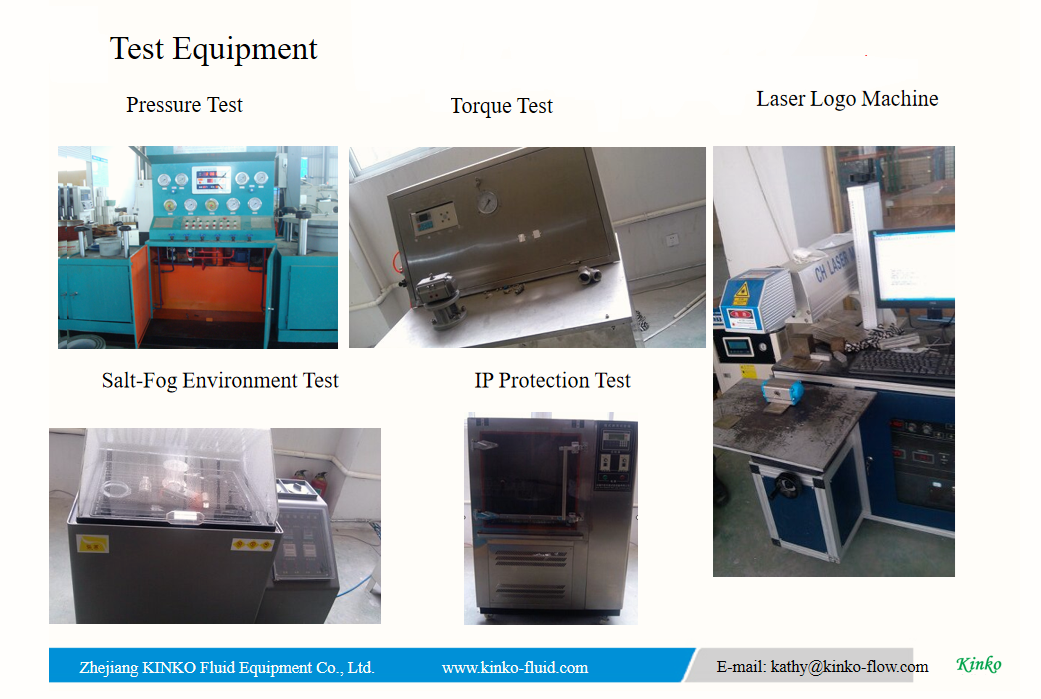
A product’s appearance alone cannot demonstrate its functional performance. Appropriate inspection and testing are important for evaluating whether components and finished products meet their specified requirements.
KINKO’s company presentation identifies a range of quality inspection and testing equipment, including the following.
Pressure testing
Pressure testing is used to evaluate pressure-related performance under specified test conditions. The applicable test method and acceptance criteria depend on the product type and relevant requirements.
For valve buyers, it is important to confirm the pressure rating, test requirements, and applicable standards for the specific valve model.
Torque testing
Torque testing is relevant to products that require mechanical output to operate a valve.
The results can help evaluate output performance against the applicable product specifications. When selecting an actuator, buyers should also consider the torque required by the valve under actual operating conditions.
Valve and actuator service-life testing
KINKO lists valve and actuator service-life testing equipment among its inspection resources.
Service-life testing helps evaluate product operation over repeated cycles under defined test conditions. The actual results depend on product design, operating conditions, and the test procedure.
Buyers evaluating products for frequent switching should ask about the applicable cycle-test conditions and product-specific results.
Spring service-life and tension-strength testing
KINKO’s testing equipment also includes spring service-life and spring tension-strength tests.
These tests are relevant to spring-equipped mechanisms, including applicable spring-return pneumatic actuators. They help assess spring performance under the conditions defined by the test procedure.
High- and low-temperature change testing
Temperature-related testing is included in KINKO’s inspection equipment.
Temperature can affect materials, sealing components, and mechanical performance. For applications involving temperature variation, buyers should confirm the product’s specified operating temperature range and the applicable validation requirements.
Coordinate measurement
KINKO lists a tri-coordinate measuring machine, also known as a coordinate measuring machine (CMM).
CMM equipment is used to measure component geometry and dimensions. Dimensional inspection supports the evaluation of machined parts against their specified measurements.
Salt-fog testing
Salt-fog testing equipment is included in KINKO’s quality inspection resources.
This type of test is commonly used to evaluate the corrosion resistance of materials or surface treatments under defined test conditions. Results should be interpreted according to the tested component, coating or surface treatment, and applicable test method.
IP protection testing
KINKO lists IP protection testing equipment for evaluating the relevant enclosure protection requirements of applicable products.
The required IP rating depends on the product and installation environment. Buyers should confirm the actual protection rating of the specific model rather than assuming all products have the same rating.
Additional inspection equipment
The company presentation also identifies a laser logo machine, which supports product marking.
The inspection and testing equipment described above forms part of KINKO’s manufacturing and quality-control resources. The exact tests performed on a particular product depend on its design, configuration, and applicable inspection requirements. Buyers can request the relevant product specifications and test documentation when evaluating a model for a project.
Why Choose KINKO for Industrial Valve and Actuator Solutions?
KINKO focuses on industrial valves, actuators, and valve automation products. Its manufacturing resources include a CNC machining center, assembly lines, warehouse facilities, and a range of testing and inspection equipment.
Key capabilities include:
Approximately 7,000 square meters of factory area
CNC machining and component processing
Dedicated production workflows for pneumatic actuators, electric actuators, and angle seat valves
Assembly of pneumatic, electric, and manual valve products
Inspection resources covering pressure, torque, service life, temperature changes, dimensional measurement, salt-fog exposure, and IP protection
A product range that includes valves, actuators, and automation accessories
After-sales support, including 24-hour online service and lifetime service commitment, as stated in the company presentation
For distributors, OEM customers, engineering companies, and industrial end users, these capabilities provide a starting point for evaluating a manufacturing partner.
Conclusion
KINKO’s manufacturing workflow and inspection resources support the production of pneumatic actuators, electric actuators, angle seat valves, and complete valve assemblies for a range of industrial applications.
Website: www.kinko-flow.com
Email: kathy@kinko-flow.com
 info@kinko-flow.com
 +86-133 5611 9006