Tel:
 E-Mail:
 English
 Chinese
 한국어
 Español




News
1. Why Is Valve Selection Important in Food and Beverage Processing?
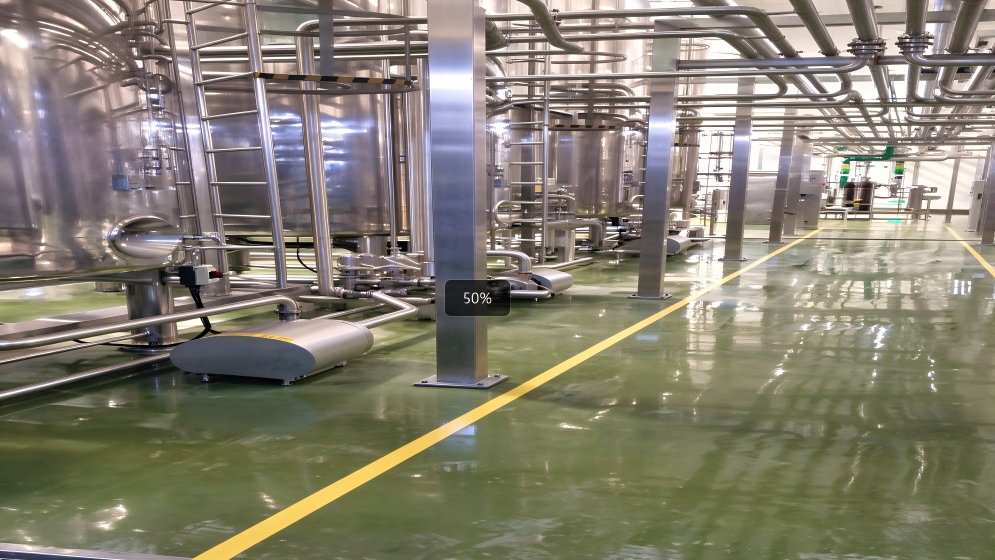
Valves play an essential role in controlling the movement of liquids and gases throughout a production line. They may be used for ingredient transfer, product circulation, tank filling, cleaning operations, and other process functions.
The wrong valve can create unnecessary pressure loss, maintenance challenges, leakage risks, or cleaning difficulties. In applications involving direct product contact, unsuitable materials or valve geometry may also create hygiene concerns.
Key considerations include:
Product safety: Materials and valve designs must be appropriate for the intended product-contact application.
Cleanability: The valve should be compatible with the plant's cleaning procedures and process requirements.
Corrosion resistance: Wetted components must withstand the product, cleaning chemicals, and operating conditions.
Sealing performance: Reliable sealing helps prevent unwanted leakage and product loss.
Process efficiency: Appropriate valve sizing and flow characteristics help support stable production.
Automation: Pneumatic or electric actuation can improve repeatability and reduce manual operation.
Maintenance: Accessible components and suitable designs can simplify inspection and servicing.
The exact requirements depend on whether the valve contacts the final product, handles utility water, controls steam, or operates in a cleaning circuit.
2. Common Applications in Food and Beverage Processing
Different production processes place different demands on valves. Understanding the application is the first step toward selecting the right solution.
2.1 Dairy Processing
Dairy production may involve milk transfer, cream processing, yogurt production, pasteurization, and cleaning operations.
Typical valve requirements include:
Compatibility with milk and other dairy products
Appropriate sealing and leakage performance
Compatibility with cleaning and sanitizing chemicals
Suitable temperature and pressure ratings
Hygienic design for direct product-contact applications
Valves used in direct product-contact lines should be selected according to the applicable hygienic design and material requirements. A standard industrial valve should not automatically be considered suitable for sanitary dairy service.
2.2 Beer Brewing and Beverage Production
Breweries and beverage plants may handle water, wort, beer, syrups, carbonated liquids, cleaning solutions, and other process media.
Valve selection should consider:
Product-contact material compatibility
Pressure and temperature conditions
Carbonation and process requirements
Cleaning procedures
Flow control and filling requirements
Corrosion resistance in the operating environment
For beer and beverage production, the valve's cleanability and compatibility with cleaning procedures are particularly important where product quality and hygiene must be maintained.
2.3 Bottled Water and Soft Drinks
Water bottling and soft drink production often require stable flow control across filtration, blending, filling, and cleaning systems.
Depending on the process, valves may be needed for:
Water transfer and distribution
Syrup and ingredient dosing
Mixing and blending
Tank filling
Cleaning and utility systems
Automated valves can help coordinate flow paths and repeatable operating sequences. The valve type and material should be selected according to the medium, flow requirements, pressure, temperature, and whether direct product contact occurs.
2.4 Food Ingredient and Sauce Processing
Food processing plants may handle oils, sauces, concentrates, liquid ingredients, and products containing suspended particles.
Important selection factors include:
Product viscosity
Particle size and solids content
Required flow capacity
Resistance to product buildup
Cleaning method
Compatibility of seats and seals
A valve that performs well with clean water may not provide the same performance with viscous or particle-containing products. The application should be evaluated before the valve type is finalized.
2.5 Cleaning-in-Place (CIP) Systems
Cleaning-in-place systems circulate cleaning solutions through equipment and process pipelines without requiring complete disassembly.
Valves used in CIP systems must be compatible with the cleaning chemicals, temperatures, pressures, and flow conditions involved.
Consider:
Chemical compatibility of all wetted materials
Resistance to the specified cleaning temperature
Suitable flow paths and drainage
Seal and seat durability
Integration with the plant's cleaning sequence
CIP compatibility alone does not prove that a valve is hygienically designed or that it can meet every cleaning requirement. The complete valve design and cleaning process must be evaluated together.
3. Which Valve Types Are Used in Food and Beverage Plants?
Different valve types perform different functions. The right choice depends on the process medium, required flow, pressure conditions, control method, and hygiene requirements.
| Valve Type | Common Functions | Key Selection Considerations |
|---|---|---|
| Ball valve | On/off isolation and general fluid handling | Flow requirements, seat compatibility, pressure rating, and cleanability |
| Butterfly valve | Flow isolation in pipelines and larger-diameter lines | Disc and seat materials, pressure conditions, and product-contact requirements |
| Angle seat valve | Automated switching of compatible fluids and certain utility services | Media compatibility, temperature, pressure, cycle frequency, and valve configuration |
| Control valve | Regulating flow or pressure in compatible process systems | Required control range, flow characteristics, pressure drop, and control accuracy |
| Check valve | Preventing reverse flow | Installation orientation, pressure drop, cleaning requirements, and media compatibility |
These valve types are not interchangeable in every application. For direct product-contact duties, confirm whether the particular model has the hygienic design, materials, surface finish, and documentation required by the plant.
Ball Valves
Ball valves are widely used for on/off isolation in industrial fluid systems. Depending on their design and materials, they may be suitable for certain food and beverage plant services, including utility lines and compatible process fluids.
Before choosing a ball valve, check:
Ball and body material
Seat and seal compatibility
Pressure and temperature ratings
Required leakage performance
Whether the internal geometry is suitable for cleaning
Whether the application requires a documented hygienic design
For direct product-contact applications, do not assume that a general-purpose ball valve meets sanitary requirements.
Butterfly Valves
Butterfly valves are commonly considered for pipeline isolation, particularly where compact installation and relatively low weight are beneficial.
Important selection factors include:
Body, disc, and seat materials
Pipeline size and pressure rating
Operating temperature
Required sealing performance
Cleaning and drainage requirements
Product-contact suitability
For hygienic applications, the exact butterfly valve design and its supporting documentation must be checked. Not every butterfly valve is designed for sanitary processing.
Angle Seat Valves
Pneumatic angle seat valves are often used for automated switching of compatible fluids and utility media. Depending on the model and materials, potential applications may include water, steam, and other suitable process or cleaning services.
Key selection factors include:
Medium and material compatibility
Working pressure and temperature
Flow capacity
Required switching frequency
Actuation configuration
Cleaning requirements
For direct product-contact duties, verify the valve's hygienic design and applicable documentation. A valve's suitability for steam or cleaning service does not automatically establish its suitability for direct food contact.
Control Valves
Control valves regulate flow, pressure, or other process variables when used with a suitable control system.
In food and beverage plants, they may be considered for compatible ingredient dosing, utility systems, and other processes requiring controlled flow.
Selection should account for the required control range, valve characteristics, operating conditions, and compatibility with the process medium. Modulating performance depends on the complete valve, actuator, and control-system configuration.
4. Hygienic Valve Design: What Should Buyers Check?
For direct product-contact applications, hygienic design is a major selection consideration. The goal is to reduce locations where product residues, microorganisms, or cleaning fluids could become trapped and to support the required cleaning process.
Important design features may include:
Smooth Product-Contact Surfaces
Surface finish can influence cleanability and residue retention. The required finish depends on the process, applicable standards, and plant specifications.
Do not rely on the phrase "smooth surface" alone. Request the specified surface-finish data and relevant documentation when required.
Suitable Internal Geometry
Poorly designed cavities, dead legs, gaps, and inaccessible areas can make cleaning more difficult.
Evaluate the valve's internal geometry, installation orientation, drainage characteristics, and compatibility with the intended cleaning procedure.
Appropriate Seals and Seats
Seats and seals must be chemically compatible with both the product and the cleaning chemicals. They must also tolerate the required temperatures, pressures, and operating cycles.
Hygienic Connections and Installation
Connection design and installation affect cleanability. Confirm that the valve connections, pipeline arrangement, and installation method match the plant's hygienic requirements.
Documentation and Compliance
Depending on the market and application, buyers may need material declarations, certificates, test reports, or documentation supporting compliance with applicable regulations and standards.
Important: FDA-related material compliance, 3-A Sanitary Standards, and other hygienic requirements are not interchangeable. Confirm the exact requirement and verify that the specific valve model and its wetted materials meet it.
5. How to Choose Valve Materials for Food and Beverage Processing
Material selection must consider both the process product and the chemicals used during cleaning.
| Material | General Characteristics | Selection Considerations |
|---|---|---|
| 304 stainless steel | Commonly used in many food and beverage equipment applications | Verify resistance to the product, chlorides, cleaning chemicals, and temperature |
| 316 stainless steel | Contains molybdenum, which improves resistance to certain types of corrosion compared with 304 | Not universally resistant to all chemicals or high-chloride conditions |
| PTFE | Broad chemical resistance in many applications | Check temperature, pressure, deformation, and product-specific compatibility |
| Reinforced PTFE (RPTFE) | Reinforcement can improve mechanical stability in certain valve-seat designs | Verify the exact formulation, operating limits, and cleaning compatibility |
| EPDM | Used for many water-based and selected chemical services | Verify compatibility with the product, cleaning chemicals, oils, and temperature |
| FKM | Suitable for many oils and selected chemicals | May not be appropriate for all steam, hot-water, or cleaning conditions |
These are general characteristics, not universal recommendations. The exact grade, formulation, valve design, chemical concentration, and temperature all affect suitability.
Why Are Seat and Seal Materials Important?
Even when the valve body is corrosion-resistant, unsuitable seats or seals can swell, harden, crack, deform, or lose sealing performance.
For food and beverage applications, confirm:
Compatibility with the product
Compatibility with cleaning and sanitizing agents
Maximum and minimum operating temperatures
Pressure and deformation limits
Applicable food-contact requirements
Traceability or material documentation, where required
Do not select materials based on chemical resistance alone if the application also has hygienic or regulatory requirements.
6. Pneumatic vs. Electric Actuators for Food and Beverage Valves
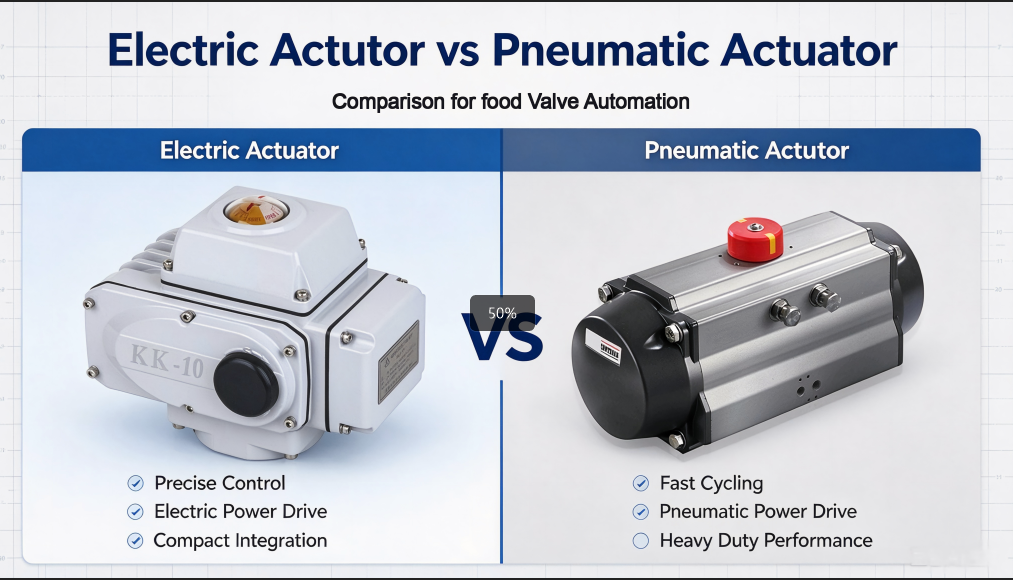
Automated valves can improve production consistency and reduce manual intervention. Pneumatic and electric actuators each offer advantages, depending on the application.
| Factor | Pneumatic Actuator | Electric Actuator |
|---|---|---|
| Energy source | Compressed air | Electrical power |
| Typical use | Automated on/off operation and compatible control configurations | On/off operation and, for suitable models, modulating control |
| Operating speed | Often suitable for fast switching | Depends on motor, gearing, and model |
| Infrastructure | Requires a suitable compressed-air supply | Requires a suitable electrical supply |
| Failure response | Spring-return designs can provide a defined fail position when correctly configured | Depends on the model and any fail-safe or backup-power arrangement |
| Maintenance considerations | Air quality, seals, pneumatic accessories, and air supply | Electrical connections, motor, gears, seals, and control components |
When Should You Choose a Pneumatic Actuator?
A pneumatic actuator may be suitable when:
Compressed air is already available.
Fast on/off operation is required.
The valve needs to operate repeatedly as part of an automated sequence.
The application benefits from a spring-return configuration with a defined failure response.
The actuator must still be correctly sized and compatible with the valve, operating pressure, environment, and required control function.
When Should You Choose an Electric Actuator?
An electric actuator may be suitable when:
Electrical power is readily available.
The selected model supports the required control and feedback functions.
Compressed air is unavailable or inconvenient.
The automation system requires specific electrical interfaces.
Not every electric actuator supports modulating control or fail-safe operation. Verify the exact model specifications before selection.
Automation Must Not Compromise Hygiene
Actuators, brackets, cables, air lines, and accessories should be installed in a way that meets the plant's environmental and cleaning requirements.
The actuator does not automatically make a valve hygienic. Evaluate the valve's product-contact design separately from the actuator and automation system.
7. How to Select the Right Valve for Your Process
A practical selection process helps reduce the risk of choosing a valve that is unsuitable for the actual application.
Step 1: Identify the Medium
Determine whether the valve will handle milk, beer, water, syrup, oil, steam, cleaning chemicals, or another medium.
For mixtures, provide the relevant composition and concentration information.
Step 2: Determine Whether the Valve Contacts the Product
Separate direct product-contact duties from utility services and cleaning circuits.
Direct product-contact applications may have specific hygienic design, material, surface-finish, and documentation requirements.
Step 3: Confirm Operating Conditions
Record:
Minimum and maximum temperature
Operating pressure and differential pressure
Required flow rate
Viscosity and solids content, where relevant
Operating frequency
Cleaning and sanitizing conditions
Step 4: Select the Valve Type
Choose the valve according to its function, flow requirements, pressure conditions, and application.
For example, a ball valve may be considered for suitable isolation duties, a butterfly valve for compatible pipeline isolation, an angle seat valve for certain automated switching applications, and a control valve for regulated flow.
These are starting points rather than universal rules. The actual model must be checked against the process requirements.
Step 5: Verify Wetted Materials
Confirm the body, disc or ball, stem, seats, seals, and other wetted components are compatible with both the product and the cleaning chemicals.
Step 6: Check Hygiene and Compliance Requirements
Identify the applicable regulatory requirements, hygienic design standards, material declarations, and project documentation.
Request model-specific evidence instead of relying on general product descriptions.
Step 7: Confirm Automation and Installation
Check the actuator type, control mode, mounting interface, accessories, enclosure protection, and installation space.
Ensure the complete assembly is suitable for the plant's operating and cleaning environment.
8. Common Mistakes When Choosing Food and Beverage Valves
Mistake 1: Assuming Every Stainless Steel Valve Is Hygienic
Stainless steel can be suitable for many food and beverage applications, but material alone does not establish hygienic design.
Better approach: Verify the valve geometry, surface finish, cleanability, product-contact materials, and required documentation.
Mistake 2: Ignoring Cleaning Chemicals
A valve may be compatible with the product but incompatible with cleaning or sanitizing agents.
Better approach: Evaluate the full chemical exposure, including cleaning concentration, temperature, and duration.
Mistake 3: Selecting the Valve Based Only on Pipeline Size
Nominal diameter alone does not determine whether a valve provides the required flow capacity or suitable performance.
Better approach: Consider flow rate, pressure drop, media properties, valve characteristics, and operating conditions.
Mistake 4: Overlooking Seat and Seal Compatibility
Incompatible seats and seals can cause leakage or premature failure even if the valve body performs well.
Better approach: Check the material specifications of all wetted components.
Mistake 5: Assuming All Automated Valves Are Suitable for Sanitary Service
Adding a pneumatic or electric actuator does not establish hygienic suitability.
Better approach: Verify the valve design and documentation separately from the actuator's functions.
9. Valve Selection Checklist for Food and Beverage Buyers
Before requesting a quotation, prepare the following information:
Product or process medium
Whether the valve contacts the final product
Required hygienic design or regulatory standards
Valve type and nominal size
Operating pressure and temperature
Required flow rate and pressure drop
Body, seat, seal, and other wetted-material requirements
Cleaning and sanitizing chemicals and procedures
Required leakage performance
Manual, pneumatic, or electric operation
On/off or modulating control requirements
Required certificates and technical documentation
OEM logo, packaging, and customization requirements
Providing these details helps the supplier evaluate the application and propose a suitable valve configuration.
KINKO supplies industrial valve and actuator products, including pneumatic and electric actuat
10. How KINKO Can Support Food and Beverage Valve Projects
ors, ball valves, butterfly valves, angle seat valves, control valves, and related accessories.
For food and beverage equipment manufacturers, distributors, and OEM brands, valve selection should start with the actual process requirements rather than a general assumption that one valve type or material suits every application.
When discussing a project with KINKO, provide:
Process medium and operating conditions
Whether the valve is used for direct product contact, utility service, or cleaning
Required valve type, size, and connection
Body, seat, and seal material requirements
Required automation and control functions
Applicable hygienic standards and certifications
OEM branding, packaging, and customization needs
The proposed valve configuration should be verified against the exact model specifications and the plant's requirements. Where hygienic compliance or food-contact suitability is required, confirm the relevant documentation before purchase.
11.Frequently Asked Questions
1. Which valves are commonly used in food and beverage processing?
Ball valves, butterfly valves, angle seat valves, control valves, and check valves may be used in different parts of a food and beverage plant. The appropriate type depends on the medium, process function, flow requirements, hygiene needs, and operating conditions.
2. Is stainless steel enough to make a valve suitable for food processing?
No. Stainless steel is only one part of the selection. Hygienic design, surface finish, internal geometry, cleanability, seats, seals, and applicable documentation may also be required.
3. Is 316 stainless steel always better than 304?
Not in every application. 316 contains molybdenum and offers improved resistance to certain forms of corrosion in many environments, but the best material depends on the product, cleaning chemicals, concentration, and temperature.
4. Can industrial ball valves be used in food and beverage production?
Some industrial ball valves may be suitable for utility lines or compatible process duties. For direct product-contact service, verify that the exact model meets the applicable hygienic design, material, and documentation requirements.
5. Are pneumatic actuators suitable for food and beverage plants?
Pneumatic actuators can automate compatible valves in food and beverage facilities. However, actuator selection and installation must account for the operating environment, cleaning procedures, required control functions, and the valve's hygienic suitability.
6. What should I check before buying a hygienic valve?
Confirm the process medium, temperature, pressure, product-contact materials, surface finish, cleanability, seal compatibility, applicable standards, and model-specific documentation. Also check whether the valve is compatible with the plant's cleaning and sanitizing procedures.
Conclusion
Valve solutions for food and beverage processing must balance reliable flow control, material compatibility, cleanability, automation, and applicable hygiene requirements.
Ball valves, butterfly valves, angle seat valves, and control valves can serve different functions, but the right choice depends on the actual process. Body material alone does not establish suitability: seats, seals, internal geometry, surface finish, and supporting documentation may all be critical.
Before purchasing, confirm the complete valve configuration against the product, cleaning process, operating conditions, and applicable requirements.
Looking for valve solutions for your food and beverage project?
Contact KINKO with your application details, valve requirements, operating conditions, and OEM/ODM needs to discuss a suitable industrial valve and actuator configuration.
Website: www.kinko-flow.com
Email: kathy@kinko-flow.com
WhatsApp:+86- 13185862950
Wechat: +86- 13185862950
 info@kinko-flow.com
 +86-133 5611 9006