Tel:
 E-Mail:
 English
 Chinese
 한국어
 Español




News
1. What Is an Angle Seat Valve?
An angle seat valve is a pneumatically or electrically actuated valve, depending on the design, that controls fluid flow through a valve body with an angled flow path. Pneumatic angle seat valves are commonly used for automated on/off control in industrial processes.
Their design can provide a relatively direct flow path, fast actuation, and suitability for frequent switching when the valve is correctly selected for the application.
Typical applications include:
Steam and hot-water systems
Water treatment equipment
Industrial washing and cleaning systems
Food and beverage processing, where the specific valve design meets the required hygiene standards
General process automation
Applications requiring frequent automatic opening and closing
Angle seat valves are available in different sizes, body materials, seal materials, and actuator configurations. The suitable model depends on the medium, temperature, pressure, flow requirement, and control system.
2. What Is a Ball Valve?
A ball valve controls flow using a rotating ball with a bore through its center. When the bore aligns with the pipeline, the valve opens; when the ball rotates approximately 90 degrees, the valve closes.
Ball valves are available in manual, pneumatic, and electric versions, with different body designs, pressure ratings, materials, and seat options.
Common applications include:
General industrial shut-off
Water, oil, and gas pipelines
Chemical processing, with compatible materials selected
High-pressure service, when the valve is appropriately rated
Large-diameter pipelines
Applications requiring reliable isolation
Ball valves are versatile and widely available in a broad range of sizes and pressure classes, making them a practical choice for many general-purpose pipeline applications.
3. Angle Seat Valve vs Ball Valve: Key Differences
The two valve types should be compared according to their actual operating requirements rather than by price or nominal size alone.
| Comparison factor | Angle Seat Valve | Ball Valve |
|---|---|---|
| Operating principle | Linear movement of the sealing element in common designs | Rotation of a ball, typically about 90° |
| Typical automation | Commonly pneumatic; other configurations depend on the design | Manual, pneumatic, or electric |
| Switching response | Often well suited to rapid automated switching | Fast quarter-turn operation |
| Frequent switching | Often a strong choice for frequent cycling when properly specified | Suitable for many applications; suitability depends on design and duty cycle |
| Flow characteristics | Body design can provide an efficient flow path; Y-type designs may improve flow capacity | Full-port designs can provide a relatively unrestricted flow path |
| High-pressure service | Depends on the specific model and rating | Many designs are available for higher-pressure service |
| Large pipeline applications | Available in selected sizes; verify the product range | Widely available in large sizes |
| Maintenance considerations | Seal, actuator, and internal-component condition | Seat, ball, stem, seals, and actuator condition |
| Typical cost advantage | May reduce cost in suitable automated, frequent-switching applications | Often economical and widely available for general shut-off |
| Best-fit applications | Frequent switching, selected steam applications, compact automated process control | General shut-off, isolation, high-pressure or larger-pipeline applications when correctly rated |
Important: Neither valve type is automatically superior in every category. Actual performance depends on the valve design, size, materials, pressure rating, actuator, and operating conditions.
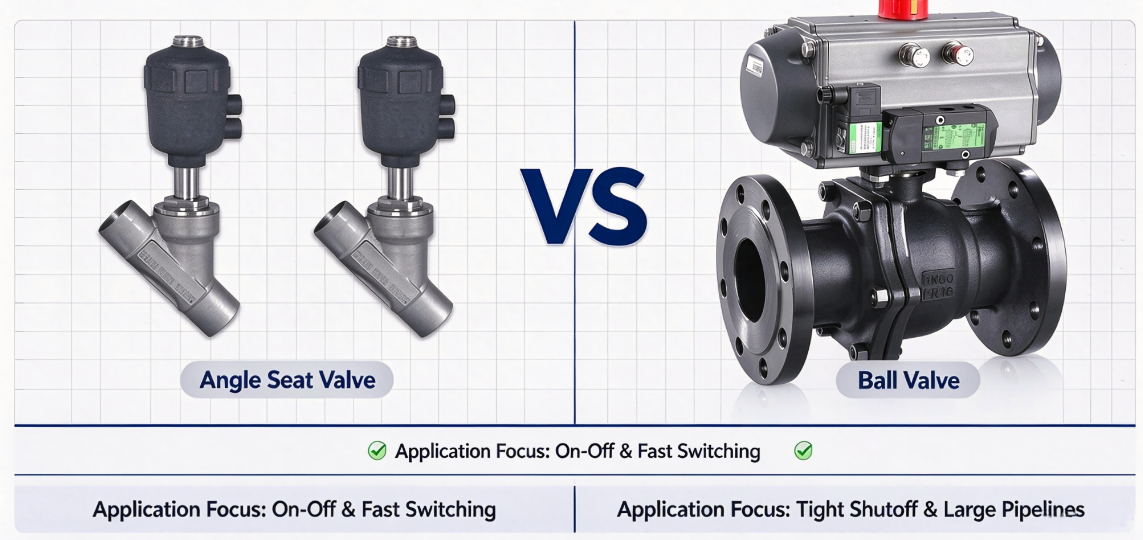
4. Performance Comparison
4.1 Switching Speed and Frequency
Angle seat valves are often selected for automated processes that require frequent opening and closing. Their actuator and valve-body design can support responsive operation when the air supply, actuator sizing, and control system are correctly configured.
Ball valves also provide fast quarter-turn operation. However, the suitability of a particular ball valve for frequent cycling depends on its construction, seat material, actuator sizing, process conditions, and required cycle life.
For production lines that repeatedly switch between flow and shut-off, compare the manufacturer's cycle-life data and test conditions instead of relying on the valve type alone.
Recommended direction: Consider an angle seat valve for frequent automated switching; evaluate a ball valve when quarter-turn isolation is the primary requirement.
4.2 Flow Capacity and Pressure Drop
Flow performance depends on the internal flow path, effective flow area, valve size, pressure differential, and medium properties.
A well-designed angle seat valve can provide an efficient flow path. KINKO's Y-type angle seat valve design is intended to improve flow efficiency, with the stated design benefit of up to 30% greater flow capacity compared with the relevant conventional design. This figure should be verified against the specific model, size, and comparison conditions before being used as a guaranteed performance claim.
Ball valves are also available in full-port designs, where the bore can closely match the connecting pipeline's internal diameter. This can help minimize flow restriction when the valve is fully open.
When comparing flow performance, request the relevant flow coefficient (Kv or Cv), pressure-drop data, and sizing guidance for each candidate valve.
Do not assume that every angle seat valve has lower pressure drop than every ball valve. The actual result depends on the specific designs being compared.
4.3 Pressure and Temperature
Ball valves are available in many pressure classes and designs, including models intended for demanding high-pressure applications. They are often a practical choice for larger pipelines and general isolation duties.
Angle seat valves can also handle demanding process conditions, including certain steam applications, when the selected model's body, seals, pressure rating, and temperature limits are suitable.
Before selection, verify:
Maximum and minimum operating pressure
Operating and peak temperature
Medium compatibility
Required leakage performance
Pressure differential across the valve
Applicable standards and certification requirements
For steam service, pay particular attention to the valve's temperature rating and seal compatibility. A valve should not be selected for steam solely because it is described as an angle seat valve or a ball valve.
4.4 Service Life and Maintenance
Service life is influenced by switching frequency, pressure, temperature, media properties, material compatibility, installation, and maintenance.
An angle seat valve may offer a long working life in a properly sized, well-maintained frequent-switching application. A ball valve may offer excellent durability in a suitable isolation application. Neither outcome is guaranteed by valve type alone.
Maintenance considerations differ by design:
Angle seat valve: Inspect the sealing components, actuator, air connections, and internal moving parts according to the manufacturer's instructions.
Ball valve: Inspect the seats, ball, stem seals, actuator, and signs of wear or leakage as appropriate for the model.
For either type, clean operating conditions, correct sizing, and suitable replacement parts help support long-term reliability.
5. Cost Comparison: Purchase Price vs Total Cost of Ownership
The cheapest valve to purchase is not necessarily the cheapest valve to operate over its service life.
When comparing an angle seat valve with a ball valve, consider the following cost categories:
| Cost factor | Angle Seat Valve | Ball Valve |
|---|---|---|
| Initial purchase cost | Depends on size, material, actuator, and configuration | Depends on size, pressure class, material, and actuation |
| Automation cost | Pneumatic control may require an air supply and control accessories | Manual versions may need no actuator; automated versions require a suitable actuator |
| Energy and utilities | Pneumatic operation requires compressed air; consumption depends on actuator size and cycling | Manual operation requires no actuator power; pneumatic or electric versions have their own energy requirements |
| Maintenance cost | Depends on duty cycle, seal wear, access, and replacement parts | Depends on seat and seal wear, process conditions, and replacement parts |
| Downtime cost | Depends on reliability and the consequences of failure in the application | Depends on reliability and the consequences of failure in the application |
| Long-term value | Can be attractive for suitable frequent-switching automated duties | Can be attractive for general isolation and a broad range of pipeline applications |
Can an Angle Seat Valve Save 50% Compared with a Ball Valve?
In some applications, an angle seat valve may offer a meaningful cost advantage. However, a claim such as “50% lower cost” should be treated as application-specific rather than a universal rule.
A fair comparison must use equivalent specifications, including valve size, body and seal materials, pressure and temperature ratings, actuation, accessories, and expected operating life.
To estimate the total cost of ownership, consider:
Total cost of ownership = purchase cost + installation cost + operating cost + maintenance cost + downtime cost
The actual cost advantage can vary substantially depending on the process and system design. For an automated production line with frequent switching, the best choice may differ from that for a large, high-pressure isolation pipeline.
For OEM projects, distributors and brand owners should compare complete valve assemblies rather than comparing the price of one valve body against another.
6. Which Valve Is Better for Your Application?
The following guide can help narrow down the choice.
| Application requirement | Starting point for evaluation | Why |
|---|---|---|
| Frequent automatic switching | Angle Seat Valve | Often suited to repeated automated operation |
| Selected steam applications | Angle Seat Valve or Ball Valve | Verify temperature, pressure, materials, and sealing requirements |
| High-pressure isolation | Ball Valve or a suitably rated alternative | Many ball-valve designs are available in high-pressure ratings |
| Large pipeline shut-off | Ball Valve or a suitably sized alternative | Broad availability in larger sizes |
| Compact automated process control | Angle Seat Valve | May provide a practical configuration for automated switching |
| Full-port flow path | Full-Port Ball Valve | Bore design can minimize flow restriction when fully open |
| Lowest total operating cost | Compare both | Depends on complete specifications, duty cycle, maintenance, and downtime |
This table is a starting point, not a substitute for engineering selection. Always confirm that the specific model meets the process requirements.
7. How to Choose the Right Valve
Before requesting a quotation, prepare the following information:
Medium: Water, steam, air, oil, gas, or chemical fluid.
Pipeline size: Nominal diameter and connection standard.
Operating conditions: Normal and maximum pressure, temperature, and pressure differential.
Flow requirement: Required flow rate and acceptable pressure drop.
Operating frequency: Expected switching cycles and operating pattern.
Control method: Manual, pneumatic, or electric.
Material requirements: Body, seat, and seal compatibility with the medium.
Compliance requirements: Applicable industry standards and any required documentation.
Commercial priorities: Initial budget, maintenance access, spare parts, and expected service life.
With these details, a supplier can compare suitable models more accurately and help avoid unnecessary cost from incorrect sizing or unsuitable materials.
8. KINKO Angle Seat Valves and Ball Valves
KINKO supplies industrial valve and automation products, including angle seat valves, ball valves, pneumatic actuators, and electric actuators.
For suitable applications, KINKO angle seat valves offer design options intended for responsive automated operation and efficient flow. KINKO also offers ball-valve solutions for general shut-off and other industrial applications, subject to the specifications of the selected model.
For OEM and ODM customers, the valve selection process can consider:
Valve size, body material, and sealing material
Pressure and temperature requirements
Pneumatic or electric actuation
Connection and installation requirements
Branding and product configuration options
Applicable technical documentation and quality requirements
Ask the KINKO team to evaluate the actual operating conditions and compare suitable models before making a final decision.
Frequently Asked Questions
1. Is an angle seat valve better than a ball valve?
Not in every situation. Angle seat valves are often considered for frequent automated switching and selected process applications. Ball valves are widely used for general shut-off, high-pressure service, and larger pipelines when the model is appropriately rated.
2. Which valve is more economical?
The more economical option depends on the complete specification and operating conditions. Purchase price alone does not account for actuator cost, utilities, maintenance, and downtime.
3. Can an angle seat valve be used for steam?
Some angle seat valves are suitable for steam service. Always check the specific model's pressure and temperature limits, body and seal materials, and applicable documentation.
4. Are angle seat valves suitable for frequent switching?
They are often used in frequent-switching applications, provided the selected valve and actuator are correctly sized and rated for the required operating conditions and cycle frequency.
5. Which valve should I choose for a large-diameter pipeline?
Ball valves are widely available in large sizes, but the correct choice depends on the required flow capacity, pressure rating, installation space, cost, and process conditions. Compare actual model specifications before deciding.
Conclusion
Angle seat valves and ball valves both play important roles in industrial fluid control, but they serve different priorities.
An angle seat valve is worth evaluating for frequent automated switching, selected steam applications, and process control where its flow-path design is beneficial. A ball valve is a strong option for general isolation, many high-pressure duties, and larger pipelines when the selected design meets the requirements.
The best choice is not simply the valve with the lowest purchase price. It is the valve that meets the required performance while delivering the most suitable total cost of ownership over its intended service life.
Looking for the right valve for your project? Contact KINKO to compare angle seat valve and ball valve options based on your medium, pressure, temperature, flow requirements, and automation needs.
 info@kinko-flow.com
 +86-133 5611 9006