Tel:
Tel: E-Mail:
 English
 Chinese
 한국어
한국어
 Español




News
What Defines a "High-Pressure" Ball Valve?
Industry thresholds vary by standard:
| Standard | High-Pressure Threshold | Typical Applications |
|---|---|---|
| ASME B16.34 | Class 900 and above (2,220 psi @ 100°F) | Power generation, refineries |
| API 6D | Class 600 and above (1,480 psi) | Pipeline transmission |
| API 6A | 5,000 psi – 20,000 psi | Wellhead, frac, subsea |
| ISO 9393 | PN 250 and above (3,625 psi) | Hydraulic systems, chemical injection |
For this guide, Kinko defines high-pressure as >1,500 psi (PN100) . Our high-pressure line extends to 20,000 psi API 6A.
5 Critical Selection Criteria for High-Pressure Ball Valves
Criterion 1: Pressure Class vs. Temperature De-rating
ASME B16.34 requires pressure de-rating as temperature increases. Never select a valve based on room-temperature pressure alone.
Example – Kinko Class 1500 Carbon Steel Valve:
| Temperature (°F) | Pressure (psi) | De-rating Factor |
|---|---|---|
| 100 | 3,705 | 1.00 (baseline) |
| 400 | 3,060 | 0.826 |
| 650 | 2,620 | 0.707 |
| 850 | 2,125 | 0.574 |
→ For 600°F steam at 2,800 psi, Class 1500 is insufficient. Select Class 2500.
Criterion 2: Body & Trim Material for High-Pressure Service
High pressure magnifies corrosion and erosion effects. Use this material selector:
| Media | Recommended Body | Recommended Ball & Stem | Max Pressure (psi) |
|---|---|---|---|
| Natural gas (dry) | Carbon steel (A105) | 13Cr stainless + ENP | 6,000 |
| Sour gas (H₂S) | Low-temp carbon steel (A350 LF2) | Inconel 625 cladding | 10,000 |
| Hydraulic oil | Carbon steel | Hard chrome plated (≥70 HRC) | 15,000 |
| Seawater injection | Duplex (F51) or Super Duplex (F55) | Duplex + tungsten carbide coating | 10,000 |
| Chemical (high-corrosion) | Hastelloy C276 | C276 | 6,000 |
| Sand-laden frac fluid | Precipitation hardened (17-4PH) | Tungsten carbide or ceramic | 20,000 |
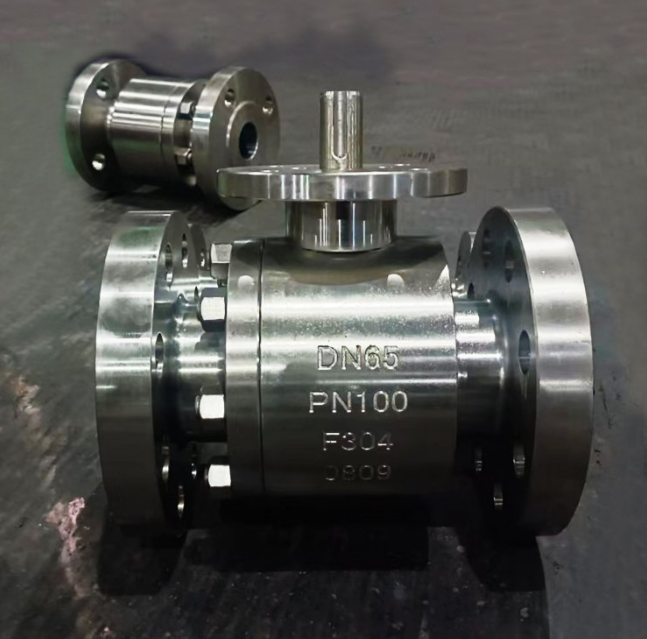
Criterion 3: Trunnion vs. Floating Design
| Feature | Floating Ball Valve | Trunnion Ball Valve |
|---|---|---|
| Ball support | Floats between seats | Fixed top & bottom bearings |
| Torque requirement | Higher (ball presses seats) | Lower (bearings absorb thrust) |
| Max pressure rating | Class 600 (≤1,480 psi) | Class 4500+ (≤7,500+ psi) |
| Seat design | Pressure-energized | Independent spring-energized |
| Recommended for >1,500 psi | ❌ No | ✅ Yes |
Kinko recommendation: Above 1,500 psi, specify trunnion ball valves only.
Criterion 4: Seat Material for High Differential Pressure
High pressure across a partially open seat causes rapid extrusion and failure.
| Seat Material | Max ΔP (psi) | Temperature Range | Best For |
|---|---|---|---|
| Virgin PTFE | 1,500 | -20°F to 400°F | Clean gas/liquid |
| 15% GF PTFE | 2,500 | -20°F to 450°F | Moderate cycling |
| PEEK (unfilled) | 5,000 | -100°F to 480°F | High-cycle, chemical |
| PEEK + 30% carbon | 7,500 | -100°F to 480°F | Abrasive media |
| Metal seat (316SS) | 10,000+ | -100°F to 1,200°F | High-temp, fire-safe |
| Tungsten carbide | 15,000+ | -300°F to 800°F | Extreme abrasion (sand, slurry) |
Criterion 5: End Connections for High-Pressure Integrity
Threaded or flanged? The wrong connection fails first.
| Connection Type | Max Pressure Rating | Recommended Use | Common Failure Mode |
|---|---|---|---|
| NPT threaded (1/4"–2") | 6,000 psi (schedule 160) | Low-cycle, small bore | Thread galling (stainless) |
| RTJ flange (Ring Type Joint) | 15,000 psi | All high-pressure gas | Gasket extrusion |
| Lapped flanges (metal-to-metal) | 20,000 psi | Subsea, critical service | Surface scratching |
| Grayloc / clamp connector | 20,000+ psi | Wellhead, frac iron | Hydrogen embrittlement |
| Welded ends | Full pipe rating | Permanent installations | Weld cracking (H₂S service) |
Kinko recommendation: For >10,000 psi, specify RTJ flanges with soft iron or stainless steel gaskets only. Never use spiral wound gaskets above Class 1500.
High-Pressure Ball Valve Usage Guide – Best Practices
Proper Installation for High-Pressure Systems
Verify direction arrow – High-pressure valves often have asymmetric seat designs. Reverse flow exceeds seat pressure capability.
Use concentric flange alignment pins – Misalignment creates bending stress on the valve body.
Torque flange bolts in 3 incremental passes – 30% → 70% → 100% of target torque.
Hydrotest at 1.5× working pressure – Hold for 15 minutes minimum. Record any pressure drop.
Operational Best Practices
| Practice | Why It Matters |
|---|---|
| Always open fully or close fully | Partially open high-pressure valves cause seat erosion and vibration (chatter) |
| Cycle slowly (≥10 seconds per 90°) | Prevents pressure surge (water hammer) and seat damage |
| Install bypass valves for ΔP > 2,000 psi | Reduces seat extrusion risk; equalizes pressure before main valve opens |
| Monitor stem torque daily | Sudden torque increase indicates seat or bearing failure |
High-Cycle Automation Considerations
If your high-pressure ball valve cycles >10 times per hour:
Actuator sizing: Add 30% safety margin for unknown pressure spikes
Stem bearings: Specify carbon-filled PTFE or bronze (not virgin PTFE)
Cycle counting: Install proximity switches for maintenance tracking
Lubrication: Apply high-pressure grease every 10,000 cycles (Kluber Syntheso GLEP 1)
Troubleshooting Common High-Pressure Valve Failures
| Symptom | Root Cause | Corrective Action |
|---|---|---|
| External leakage at stem | Packing extruded under high pressure | Replace with high-density PTFE + anti-extrusion rings |
| Cannot open (torque > spec) | High differential pressure across ball | Install equalizing bypass line |
| Seat leakage (bubble test fails) | Seat cold flowed under sustained pressure | Upgrade to PEEK or metal seats |
| Body weep at flange | Gasket crushed unevenly | Replace with RTJ gasket; re-torque in sequence |
| Ball surface scoring | Hard particles trapped during operation | Install upstream y-strainer (40 mesh minimum) |
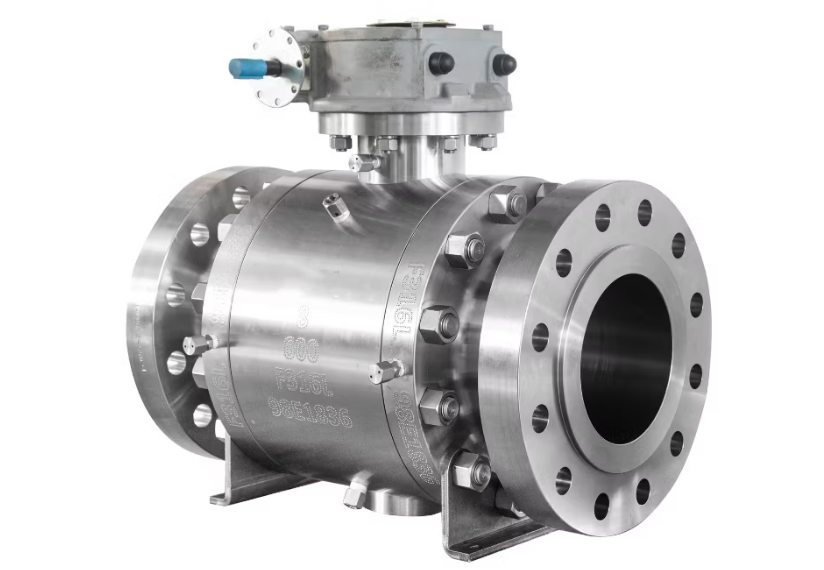
Kinko High-Pressure Ball Valve Series – Selection Table
| Series | Body Material | Pressure Rating | Design Type | Seat Standard | Connection Type | Max Temp | Bore Type |
|---|---|---|---|---|---|---|---|
| KINKO-HP600 | A105 Carbon Steel | Class 600 (1,480 psi) | Floating | PTFE / PEEK | RF flange / NPT | 400°F | Full or Reduced |
| KINKO-HP900 | F22 Alloy Steel | Class 900 (2,220 psi) | Trunnion | 15% GF PTFE | RTJ flange | 650°F | Reduced bore |
| KINKO-HP1500 | F316 Stainless | Class 1500 (3,705 psi) | Trunnion | PEEK + carbon | RTJ or welded | 480°F | Full bore (1–4") |
| KINKO-HP2500 | F51 Duplex | Class 2500 (6,170 psi) | Trunnion | Metal seat (316SS) | RTJ only | 800°F | Reduced bore |
| KINKO-API6A-5K | 17-4PH (H1150) | 5,000 psi (API 6A) | Trunnion | PEEK + tungsten | Flanged or clamp | 350°F | Full (≤2") |
| KINKO-API6A-10K | Inconel 718 | 10,000 psi (API 6A) | Trunnion | Tungsten carbide | Clamp connector | 450°F | Full (≤1.5") |
| KINKO-API6A-15K | F22 + Inconel clad | 15,000 psi | Trunnion | Metal + carbide | Threaded / clamp | 400°F | Reduced |
| KINKO-API6A-20K | Precipitation hardened | 20,000 psi | Trunnion | Custom ceramic | Grayloc / clamp | 300°F | Reduced (≤1") |
High-Pressure Valve Sizing Quick Reference
For quick estimation before detailed engineering:
| Nominal Size (inch) | Full Bore Area (in²) – Reduced 60% | Approx. Operating Torque @ 5,000 psi (lb·in) | Recommended Actuator (min) |
|---|---|---|---|
| 1/2" | 0.20 (0.12) | 450 | Double-acting pneumatic |
| 1" | 0.79 (0.47) | 1,200 | Double-acting or spring-return |
| 2" | 3.14 (1.88) | 3,500 | Hydraulic or high-torque pneumatic |
| 3" | 7.07 (4.24) | 8,000 | Hydraulic + manual override |
| 4" | 12.57 (7.54) | 15,000 | Hydraulic only (gear required) |
*Reduced bore assumes 60% of full bore area – typical for high-pressure trunnion valves.*
When to Specify a High-Pressure Ball Valve vs. Other Types
| Application | High-Pressure Ball Valve | Alternative | When to Choose Alternative |
|---|---|---|---|
| On/off isolation (clean media) | ✅ Best | Gate valve | If pressure drop irrelevant |
| Frequent cycling (10+ cycles/day) | ✅ Best | Butterfly valve | Only if <1,000 psi |
| Throttling / flow control | ❌ Poor | Globe or needle valve | Always for >30% open time |
| Slurry service (particles) | ⚠️ Special coating required | Knife gate or pinch valve | If particles >5% by volume |
| Extreme high-cycle (>100/day) | ✅ Trunnion with bearings | Ball valve only | No alternative |
Conclusion: Safety and Reliability Above All
High-pressure ball valve selection is not about price – it is about risk mitigation. A valve failure at 10,000 psi releases energy equivalent to a small explosion. Kinko designs every high-pressure valve with:
Finite Element Analysis (FEA) validated burst pressure (4× working pressure)
API 6A PR2 performance testing (including gas testing at full rated pressure)
Full material traceability (EN 10204 3.2 certification available)
Hydrostatic and gas seat testing before shipment
For your next high-pressure specification: Download Kinko's high-pressure valve sizing worksheet and torque calculation template. Contact our engineering team with your pressure, temperature, media, and cycle frequency – we provide stamped calculations within 24 hours.
Recommended internal resources (no links – search on site):
Kinko API 6A product catalog (5,000–20,000 psi)
Seat material pressure-temperature rating charts
Actuator sizing guide for high-pressure valves
Flange bolt torque specification sheet (Class 600–2500)
Ivan (Mobile:+86-18968769287)
WhatsApp:+86-13579991606
Wechat:+86-18968769287
Website:www.kinko-flow.com
ZHEJIANG KINKO FLUID EQUIPMENT CO.,LTD

 info@kinko-flow.com
 +86-133 5611 9006