Tel:
Tel: E-Mail:
 English
 Chinese
 한국어
한국어
 Español




News
1. Introduction
Butterfly valves are widely used for on/off and throttling control. But the valve body is only half the solution – actuation determines speed, control accuracy, safety, and operating cost.
The two most common automated actuation types are:
Pneumatic (air-operated) – fast, simple, explosion-proof
Motorized (electric) – precise, no air supply needed, suitable for remote control
This guide compares both types across key parameters to help procurement professionals select the right actuation for their application.
2. Quick Comparison Table – Pneumatic vs Motorized Butterfly Valves
| Parameter | Pneumatic Actuator | Motorized (Electric) Actuator |
|---|---|---|
| Power Source | Compressed air (4–8 bar) | Electricity (24V DC, 110V AC, 220V AC) |
| Operating Speed | Fast (0.5–3 seconds) | Slow (5–30+ seconds per 90°) |
| Control Type | On/off or modulating (with positioner) | On/off or modulating (4-20mA, 0-10V) |
| Positioning Accuracy | ±1% (with positioner) | ±0.5% to ±1% |
| Fail-Safe | Yes (spring-return) – auto close/open on air loss | No (requires battery backup or spring-return electric) |
| Explosion-Proof | Inherently safe (no sparks) | Requires special enclosure (ATEX / Explosion-proof) |
| Duty Cycle | 100% (continuous) | Typically 25–50% (motor needs cooling) |
| Initial Cost | Low to medium | Medium to high |
| Operating Cost | Air compressor energy + maintenance | Low electricity cost |
| Maintenance | Regular (air filtration, lubrication, seals) | Low (gear lubrication only) |
| Temperature Range | -20°C to +80°C (standard) / -40°C to +150°C (extreme) | -10°C to +60°C (standard) |
| Feedback Signal | Limit switches / proximity sensors | Built-in feedback (4-20mA, dry contacts) |
| Torque Range | Up to 4000+ Nm | Up to 3000+ Nm |
| Best For | Fast cycling, hazardous areas, fail-safe required | Remote locations, no air supply, precise control |
3. Detailed Comparison by Selection Criteria
3.1 Speed of Operation
| Requirement | Recommended Actuation |
|---|---|
| Fast shut-off (< 1 second) | Pneumatic (double-acting) |
| Moderate speed (2–5 seconds) | Pneumatic or electric |
| Slow, gentle opening (10+ seconds) | Electric (modulating) |
KINKO note: For water hammer prevention, slow electric actuation is preferred. For emergency shut-down (ESD), pneumatic spring-return is standard.
3.2 Fail-Safe Requirement
| Scenario | Pneumatic | Motorized |
|---|---|---|
| Close on power/air loss | Spring-return (air to open) | Requires battery backup or capacitor |
| Open on power/air loss | Spring-return (air to close) | Requires battery backup |
| Stay put on failure | Double-acting (no spring) | Yes (electric brake holds position) |
Verdict: Pneumatic is superior for fail-safe applications.
3.3 Hazardous / Explosive Environment
| Environment | Pneumatic | Motorized |
|---|---|---|
| Zone 0, 1, 2 (gas) | Safe (no electrical components) | Requires explosion-proof (Ex d) enclosure – expensive |
| Zone 21, 22 (dust) | Safe | Requires dust-ignition-proof enclosure |
| Outdoor / wet | Requires clean, dry air | Requires IP65+ enclosure |
Verdict: Pneumatic is inherently explosion-proof – no special enclosure needed.
3.4 Control Accuracy
| Control Type | Pneumatic | Motorized |
|---|---|---|
| On/Off (open/close) | Excellent (limit switches) | Excellent |
| Modulating (throttling) | Good (with I/P positioner) | Excellent (built-in PID control) |
| Positional accuracy | ±1% | ±0.5% |
Verdict: Electric is better for precise modulating control.
3.5 Availability of Air Supply
| Situation | Recommendation |
|---|---|
| Plant has existing compressed air line | Pneumatic (low incremental cost) |
| Remote location / no air compressor | Motorized (only needs electrical power) |
| Mobile equipment / skid | Motorized (simpler installation) |
3.6 Duty Cycle & Continuous Operation
| Duty Cycle | Pneumatic | Motorized |
|---|---|---|
| Occasional operation (once per hour) | Both suitable | Both suitable |
| Frequent cycling (10+ times/minute) | Pneumatic (100% duty) | Electric motor may overheat |
| Continuous modulating | Pneumatic (with positioner) | Electric (requires high duty cycle motor – expensive) |
Verdict: Pneumatic handles high cycling rates without overheating.
4. Cost Comparison (Typical 6" Butterfly Valve)
| Cost Component | Pneumatic | Motorized |
|---|---|---|
| Valve body (KBF-LT, 6", wafer) | $120 | $120 |
| Actuator | 150(double−acting)/220 (spring-return) | 300(on/off)/500 (modulating) |
| Solenoid valve | $30 | Not required |
| Positioner (if needed) | $200 (I/P) | Built-in (modulating models) |
| Installation | Air line + filtration | Electrical wiring + conduit |
| Total typical cost | 300–550 | 420–650 |
Pneumatic is generally 20–30% lower upfront cost for on/off applications.
5. Selection Guide – Which One Should You Choose?
Choose Pneumatic Butterfly Valve when:
Fast operation required (< 3 seconds)
Fail-safe (spring-return) is mandatory
Plant has existing compressed air system
Hazardous / explosive environment (no electrical sparks)
High cycle rate (frequent opening/closing)
Budget is tight for upfront purchase
Choose Motorized Butterfly Valve when:
No compressed air available at the valve location
Remote monitoring and control needed (SCADA, PLC)
Precise modulating control required (e.g., flow regulation)
Low maintenance and low operating cost are priorities
Speed is not critical (slow opening acceptable)
Operating in very cold climates (air lines may freeze)
6. KINKO Actuator Options for Butterfly Valves
| Actuator Type | Series | Torque Range | Supply Voltage / Air Pressure | Key Features |
|---|---|---|---|---|
| Pneumatic (Rack & Pinion) | KPA Series | 5–4000 Nm | 4–8 bar (60–115 PSI) | Double-acting or spring-return, ISO 5211 |
| Pneumatic (Scotch Yoke) | KPS Series | 100–15000 Nm | 4–8 bar | High torque, large valves (10"+) |
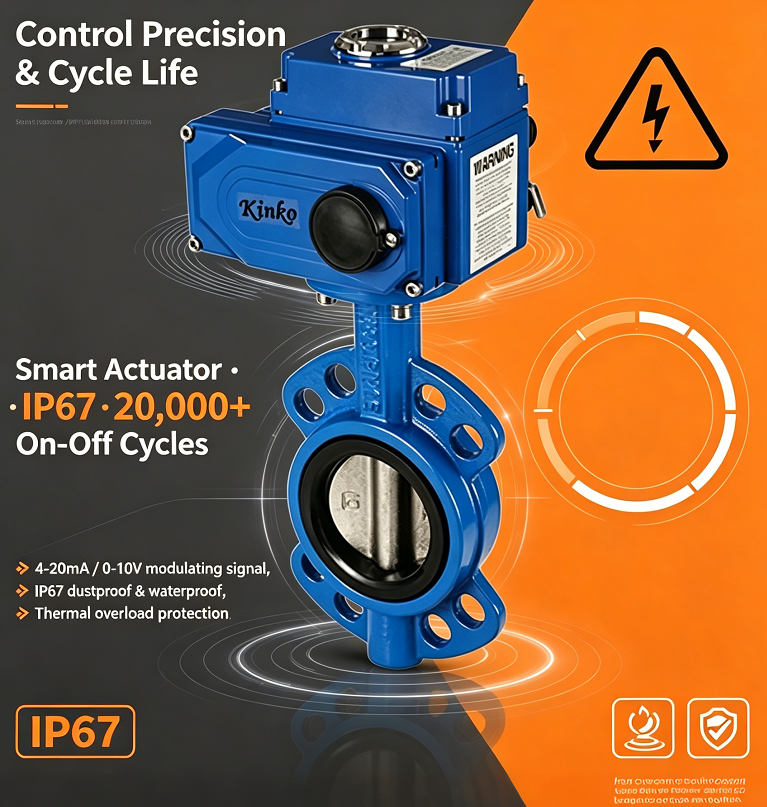
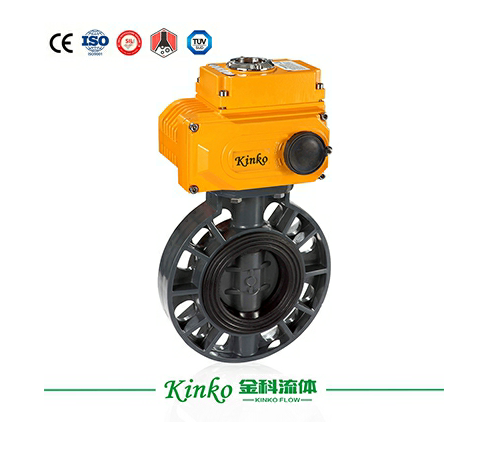
| Electric (On/Off) | KEA Series | 10–3000 Nm | 24V DC, 110V AC, 220V AC | IP67, manual override, limit switches |
| Electric (Modulating) | KEM Series | 10–3000 Nm | 24V DC, 110V AC, 220V AC | 4-20mA input, 0.5% accuracy, PID control |
All KINKO actuators come with:
ISO 5211 direct mounting (no bracket needed for KINKO butterfly valves)
Manual override as standard
Visual position indicator
Weatherproof (IP65/IP67)
7. Summary – One-Page Decision Matrix
| Your Priority | Best Choice |
|---|---|
| Fastest operation | Pneumatic |
| Fail-safe required | Pneumatic (spring-return) |
| Explosion-proof needed | Pneumatic |
| High cycle rate | Pneumatic |
| No air supply available | Motorized |
| Precise modulation | Motorized |
| Remote SCADA control | Motorized |
| Lowest operating cost | Motorized |
| Lowest upfront cost | Pneumatic |
| Very cold environment | Motorized (air lines can freeze) |
8. Conclusion
Both pneumatic and motorized butterfly valves have their place in industrial systems.
Pneumatic is the workhorse for fast, fail-safe, hazardous-area applications where compressed air is available.
Motorized is the choice for precision, remote control, and locations without air infrastructure.
KINKO offers both actuation types fully assembled and tested on our KBF butterfly valve series – ready to install, with full documentation.
Ivan (Mobile:+86-18968769287)
WhatsApp:+86-13579991606
Wechat:+86-18968769287
Website:www.kinko-flow.com
ZHEJIANG KINKO FLUID EQUIPMENT CO.,LTD

 info@kinko-flow.com
 +86-133 5611 9006