Tel:
Tel: E-Mail:
 English
 Chinese
 한국어
한국어
 Español




News
1. Introduction
Butterfly valves are reliable, but they do fail. Most issues stem from incorrect installation, incompatible materials, or normal wear. Recognizing symptoms early prevents unplanned downtime.
This guide covers the most common butterfly valve problems, their root causes, and step-by-step solutions.
2. Quick Troubleshooting Table
| Problem | Most Likely Cause | Quick Fix |
|---|---|---|
| Leakage when closed | Worn or damaged seat | Replace seat |
| Leakage at stem (top) | Worn O-ring / packing | Tighten gland or replace seal |
| Valve won't close fully | Debris in seat | Cycle valve to clear debris |
| Valve won't close fully | Actuator limit stop misadjusted | Recalibrate limit stops |
| High operating torque | Over-tightened flange bolts | Re-torque bolts |
| High operating torque | Seat swelling (chemical attack) | Replace with compatible seat |
| Disc binds or sticks | Disc hitting pipe flange | Realign valve between flanges |
| Disc binds or sticks | Seat bonded to disc (static storage) | Cycle manually with force |
| Flange leakage | Loose bolts or damaged gasket | Re-torque or replace gasket |
| Cavitation noise | Excessive pressure drop | Use larger valve or double offset |
| Vibration / chatter | Flow too low for valve size | Downsize valve or use throttling disc |
| No flow when open | Disc not rotating (actuator failure) | Check actuator coupling |
3. Problem #1: Leakage Through Seat (Valve Closed)
Symptoms
Visible flow downstream when valve is fully closed
Pressure drops in isolated section
Possible Causes & Solutions
| Cause | Solution |
|---|---|
| Worn or damaged seat | Replace seat (in-line for concentric valves) |
| Debris (scale, weld slag) on disc edge | Cycle valve open/close 2–3 times to clear |
| Disc not fully closed | Adjust actuator or lever stop |
| Seat swelling from chemical attack | Replace with compatible seat material |
| Seat extrusion (PTFE under high pressure) | Add backup ring or switch to double offset |
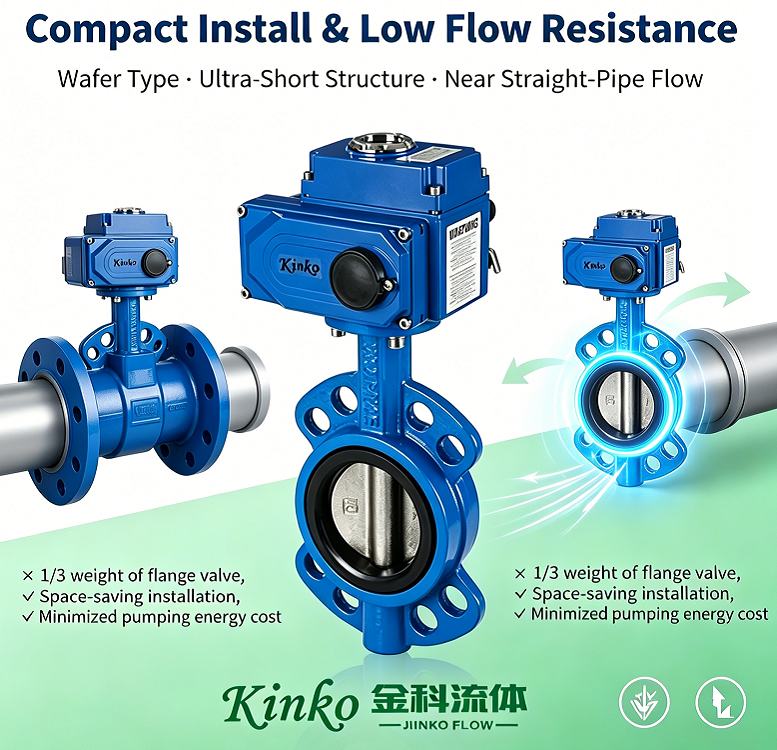
KINKO note: Seat replacement takes 30–60 minutes on concentric wafer/lug valves – no need to remove valve from line.
4. Problem #2: Leakage at Stem (Top of Valve)
Symptoms
Visible fluid dripping from top of valve body
Corrosion around stem area
Possible Causes & Solutions
| Cause | Solution |
|---|---|
| Loose gland nut | Tighten gland nut (1/4 turn at a time) |
| Worn O-ring or packing | Replace stem seal kit |
| Scratched stem surface | Replace stem (requires disassembly) |
| Over-pressure exceeding seal rating | Reduce pressure or upgrade valve |
Temporary fix: Tightening the gland nut often stops minor leaks.
5. Problem #3: High Operating Torque (Difficult to Turn)
Symptoms
Lever requires excessive force
Actuator stalls or trips
Gear operator grinds
Possible Causes & Solutions
| Cause | Solution |
|---|---|
| Flange bolts over-tightened | Re-torque to specification (star pattern) |
| Seat swelling from incompatible fluid | Replace seat with chemically compatible material |
| Disc binding on pipe flange (misalignment) | Realign valve between flanges |
| Debris in seat | Cycle valve to clear |
| Corrosion on stem or disc edge | Disassemble, clean, or replace parts |
| Actuator undersized | Recalculate torque and upsize actuator |
Do not force a stuck valve – find the root cause first.
6. Problem #4: Valve Won't Close Fully
Symptoms
Disc stops at 80° instead of 90°
Leakage persists even when "closed"
Possible Causes & Solutions
| Cause | Solution |
|---|---|
| Debris trapped in seat | Cycle valve several times to clear |
| Actuator limit stop misadjusted | Recalibrate open/close limits |
| Disc or stem damaged (bent) | Replace damaged components |
| Seat displaced from groove | Remove seat and reinstall correctly |
7. Problem #5: Flange Leakage (Between Valve and Pipe)
Symptoms
Fluid weeping from between flanges
Gasket material visible extruding
Possible Causes & Solutions
| Cause | Solution |
|---|---|
| Bolts under-tightened | Re-torque to specification |
| Gasket damaged or missing | Replace gasket |
| Flange faces not parallel | Realign piping |
| Gasket wrong material for media | Replace with compatible gasket |
8. Problem #6: Cavitation Noise
Symptoms
Crackling or popping sound from valve
Pitting damage on disc downstream side
Possible Causes & Solutions
| Cause | Solution |
|---|---|
| Excessive pressure drop across valve | Increase valve size or use double offset design |
| Valve too small for flow rate | Upsize valve |
| Throttling at high differential pressure | Use double offset or anti-cavitation disc |
Cavitation destroys soft seats quickly. If noise is present, investigate immediately.

9. Problem #7: Valve Sticks After Long Period of Inactivity
Symptoms
Valve won't move initially
Breaks free with high force
Cause
The elastomeric seat bonds to the disc surface after prolonged static contact (weeks or months).
Solution
Prevention: Cycle valve monthly (even if system is idle)
Fix: Apply gradual, steady force – do not hammer or use cheater bar
If stuck hard: Disassemble and separate disc from seat manually
Store valves with disc slightly open (5–10%) to prevent this issue.
10. Problem #8: Actuator Fails to Operate Valve
Symptoms
Electric actuator hums but disc doesn't move
Pneumatic actuator doesn't respond
Possible Causes & Solutions
| Cause | Solution |
|---|---|
| No power / air supply | Check supply lines |
| Actuator undersized for torque | Recalculate torque, upsize actuator |
| Valve seized (see Problem #3) | Fix valve first |
| Coupling loose or broken | Tighten or replace coupling |
| Limit switches mis-set | Recalibrate switch positions |
11. Preventive Maintenance Checklist
| Action | Frequency | Prevents |
|---|---|---|
| Cycle valve open/close | Monthly | Seat sticking |
| Visual leak check | Weekly | Undetected failures |
| Re-torque flange bolts | Annually | Flange leakage |
| Lubricate stem | Quarterly | Stem seal wear |
| Inspect seat for wear | Annually | Unexpected leakage |
12. When to Replace vs Repair
| Condition | Action |
|---|---|
| Worn seat only | Replace seat (in-line) |
| Scratched or pitted disc | Replace disc or entire valve |
| Corroded body | Replace valve |
| Damaged stem | Replace stem (if available) |
| Multiple failures (seat + stem + disc) | Replace complete valve |
| Valve >10 years old with no spare parts | Replace valve |
14. KINKO Support Resources
| Resource | Description |
|---|---|
| Spare seat kits | EPDM, NBR, Viton, PTFE for all KBF series |
| Stem seal kits | O-rings, packing, gland hardware |
| Technical support | Phone/email troubleshooting assistance |
| Field service | On-site repair and training (available) |
15. Conclusion
Most butterfly valve issues are preventable with correct installation and regular maintenance. When problems occur, use this guide to:
Identify the symptom
Find the root cause
Apply the correct fix
Contact KINKO for spare parts, replacement valves, or technical support.
Ivan (Mobile:+86-18968769287)
WhatsApp:+86-13579991606
Wechat:+86-18968769287
Website:www.kinko-flow.com
ZHEJIANG KINKO FLUID EQUIPMENT CO.,LTD

 info@kinko-flow.com
 +86-133 5611 9006