Tel:
Tel: E-Mail:
 English
 Chinese
 한국어
한국어
 Español




News
1. The Basics: Pneumatic Actuators in Flow Control
A pneumatic actuator converts energy from compressed air into mechanical motion to operate a flow control device—typically a valve.
Two Primary Functions in Flow Control:
| Function | Description | Example |
|---|---|---|
| On/Off Isolation | Valve is either fully open (100% flow) or fully closed (0% flow) | Emergency shutdown, tank filling |
| Modulating Control | Valve positioned at any point between open and closed to regulate flow rate | Temperature control, pressure regulation, mixing |
The KINKO JAT-SR Advantage:
The JAT-SR Series rack-and-pinion pneumatic actuators are designed for both applications. With the right accessories, they can handle simple on/off duties or precise modulating control.
2. How Pneumatic Actuators Work: The Mechanism
The Rack-and-Pinion Principle (JAT-SR Series)
The KINKO JAT-SR Series uses a rack-and-pinion design—a simple, reliable, and powerful mechanism.
Components:
Pistons: Two opposed pistons inside the actuator body.
Rack Gears: Teeth machined into the pistons.
Pinion Gear: A central gear that meshes with the piston racks.
Drive Shaft: Connected to the pinion, extends to mount the valve.
Operation:
Air Introduction: Compressed air enters the actuator through the center chamber, pushing the pistons outward.
Linear to Rotary Conversion: As the pistons move, their rack gears drive the pinion gear to rotate.
Valve Movement: The rotating pinion shaft turns the valve stem 90 degrees (quarter-turn).
For Double Acting (JAT-SR DA):
Air to Port A pushes pistons outward → valve opens.
Air to Port B pushes pistons inward → valve closes.
For Spring Return (JAT-SR SR):
Air pressure compresses springs → valve opens.
Air pressure released → springs decompress → valve closes (fail-safe).
3. On/Off Flow Control: Simple and Fast
The most common application for pneumatic actuators is simple on/off control.
How It Works:
Open Command: Solenoid valve energizes, directing air pressure to the actuator.
Actuator Strokes: Valve moves to full open position.
Flow Occurs: Media flows through the valve at maximum rate.
Close Command: Solenoid valve de-energizes (or opposite port energized), air exhausts, and actuator returns valve to closed position.
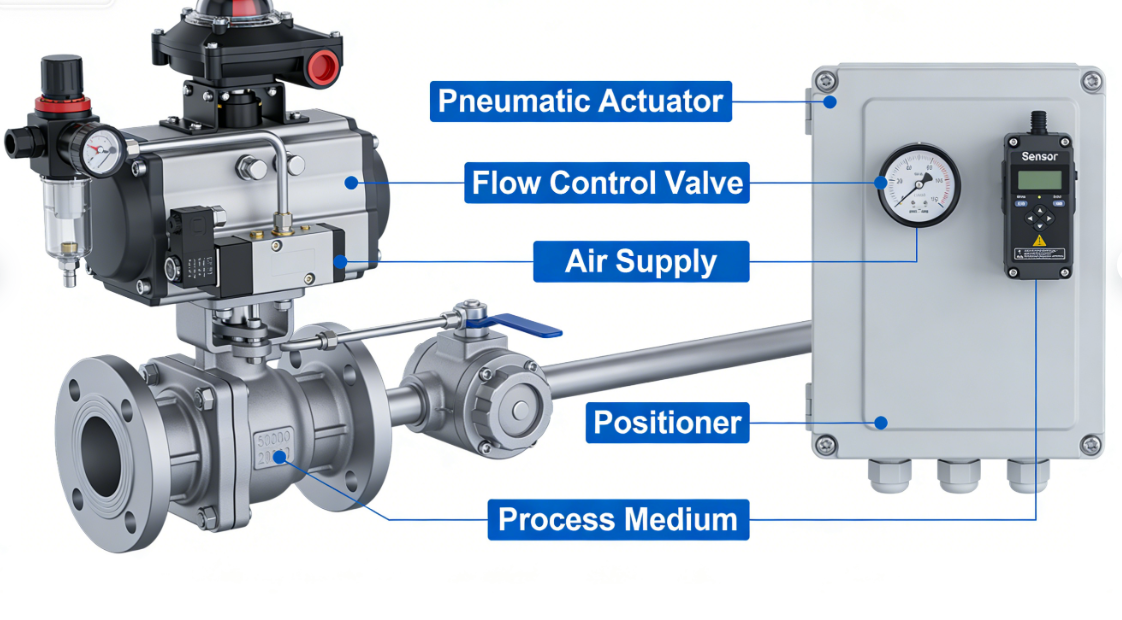
Key Components for On/Off Control:
| Component | Function |
|---|---|
| Solenoid Valve | Electrically controls air flow to the actuator |
| Filter/Regulator | Ensures clean, pressure-regulated air supply |
| Speed Control Valves | Adjust opening and closing speed |
| Limit Switch Box | Provides position feedback (open/closed signals) |
KINKO JAT-SR On/Off Applications:
Tank filling: Quick open/close to control batch quantities.
Conveyor diverters: Directing product flow between lines.
Emergency isolation: Rapid closure during safety events.
Compressor unloading: Controlling air flow in compressed air systems.
4. Modulating Flow Control: Precision Positioning
For processes requiring variable flow rates, modulating control is essential.
What Is Modulating Control?
Modulating control means positioning the valve at any point between 0% and 100% open to achieve a desired flow rate, pressure, or temperature.
Example: A heat exchanger requires exactly 45% hot water flow to maintain 75°C outlet temperature. The actuator must hold the valve at 45% open, adjusting continuously as conditions change.
How Pneumatic Modulating Works:
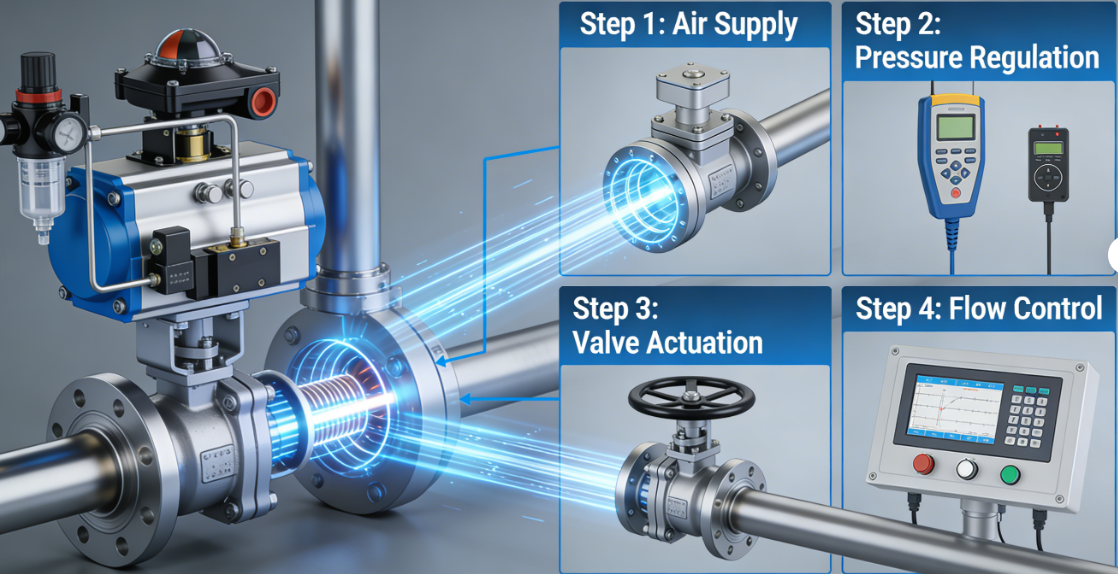
Instead of a simple on/off solenoid, modulating control requires a positioner.
The Positioner's Role:
Receive Signal: Positioner receives a control signal (typically 4-20 mA or 3-15 psi) from a PLC or controller.
Compare Position: Positioner compares the signal to the actual valve position (feedback from a linked mechanism).
Adjust Air: If there is a difference, the positioner sends more or less air pressure to the actuator to move the valve to the correct position.
Hold Position: Once the target position is reached, the positioner traps air in the actuator to hold the valve steady.
Modulating Control Loop:
Controller → Signal (4-20mA) → Positioner → Air Pressure → Actuator → Valve Position
                                             ↑                          |
                                             └───── Feedback ──────────┘
5. Key Components for Modulating Flow Control
A. Valve Positioner
The positioner is the brain of modulating control.
Types:
| Type | How It Works | Best For |
|---|---|---|
| Pneumatic Positioner | Uses air signal (3-15 psi) as input | Simple systems, hazardous areas |
| Electropneumatic Positioner | Uses electrical signal (4-20 mA), outputs air pressure | Modern PLC control, precise applications |
| Smart Positioner | Microprocessor-based, digital communication, self-calibration | Critical loops, IIoT integration, diagnostics |
Mounted on JAT-SR: Positioners mount directly to the JAT-SR actuator via Namur interface (VDI/VDE 3845).
B. Position Feedback
For modulating control, the controller must know the actual valve position.
Feedback Methods:
Mechanical Linkage: Connected to positioner.
Potentiometer: Variable resistance indicates position.
Hall Effect Sensor: Non-contact position sensing.
4-20 mA Feedback: Transmits position back to PLC.
C. I/P Converter (Current to Pressure)
Converts the electrical signal (4-20 mA) to a proportional air pressure (3-15 psi) that the pneumatic positioner understands.
D. Air Supply Quality
Modulating control demands clean, dry, regulated air. Contaminants cause:
Sticky positioners
Erratic valve movement
Worn components
6. Flow Control Characteristics
Not all valves respond linearly to actuator position. Understanding valve characteristics helps in selecting the right actuator and positioner setup.
Common Valve Characteristics:
| Characteristic | Flow vs. Stroke | Application |
|---|---|---|
| Linear | Flow proportional to valve position | Liquid flow control, general service |
| Equal Percentage | Small changes at low flow, large changes at high flow | Pressure control, temperature control |
| Quick Opening | Maximum flow with minimal stroke | On/off service, relief valves |
Actuator's Role:
The actuator must provide precise positioning regardless of the valve's characteristic. With a good positioner, the JAT-SR can accurately position any valve type.
7. Control Modes in Flow Systems
Pneumatic actuators with positioners participate in various control strategies.
A. PID Control (Proportional-Integral-Derivative)
The most common control algorithm:
Proportional: Responds to current error.
Integral: Corrects accumulated past error.
Derivative: Anticipates future error based on rate of change.
The controller sends a varying 4-20 mA signal to the positioner, which moves the JAT-SR actuator to the required position.
B. Cascade Control
Two controllers work together:
Primary controller (e.g., temperature) sets the setpoint for a secondary controller (e.g., flow).
Secondary controller positions the valve faster than the primary could alone.
C. Split-Range Control
One controller signal controls two or more valves:
4-12 mA: Valve A modulates 0-100%
12-20 mA: Valve B modulates 0-100%
Common in temperature control (heating vs. cooling) or pressure control (inlet vs. bypass).
8. KINKO JAT-SR for Flow Control Applications
On/Off Configuration (JAT-SR with Solenoid)
| Component | Specification |
|---|---|
| Actuator | JAT-SR Double Acting or Spring Return |
| Control | 3/2 or 5/2 solenoid valve |
| Speed Control | Flow control valves on air ports |
| Feedback | Mechanical limit switch box |
| Best For | Isolation, diverting, emergency shutdown |
Modulating Configuration (JAT-SR with Positioner)
| Component | Specification |
|---|---|
| Actuator | JAT-SR Double Acting (preferred) or Spring Return |
| Positioner | Electropneumatic or smart positioner |
| Input Signal | 4-20 mA (standard) |
| Feedback | 4-20 mA position feedback (optional) |
| Air Supply | Clean, dry, regulated (5-7 bar) |
| Best For | Flow control, pressure regulation, temperature control |
9. Applications Across Industries
Chemical Processing
Reactor feed control: Precise chemical addition.
pH control: Modulating acid/caustic valves.
Distillation: Reflux and product draw-off control.
Why JAT-SR: Corrosion-resistant options, precise positioning with smart positioners.
Water Treatment
Filter flow control: Maintaining constant flow through filters.
Chemical dosing: Coagulant, polymer, and chlorine addition.
Backwash sequencing: Automated filter cleaning cycles.
Why JAT-SR: Reliable operation in wet environments, cost-effective for large valve counts.
Oil & Gas
Wellhead flow control: Choking production.
Separator level control: Liquid outlet modulation.
Gas blending: Precise mixing of fuel gases.
Why JAT-SR: SIL-capable for safety loops, ATEX options for hazardous areas.
Power Generation
Boiler feedwater control: Maintaining drum level.
Fuel gas control: Modulating burner flow.
Cooling water regulation: Temperature control.
Why JAT-SR: Fast response, reliable in high-temperature environments.
HVAC
Hot water control: Modulating valves for space temperature.
Chilled water regulation: Cooling coil control.
Air handler mixing: Outside air dampers.
Why JAT-SR: Cost-effective for large building automation systems.
10. Advantages of Pneumatic Actuators in Flow Control
| Advantage | Why It Matters |
|---|---|
| Inherently Safe | No electrical sparks—ideal for hazardous areas |
| High Force | Handles high-pressure drops across valves |
| Fast Response | Milliseconds for on/off, seconds for modulating |
| Simple Construction | Easy to maintain and repair |
| Fail-Safe Options | Spring return provides safety without power |
| Cost-Effective | Lower installed cost than electric for large systems |
| Proven Technology | Decades of reliable service worldwide |
Key Takeaways:
JAT-SR rack-and-pinion design converts air pressure to rotary motion.
On/off control uses solenoid valves for simple isolation.
Modulating control requires positioners for precise valve positioning.
Applications span every industry that moves fluids.
Pneumatic actuation remains the preferred choice for hazardous areas and high-force requirements.
Ivan (Mobile:+86-18968769287)
WhatsApp:+86-13579991606
Wechat:+86-18968769287
Website:www.kinko-flow.com
ZHEJIANG KINKO FLUID EQUIPMENT CO.,LTD

 info@kinko-flow.com
 +86-133 5611 9006