Tel:
Tel: E-Mail:
 English
 Chinese
 한국어
한국어
 Español




News
Introduction
The pneumatic angle seat valve is essential for industrial fluid control, handling steam, hot oil, and corrosive chemicals. However, incorrect installation causes water hammer, seal failure, or system breakdown.
This guide provides a certified engineer’s checklist for installing 2/2-way pneumatic angle seat valves, including torque specs, air pressure requirements, and dimensional data.
Pre-Installation Checklist
Before installation, verify these critical parameters:
Depressurize the System: Ensure the pipeline is fully depressurized and drained.
Check Media Compatibility: Verify body material (Stainless Steel 304/316L or Brass) and seal material (PTFE/FKM) match your media temperature.
PTFE Range: -10°C to +180°C
Ambient Temp: -10°C to +60°C
Air Source Quality: Pilot air must be dry, lubricated (if required), and filtered (40µm recommended).
Clean the Piping: Weld slag or debris will destroy the valve seat. Install a Y-strainer upstream if piping isn’t clean.
Step-by-Step Installation Guide
Step 1: Identify the Flow Direction
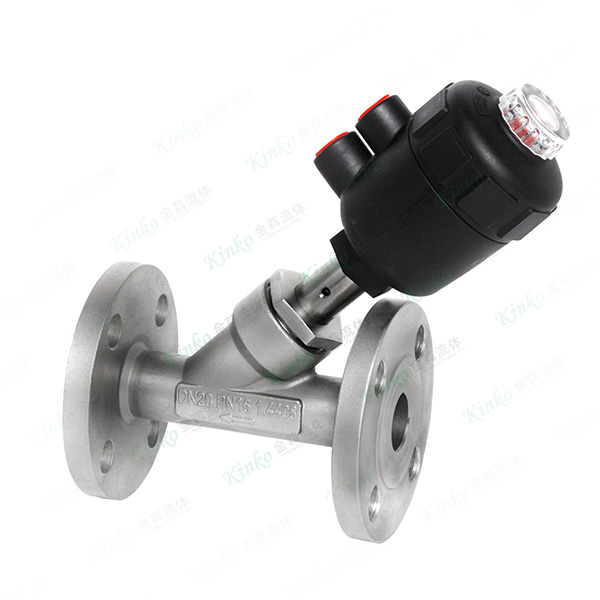
Angle seat valves are directional. Look for the arrow stamped on the valve body. The valve seat is designed to have pressure above the disc. If installed backward, the valve may fail to close properly.
Step 2: Mounting Position
These valves can be mounted in any position. Best practice is to install the actuator facing upwards to prevent sediment from entering the cylinder. For overhead installations, secure the valve against falling.
Step 3: Connecting the Pneumatic Pilot
Single-Acting (Spring Return): Connect air supply to port 2. Port 4 is the exhaust; install a silencer here.
Double-Acting: Connect air to both ports (2 and 4) alternately.
Pressure Regulator: Ensure pilot pressure meets specification (0.3–0.8 MPa / 43.5–116 psi).
Step 4: Threaded or Welded Connection
Threading (BSP/NPT): Apply PTFE tape to male threads, leaving the first two threads bare. Tighten by hand plus 1-2 turns with a wrench. Do not overtighten.
Welding (Stainless Steel): Weld pipes to the system before assembling the valve body to prevent heat damage to PTFE seals.
Step 5: Final Alignment
Loosen the union nut slightly, rotate the actuator to the desired position, and retighten. The actuator can rotate 360° relative to the valve body.
Technical Data Sheet (Selection Matrix)
| Parameter | Specification Options | Notes |
|---|---|---|
| Nominal Diameter (DN) | DN10 – DN100 (3/8" to 4") | Larger bore = higher flow rate |
| Body Material | Stainless Steel (CF8/CF8M/316L) / Brass | 316L required for chemical environments |
| Seal Material | PTFE / FKM / NBR | PTFE handles up to 180°C |
| Control Function | Normally Closed (NC) / Normally Open (NO) | NC is standard for safety |
| Actuator Size | Ø50mm – Ø100mm+ | Larger size for high upstream pressure |
| Pilot Pressure | 4.5 – 8 bar (65 – 116 psi) | Must be dry & lubricated |
| Medium Pressure | 0 – 16 bar (0 – 232 psi) | Check max differential pressure |
| Viscosity | Up to 600 mm²/s (cSt) | Suitable for oils and light pastes |
Commissioning & Testing
Follow this protocol after installation:
Initial Stroke: Manually apply air to check for smooth movement.
Slow Pressure: Slowly open the media supply valve.
Leak Test: Apply soapy water to pneumatic fittings and inspect the valve body.
Cycle Test: Actuate the valve 5-10 times to confirm full open and full close.
Common Installation Mistakes to Avoid
No Support for Heavy Pipes: Support heavy pipes—do not let the valve body bear the weight.
Water Hammer: A loud bang during closing indicates wrong flow direction or need for a damped actuator.
Low Pilot Pressure: If the valve only buzzes or doesn't open fully, the air pressure is too low.
Why Choose Kinko?
Kinko provides OEM-friendly pneumatic angle seat valves featuring:
316L Stainless Steel bodies for corrosion resistance
PTFE seals rated for 180°C steam
Visual position indicators on all actuators
Customizable NPT/BSP threads
Contact our B2B sales team for a quote or download the 3D CAD drawing.
Frequently Asked Questions (FAQ)
Q: Can I install the valve horizontally with the actuator facing sideways?
A: Yes, but avoid positioning the air connection downwards where dirt can collect.
Q: Why does my valve close slowly?
A: Either the exhaust port (port 4) is blocked or the return spring is broken
Ivan (Mobile:+86-18968769287)
WhatsApp:+86-13579991606
Wechat:+86-18968769287
Website: www.kinko-flow.com
ZHEJIANG KINKO FLUID EQUIPMENT CO.,LTD

 info@kinko-flow.com
 +86-133 5611 9006