Tel:
Tel: E-Mail:
 English
 Chinese
 한국어
한국어
 Español




News
1. The Four Pillars of Valve Efficiency
| Efficiency Factor | What It Means | Impact |
|---|---|---|
| Flow efficiency | Low pressure drop across valve | Less pump energy, faster fill |
| Actuation efficiency | Fast open/close with low air consumption | Shorter cycle time, less compressed air |
| Sealing efficiency | Zero leakage when closed | No product waste, no pressure loss |
| Lifecycle efficiency | Long service life with minimal maintenance | Lower total cost, less downtime |
Angle seat valves perform well in all four categories.
2. Flow Efficiency – Low Pressure Drop
The Y‑pattern body (15°–45° angle) creates a nearly straight flow path. This means:
Less turbulence
Lower resistance
Higher Cv (flow coefficient) for the same pipe size
Comparison: Pressure Drop at Same Flow Rate
| Valve Type | Relative Pressure Drop | Energy Loss |
|---|---|---|
| Angle seat valve | Lowest | Minimal |
| Ball valve (full port) | Low | Slight |
| Ball valve (standard port) | Medium | Moderate |
| Globe valve | High | Significant |
| Solenoid valve (pilot operated) | Medium | Moderate |
Real-world impact:
A system with angle seat valves can use a smaller pump or run the same pump at lower speed — saving electricity.
Example Calculation (Illustrative)
| Parameter | Angle Seat Valve | Globe Valve |
|---|---|---|
| Flow rate | 100 L/min | 100 L/min |
| Pressure drop | 0.3 bar | 1.2 bar |
| Extra pump energy needed | 0% (baseline) | +15% |
Over one year of continuous operation, the difference can be hundreds of dollars in electricity.
3. Actuation Efficiency – Fast and Air‑Efficient
Angle seat valves use pneumatic single‑acting actuators with spring return.
Why this improves system efficiency:
| Feature | Efficiency Benefit |
|---|---|
| Short stroke (typically 4–12 mm) | Very fast open/close → shorter cycle time |
| Small internal volume | Low air consumption per cycle |
| Direct pilot mounting | No long tubing → faster response |
| Spring return (no air needed to hold position) | Zero air consumption in idle state |
Air consumption comparison (per cycle, 6 bar supply)
| Valve Type | Air Volume per Cycle | Relative |
|---|---|---|
| Kinko angle seat valve (DN25) | ~0.15 liters | 1x |
| Double‑acting actuator (same size) | ~0.30 liters | 2x |
| Large solenoid valve (direct acting) | ~0.10 liters | 0.7x (but lower flow) |
For systems with hundreds of cycles per minute, using angle seat valves reduces total compressed air demand — which lowers energy cost.
4. Sealing Efficiency – Zero Leakage
Leakage wastes:
product (direct material cost)
pressure (energy)
time (rework)
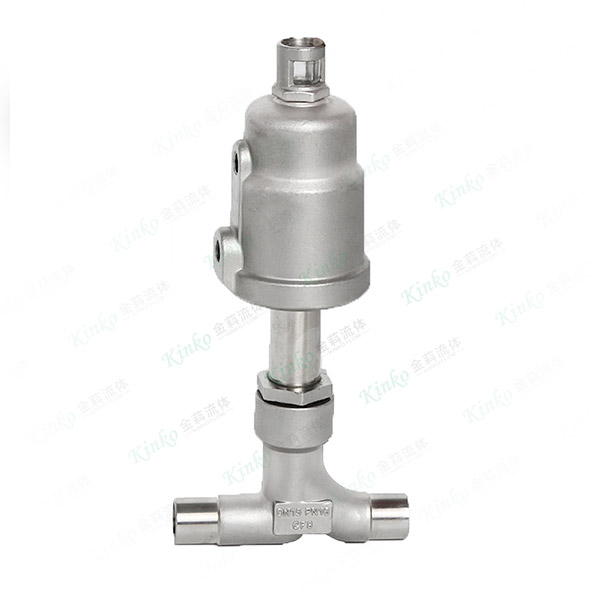
Kinko angle seat valves use a PTFE seal that provides:
Tight shut‑off (leakage rate: zero detectable)
Self‑compensating design (maintains seal as it wears)
High temperature capability (up to 180°C)
Cost of a leaking valve (example)
| Leak Rate | Waste per Day (water) | Waste per Day (expensive liquid like juice) |
|---|---|---|
| 1 drop/sec | ~4 liters | ~$0.01 (negligible) |
| 10 drops/sec | ~40 liters | ~$0.10 |
| Small stream | ~1000 liters | ~$2.50 |
For chemicals, oil, or food products, even small leaks add up quickly.
Efficiency gain: Zero leakage means zero waste.
5. Lifecycle Efficiency – Lower Total Cost
Efficiency is not just about energy — it is about cost per operating hour.
| Cost Factor | Angle Seat Valve | Low‑cost Alternative |
|---|---|---|
| Purchase price | Moderate | Low |
| Installation cost | Low (standard threads) | Low |
| Maintenance frequency | Low (≥2M cycles) | High (every 200K cycles) |
| Downtime cost | Low | High (frequent replacement) |
| Replacement part cost | Moderate | Low (but frequent) |
| Total cost over 3 years | Low | High |
A cheap valve that fails every 3 months is less efficient than a quality valve that runs for 2 years.
6. System‑Level Efficiency Gains
When multiple angle seat valves are used in one system, the benefits multiply.
| System Type | Efficiency Gain from Angle Seat Valves |
|---|---|
| Filling machine (8 nozzles) | 15–20% faster cycle time |
| CIP distribution system | Lower pump pressure needed |
| Pneumatic conveying line | Less air consumption |
| Chemical dosing skid | Consistent flow, less recalibration |
Case example (typical Kinko customer):
A beverage filler replaced globe valves with Kinko angle seat valves.
Result:
18% faster fill speed
12% lower compressed air usage
9 months longer between maintenance intervals
7. Comparison Summary – Angle Seat Valve vs Other Types
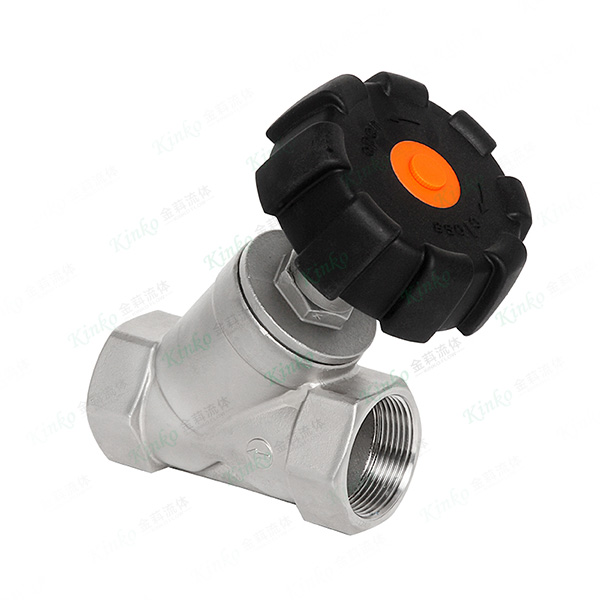
| Efficiency Metric | Angle Seat Valve | Ball Valve | Globe Valve | Solenoid Valve |
|---|---|---|---|---|
| Flow efficiency (Cv) | Excellent | Good | Poor | Good (pilot) |
| Actuation speed | Fast | Medium | Slow | Very fast |
| Air consumption (idle) | Zero | Zero | Zero | Zero (pilot) |
| Leakage (closed) | Zero | Zero | Zero to low | Zero to low |
| Cycle life (millions) | 2–5 | 0.2–0.5 | 0.1–0.3 | 10–20 (but low flow) |
| Maintenance frequency | Low | Medium | High | Low |
| Overall system efficiency | ⭐⭐⭐⭐⭐ | ⭐⭐⭐ | ⭐⭐ | ⭐⭐⭐⭐ (low flow only) |
8. How to Maximize Efficiency with Kinko Angle Seat Valves
| Tip | Efficiency Benefit |
|---|---|
| Size the valve correctly (not oversized) | Faster response, less air use |
| Use NC for closed‑at‑rest applications | No air consumed during idle |
| Keep control air clean and dry | Longer seal life, consistent speed |
| Install close to the point of use | Faster response, less tubing loss |
| Match seal material to media | Prevents leakage from seal failure |
9. Summary – Key Takeaways
✅ Angle seat valves provide lowest pressure drop among common valve types
✅ Low air consumption and fast actuation reduce cycle time and energy cost
✅ Zero leakage means no product waste
✅ Long cycle life reduces downtime and replacement cost
✅ System‑level benefits multiply when used in multi‑valve applications
If system efficiency matters to you, angle seat valves are not just a component — they are an investment in performance.
10. Want to Improve Your System Efficiency?
Kinko angle seat valves are designed for:
packaging machines
filling lines
industrial fluid control
Contact Kinko for valve sizing, efficiency analysis, and sample testing.
Ivan (Mobile:+86-18968769287)
WhatsApp:+86-13579991606
Wechat:+86-18968769287
Website:www.kinko-flow.com
ZHEJIANG KINKO FLUID EQUIPMENT CO.,LTD

 info@kinko-flow.com
 +86-133 5611 9006