Tel:
Tel: E-Mail:
 English
 Chinese
 한국어
한국어
 Español




News
1. Why Angle Seat Valves Work Well in Steam Systems
| Steam System Requirement | How Angle Seat Valve Delivers |
|---|---|
| High temperature resistance | PTFE seal rated to 180°C continuous |
| Thermal shock tolerance | Metal body absorbs expansion, PTFE seal flexes |
| Condensate drainage | Y‑body design is self‑draining, no water hammer traps |
| Tight shut‑off at high temp | PTFE seal remains stable, no creep |
| Fast actuation | Pneumatic response unaffected by steam temperature |
| Corrosion resistance | SS304 / SS316L body withstands boiler chemicals |
2. Critical Features for Steam Duty
Not every angle seat valve is suitable for steam. Look for these features:
| Feature | Why It Matters for Steam |
|---|---|
| PTFE seat seal | Only seal material rated for 180°C+ steam |
| Stainless steel body (SS304 or SS316L) | No rust, no dezincification |
| Metal stop (not plastic) | Prevents over-compression of seal at high temp |
| High-temperature actuator | Standard actuators may fail above 80°C ambient |
| External pilot port | Keeps solenoid coil away from hot valve body |
| Condensate-resistant design | Prevents water hammer damage |
Kinko angle seat valves include all of the above as standard.
3. Recommended Kinko Configurations for Steam
| Application | Body Material | Seal Material | Actuator | Max Temp |
|---|---|---|---|---|
| Saturated steam (low pressure, <6 bar) | SS304 | PTFE | Standard (remote pilot) | 180°C |
| Saturated steam (high pressure, 6–16 bar) | SS316L | PTFE | High-temp actuator | 180°C |
| Superheated steam | SS316L | Reinforced PTFE | High-temp actuator + heat shield | 200°C |
| Boiler blowdown (intermittent) | SS316L | PTFE | NC (fail-safe close) | 180°C |
| Steam tracing lines | SS304 | PTFE | Standard | 180°C |
| Condensate return | SS304 | PTFE | NO (fail-safe open) | 180°C |
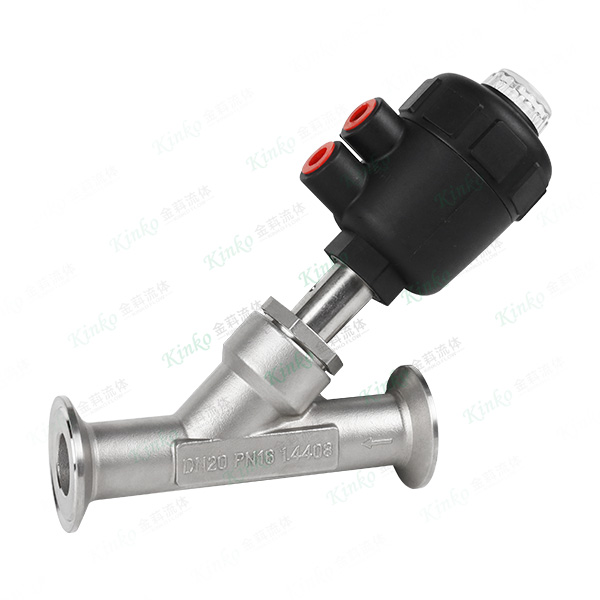
4. Steam Application Examples
| Application | Valve Function | Recommended Type | Why |
|---|---|---|---|
| Steam inlet to heat exchanger | On/off control | NC, SS304, PTFE | Closed when idle, safe |
| Steam sterilization (autoclave) | Fast cycling | NC, SS316L, PTFE | High cycle life, corrosion resistant |
| Boiler blowdown tank drain | Drain on failure | NO, SS316L, PTFE | Opens if air fails — safe |
| Steam trap bypass | Manual override | NC (or manual ball valve) | NC for auto control |
| Steam injection (food/cheese) | Precise dosing | NC, SS316L, PTFE | Clean, tight shut-off |
5. Technical Specifications – Kinko Steam‑Rated Angle Seat Valve
| Parameter | Kinko Steam Specification |
|---|---|
| Valve sizes | DN15 – DN65 (1/2″ to 2‑1/2″) |
| Body material | SS304 (standard), SS316L (recommended for steam) |
| Seal material | PTFE (standard), reinforced PTFE (option) |
| Max medium temperature | 180°C (PTFE), 200°C (reinforced PTFE) |
| Max operating pressure | 16 bar (saturated steam) |
| Control air pressure | 4 – 8 bar (dry, filtered) |
| Actuator type | Single acting, spring return (NC or NO) |
| Pilot port | G1/4″ (recommended for steam, for faster response) |
| Ambient temperature limit | Standard actuator: -10°C to +60°C; High-temp actuator: -10°C to +100°C |
Important: For steam above 150°C, Kinko recommends:
Remote mounting of solenoid pilot valve (away from valve body heat)
Heat shield between body and actuator (available as option)
6. NC or NO for Steam Applications?
| Application | Recommended | Reason |
|---|---|---|
| Steam supply line (normal operation: closed) | NC | Safe on air failure — steam stops |
| Steam vent / bleed line | NO | Opens on failure to relieve pressure |
| Condensate drain | NO | Drains even if air fails |
| Sterilizer / autoclave inlet | NC | Closed when idle |
General rule for steam:
If failure means "stop steam to prevent damage" → NC
If failure means "open to drain/pressure relief" → NO
7. Common Mistakes in Steam Valve Selection
| Mistake | Consequence | Correct Approach |
|---|---|---|
| Using FKM or EPDM seal | Seal melts or hardens quickly | Use PTFE only |
| Mounting solenoid directly on valve | Coil overheats, fails early | Remote mount pilot valve |
| Using brass or cast iron body | Corrosion, thread failure | Use SS304 or SS316L |
| Oversized valve | Slow response, water hammer | Size correctly for steam flow |
| NO valve used on steam supply | Steam flows on air failure (unsafe) | Use NC for supply lines |
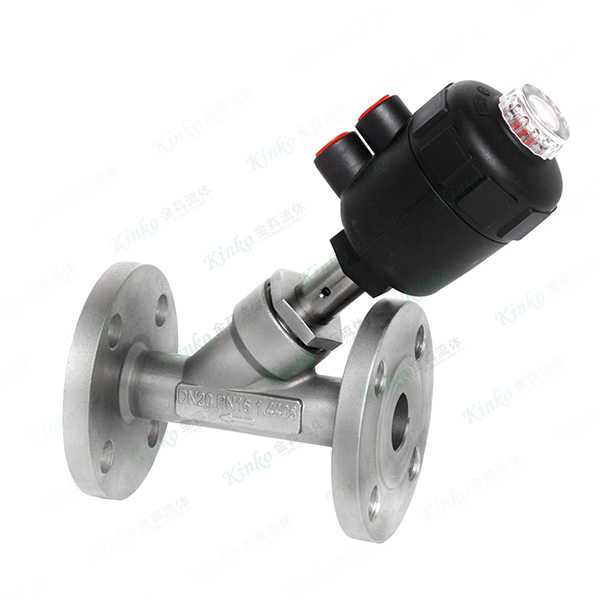
8. How to Extend Valve Life in Steam Service
| Practice | Benefit |
|---|---|
| Install a strainer upstream | Prevents scale/debris from damaging PTFE seal |
| Use dry, lubricated compressed air | Smooth actuator operation |
| Allow warm‑up time before full cycling | Reduces thermal shock |
| Drain condensate before valve (if possible) | Prevents water hammer |
| Replace PTFE seat every 1–2 years (normal wear) | Maintains zero leakage |
| Keep pilot tubes short | Faster response |
9. Comparison – Angle Seat Valve vs Other Valves for Steam
| Valve Type | Steam Suitability | Max Temp | Cycle Life (steam) | Maintenance |
|---|---|---|---|---|
| Angle seat valve (PTFE) | ✅ Excellent | 180°C | 1–2 million cycles | Low |
| Ball valve (PTFE seat) | ✅ Good | 180°C | 0.1–0.3 million cycles | Medium |
| Globe valve (metal seat) | ✅ Good | 250°C+ | High (but slow) | Medium (packing) |
| Solenoid valve (direct acting) | ⚠️ Limited | 180°C | 5–10 million (but small flow) | Low |
| Butterfly valve (PTFE lined) | ⚠️ Fair | 150°C | Low | High |
Takeaway: For a balance of flow, speed, cycle life, and cost in steam service, angle seat valves are the best choice.
10. Summary – Key Takeaways for Steam Systems
✅ Use PTFE seal only — other seals will fail
✅ Choose SS316L body for high-pressure or superheated steam
✅ NC for steam supply lines (fail-safe close)
✅ NO for drains and vents (fail-safe open)
✅ Remote mount solenoid pilot to avoid coil overheating
✅ Install strainer upstream to protect the seal
Steam systems demand the right valve. Kinko angle seat valves are built for the job.
11. Need a Steam‑Rated Angle Seat Valve?
Kinko supplies angle seat valves for:
boiler skids
steam distribution lines
sterilization equipment
food and pharmaceutical steam applications
Ivan (Mobile:+86-18968769287)
WhatsApp:+86-13579991606
Wechat:+86-18968769287
Website:www.kinko-flow.com
ZHEJIANG KINKO FLUID EQUIPMENT CO.,LTD

 info@kinko-flow.com
 +86-133 5611 9006