2026-09-17
Single Acting vs Double Acting Pneumatic Actuator: What's the Difference?
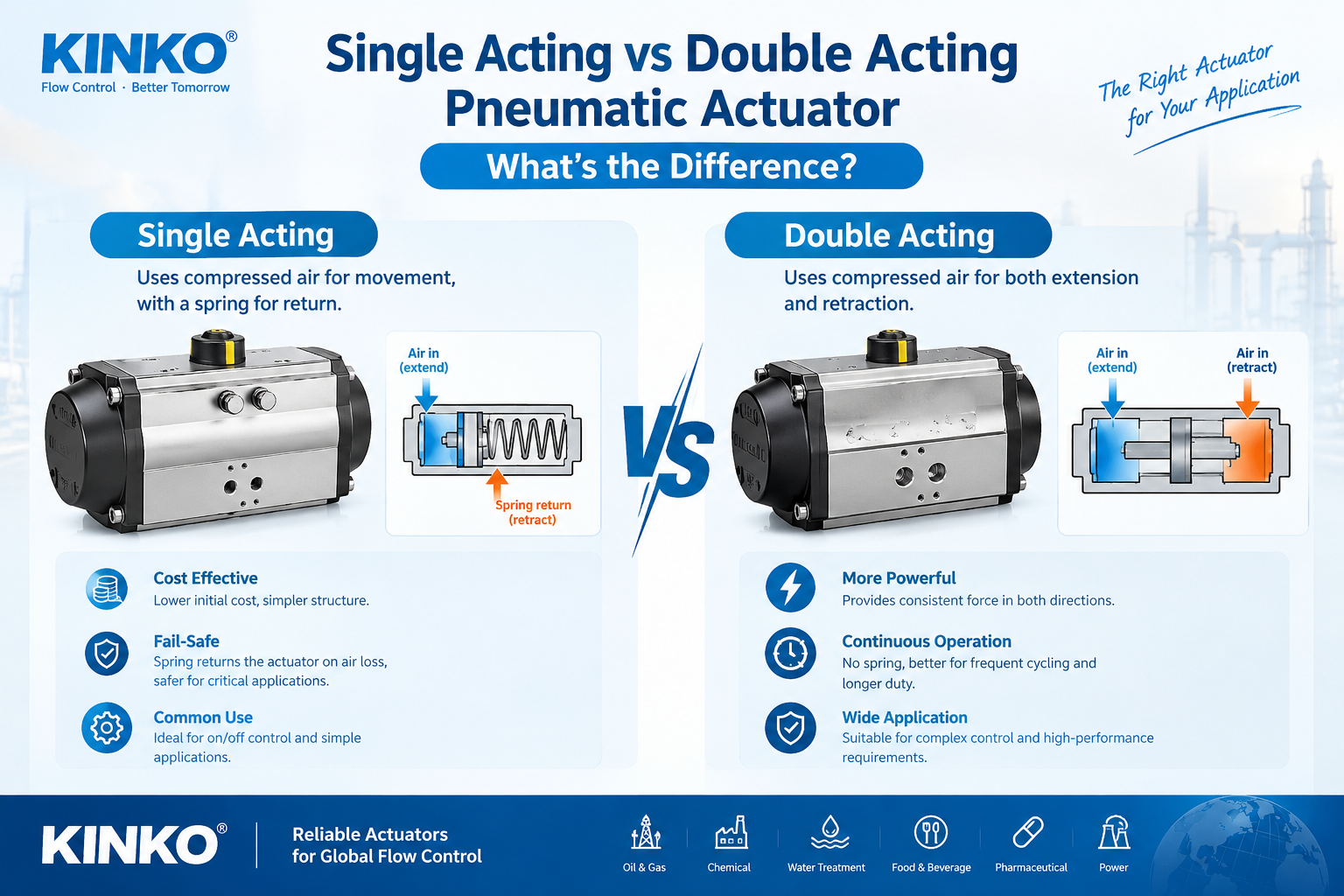
The fundamental difference between single acting and double acting pneumatic actuators is how they generate movement.
Single Acting:
Compressed Air + Spring Return
Double Acting:
Compressed Air + Compressed Air
Single acting actuators are commonly selected when a defined fail position is required.
Double acting actuators are commonly selected when pneumatic force is required in both directions and spring return is not required.
However, actuator selection should consider more than the operating principle.
Engineers should evaluate:
Valve Type + Valve Torque + Air Pressure + Fail-Safe Requirement + Cycle Frequency + Medium + Temperature + Installation Environment
KINKO provides single acting and double acting pneumatic actuator solutions for ball valves, butterfly valves, angle seat valves, and other industrial valve automation applications.
With options including rack and pinion, heavy-duty, Scotch yoke, and explosion-proof configurations, KINKO can support different industrial automation requirements.
Looking for the right pneumatic actuator for your valve?
Provide:
Valve Type + DN Size + Operating Torque + Air Pressure + Fail Position + Working Frequency
Pneumatic actuators are widely used in industrial valve automation because they provide fast response, reliable operation, and a relatively simple control system.
When selecting a pneumatic actuator, one of the most important decisions is choosing between a Single Acting Pneumatic Actuator and a Double Acting Pneumatic Actuator.
Although both types use compressed air to operate a valve, their internal working principles are different.
The main difference is simple:
Single Acting Actuator = Air for One Direction + Spring for the Other Direction
Double Acting Actuator = Air for Both Directions
But this difference affects much more than the actuator's operating principle.
It also influences:
Fail-safe operation
Air consumption
Valve control logic
Available torque
Operating reliability
Installation requirements
Suitable applications
So, how do you choose between single acting and double acting pneumatic actuators?
This guide explains the differences, advantages, applications, and selection considerations.
 Tel:
Tel: E-Mail:
 English
 Chinese
 한국어
한국어
 Español





 info@kinko-flow.com
 +86-133 5611 9006