Tel:
Tel: E-Mail:
 English
 Chinese
 한국어
한국어
 Español




News
1. Why Angle Seat Valves Work for All Three Media
| Media Challenge | How Angle Seat Valve Solves It |
|---|---|
| Liquid hammer (pressure spikes) | Y‑body design smooths flow, reduces shock |
| Gas leakage (hard to seal) | PTFE seal provides bubble‑tight shut‑off |
| Vapor condensation (phase change) | Self‑draining body prevents pooling |
| High temperature (vapor) | PTFE seal rated to 180°C |
| Fast cycling (all media) | Pneumatic actuation, short stroke |
The key is matching seal and body material to the specific medium.
2. Selection Matrix – Liquid, Gas, Vapor
| Medium | Typical Temp | Recommended Body | Recommended Seal | Special Considerations |
|---|---|---|---|---|
| Water (cold) | 5–40°C | SS304 | PTFE or EPDM | None |
| Water (hot) | 60–90°C | SS304 | PTFE or EPDM | EPDM is cost‑effective |
| Mineral oil | 20–80°C | SS304 | NBR or FKM | NBR for ambient, FKM for hot |
| Chemical / solvent | 20–100°C | SS316L | PTFE | Check compatibility |
| Food / beverage | 2–90°C | SS316L | PTFE or EPDM | Sanitary finish option |
| Compressed air (dry) | Ambient | SS304 | PTFE or NBR | Use lubricated air |
| Compressed air (wet) | Ambient | SS304 | PTFE | Drain condensate upstream |
| Nitrogen / inert gas | Ambient | SS304 | PTFE | Bubble‑tight seal required |
| Natural gas | Ambient | SS304 | PTFE or FKM | Explosion‑proof solenoid if needed |
| Steam (saturated) | 120–180°C | SS316L | PTFE | Remote pilot, heat shield |
| Solvent vapor | 40–150°C | SS316L | PTFE | Condensate drain needed |
3. Liquid Control – Key Considerations
Liquids are the most common medium for angle seat valves. Challenges include:
| Liquid Challenge | Solution |
|---|---|
| Water hammer (sudden stop) | Use NC type, install slowly closing option or soft start |
| Viscous liquids (syrup, oil) | Oversize valve slightly, use full port |
| Particulate / dirty liquid | Install strainer upstream |
| Food / sanitary | SS316L body, EPDM or PTFE seal, hygienic connections |
| Corrosive liquid | SS316L body, PTFE seal, check chemical compatibility |
Recommended Configuration for Common Liquids
| Liquid | Body | Seal | NC/NO | Notes |
|---|---|---|---|---|
| Clean water | SS304 | PTFE | NC | Standard |
| Hot water (80°C) | SS304 | EPDM | NC | EPDM cheaper than PTFE |
| Diesel / fuel | SS304 | NBR | NC | NBR handles fuel well |
| Hydraulic oil | SS304 | FKM | NC | High temp capability |
| Fruit juice | SS316L | PTFE | NC | Sanitary |
| Detergent / soap | SS304 | PTFE | NC | Foam may require slower closing |
| Acid (dilute) | SS316L | PTFE | NC | SS316L critical |
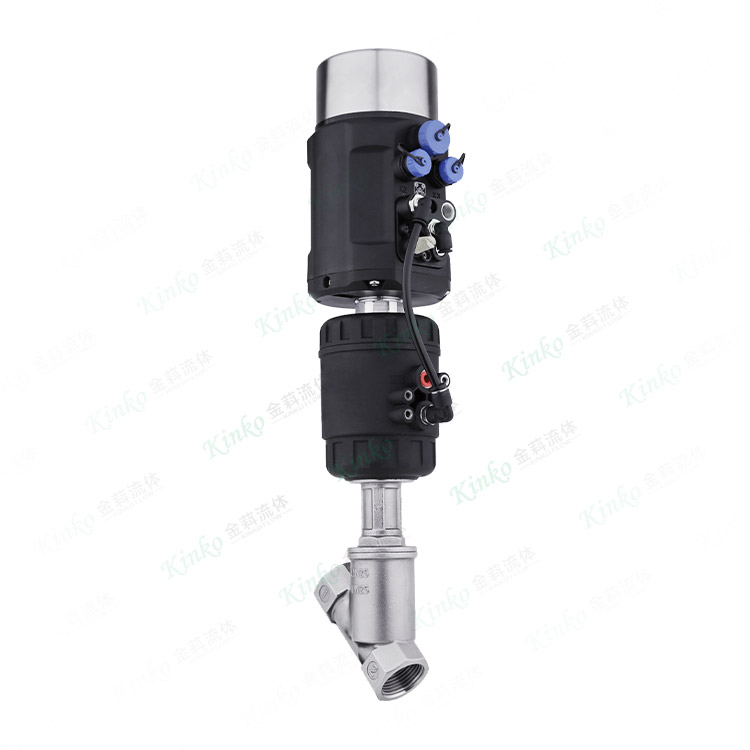
4. Gas Control – Key Considerations
Gases are more compressible than liquids, which changes valve behavior.
| Gas Challenge | Solution |
|---|---|
| Leakage (hard to detect) | PTFE seal required (bubble‑tight) |
| High flow rates | Use correct Cv, avoid undersizing |
| Dry gas (no lubrication) | Inline lubricator needed for actuator |
| Explosive gas (natural gas, hydrogen) | Use explosion‑proof solenoid, grounding |
| High pressure gas | Verify valve pressure rating (16 bar max for Kinko) |
Recommended Configuration for Common Gases
| Gas | Body | Seal | NC/NO | Special Requirement |
|---|---|---|---|---|
| Compressed air (dry) | SS304 | PTFE | NC or NO | Lubricated air supply |
| Compressed air (wet) | SS304 | PTFE | NC | Install dryer upstream |
| Nitrogen | SS304 | PTFE | NC | Bubble‑tight seal |
| Natural gas | SS304 | PTFE or FKM | NC | Explosion‑proof coil |
| CO2 | SS304 | PTFE | NC | Check for dry ice risk |
| Oxygen | SS304/316L | PTFE | NC | Oil‑free, degreased (special order) |
Warning: For oxygen service, valves must be degreased and oil‑free. Standard Kinko valves are not oxygen‑rated unless specified.
5. Vapor Control – Key Considerations
Vapor is the most challenging medium because it can condense back into liquid inside the valve.
| Vapor Challenge | Solution |
|---|---|
| Condensation inside valve | Self‑draining Y‑body design |
| Thermal cycling (hot to cool) | PTFE seal handles expansion/contraction |
| Water hammer from condensate | Install drip leg upstream, open valve slowly |
| High temperature | PTFE seal only, remote pilot |
| Corrosive vapor | SS316L body, PTFE seal |
Recommended Configuration for Common Vapors
| Vapor | Body | Seal | NC/NO | Special Requirement |
|---|---|---|---|---|
| Saturated steam | SS316L | PTFE | NC (supply) / NO (drain) | Remote pilot, heat shield |
| Superheated steam | SS316L | Reinforced PTFE | NC | High‑temp actuator |
| Solvent vapor | SS316L | PTFE | NC | Condensate drain |
| Humid air (hot) | SS304 | PTFE | NC | Drain before valve |
| Chemical vapor | SS316L | PTFE | NC | Verify compatibility |
6. Flow Direction – Matters for Each Medium
Kinko angle seat valves can be installed for flow above seat or below seat.
| Flow Direction | Effect on Liquid | Effect on Gas | Effect on Vapor |
|---|---|---|---|
| Above seat (standard) | Smoother, less hammer | Good | Better for condensate drainage |
| Below seat (reverse) | Higher Cv, possible hammer | Good | Risk of condensate pooling |
Kinko recommendation: Use above seat (standard) for liquids and vapors. Use either for clean gases.
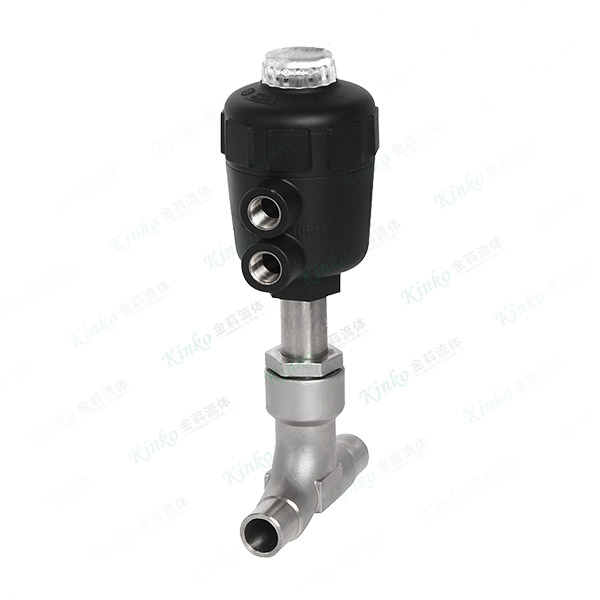
7. NC vs NO – By Medium
| Medium | Typical Normal State | Recommended Type |
|---|---|---|
| Liquid (supply / fill) | Closed | NC |
| Liquid (drain) | Open (for safety) | NO |
| Gas (supply) | Closed | NC |
| Gas (vent) | Open (for safety) | NO |
| Vapor (steam supply) | Closed | NC |
| Vapor (condensate drain) | Open | NO |
8. Performance Comparison – Same Valve, Different Media
Test data for Kinko angle seat valve (DN25, NC, PTFE seal, 6 bar air supply):
| Media | Pressure | Cycle Time (open) | Cycle Life (typical) |
|---|---|---|---|
| Water (20°C) | 5 bar | 40 ms | 3 million cycles |
| Air (dry) | 5 bar | 35 ms | 5 million cycles |
| Steam (160°C) | 5 bar | 45 ms | 1.5 million cycles |
Observation: Vapor (steam) reduces cycle life due to thermal stress, but still delivers over 1 million cycles — excellent for steam service.
9. Common Mistakes by Medium
| Medium | Mistake | Consequence | Correct Action |
|---|---|---|---|
| Liquid | Using NO for fill nozzle | Product waste on air failure | Use NC |
| Gas | No lubricator in air line | Premature piston wear | Add inline lubricator |
| Vapor | Mounting solenoid directly on valve | Coil overheats | Remote mount pilot |
| Liquid | Wrong seal (e.g., FKM with water) | Unnecessary cost | Use EPDM or PTFE |
| Gas | Undersized valve | Pressure drop, slow response | Calculate required Cv |
| Vapor | Using NO for steam supply | Unsafe (steam flows on failure) | Use NC |
10. Summary – One Valve Family, Many Media
| Medium | Key Requirement | Kinko Recommendation |
|---|---|---|
| Liquid | Correct seal for chemical compatibility | PTFE (universal) or EPDM (water) |
| Gas | Bubble‑tight shut‑off | PTFE seal + lubricated air |
| Vapor | High temperature + condensation handling | PTFE seal + SS316L + remote pilot |
The same Kinko angle seat valve body — with different seal and configuration choices — can handle all three media types.
11. Need a Valve for Liquid, Gas, or Vapor?
Kinko angle seat valves are field‑proven across:
water and oil lines
compressed air and gas systems
steam and vapor applications
Contact Kinko with your medium, temperature, pressure, and cycle requirement — we will recommend the right configuration.
Ivan (Mobile:+86-18968769287)
WhatsApp:+86-13579991606
Wechat:+86-18968769287
Website:www.kinko-flow.com
ZHEJIANG KINKO FLUID EQUIPMENT CO.,LTD

 info@kinko-flow.com
 +86-133 5611 9006