Tel:
Tel: E-Mail:
 English
 Chinese
 한국어
한국어
 Español




News
1. Two Different Pressures to Understand
| Pressure Type | Definition | Affects |
|---|---|---|
| Media pressure | Pressure of the fluid (liquid, gas, steam) flowing through the valve | Seal life, shut‑off capability, body strength |
| Control pressure | Pressure of compressed air supplied to the actuator | Opening/closing speed, actuation reliability |
Both matter. Confusing them is a common mistake.
2. Media Pressure – Maximum Ratings
Kinko angle seat valves have different maximum media pressures depending on size and configuration.
| Valve Size | Max Media Pressure (standard) | Max Media Pressure (steam) |
|---|---|---|
| DN10 – DN25 (3/8″ – 1″) | 16 bar (232 psi) | 16 bar (232 psi) |
| DN32 – DN40 (1‑1/4″ – 1‑1/2″) | 16 bar (232 psi) | 10 bar (145 psi) |
| DN50 (2″) | 16 bar (232 psi) | 10 bar (145 psi) |
| DN65 (2‑1/2″) | 10 bar (145 psi) | 6 bar (87 psi) |
Important: Higher pressure reduces seal life. For continuous operation near max pressure, expect shorter maintenance intervals.
3. How Media Pressure Affects Valve Operation
| Pressure Level | Effect on Valve | Risk |
|---|---|---|
| Very low (<0.5 bar) | May not seal fully (PTFE needs some pressure to deform) | Leakage |
| Normal range (1–10 bar) | Optimal sealing, stable cycle time | Minimal |
| High (10–16 bar) | Faster opening (pressure assists), but higher seal wear | Reduced seal life |
| Excessive (>16 bar) | Body strain, seal extrusion, actuator may not open | Catastrophic failure |
Pressure‑Assisted Sealing
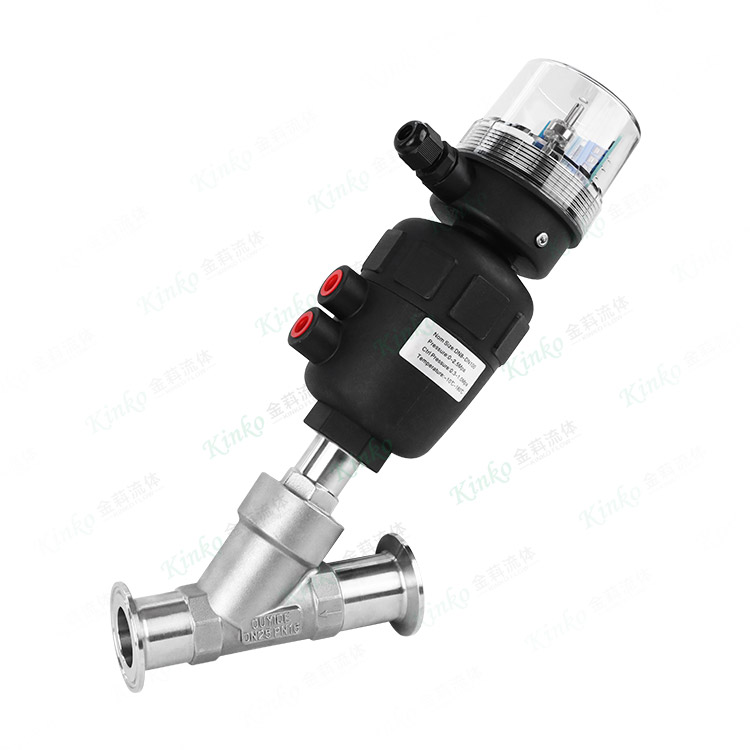
Angle seat valves use the media pressure to help seal:
NC type (flow above seat): Media pressure pushes seal closed — good for high pressure
NO type (flow below seat): Media pressure pushes seal open — requires stronger spring
Kinko recommendation: For high‑pressure applications (over 10 bar), use NC type with flow above seat.
4. Control Pressure – Minimum and Maximum
The pneumatic actuator requires a specific control air pressure range.
| Parameter | Kinko Standard |
|---|---|
| Minimum control pressure | 4 bar (60 psi) |
| Recommended control pressure | 5 – 8 bar (75 – 120 psi) |
| Maximum control pressure | 10 bar (145 psi) |
Effects of Incorrect Control Pressure
| Control Pressure | Effect |
|---|---|
| Below 4 bar | Valve may not fully open or close — stuck mid‑travel |
| 4 – 5 bar | Opens slowly, may flutter |
| 5 – 8 bar | Optimal speed, full stroke |
| 8 – 10 bar | Faster, but increased seal wear |
| Above 10 bar | Risk of actuator damage, piston seal failure |
5. Relationship Between Media Pressure and Control Pressure
The actuator must generate enough force to overcome:
Spring force (to open NC or close NO)
Media pressure force (acting on the valve seat)
For NC valve (spring holds closed, air opens):
| Media Pressure | Control Pressure Needed |
|---|---|
| 0 – 5 bar | 4 – 5 bar |
| 5 – 10 bar | 5 – 6 bar |
| 10 – 16 bar | 6 – 8 bar |
Rule: Higher media pressure requires higher control pressure to open the valve.
For NO valve (spring holds open, air closes):
| Media Pressure | Control Pressure Needed |
|---|---|
| 0 – 5 bar | 4 – 5 bar |
| 5 – 10 bar | 5 – 7 bar |
| 10 – 16 bar | 7 – 9 bar |
Note: NO valves require more control pressure to close against high media pressure.
6. Pressure Drop – Why It Matters
Pressure drop is the difference between inlet and outlet pressure when the valve is open.
| Pressure Drop | Effect |
|---|---|
| Low (<0.5 bar) | Efficient system, low energy cost |
| Moderate (0.5–1.5 bar) | Acceptable |
| High (>1.5 bar) | Wasted energy, possible cavitation (liquids) |
Factors Affecting Pressure Drop
| Factor | Impact |
|---|---|
| Valve size (undersized) | High drop |
| Flow rate | Higher flow = higher drop |
| Media viscosity | Thicker media = higher drop |
| Valve condition (dirty) | Higher drop over time |
Kinko advantage: Y‑body design provides lower pressure drop than globe valves of same size.
7. Water Hammer – Pressure Spike Risk
Water hammer occurs when a valve closes quickly and the flowing liquid suddenly stops, creating a pressure spike that can be 5–10x normal pressure.
| Media | Water Hammer Risk | Consequence |
|---|---|---|
| Water (low compressibility) | High | Pipe bang, valve damage, seal extrusion |
| Oil (medium compressibility) | Medium | Less severe |
| Gas / air (high compressibility) | None | Not applicable |
| Steam (with condensate) | High (if condensate present) | Hammer damage |
How to Reduce Water Hammer
| Method | How It Helps |
|---|---|
| Increase closing time (soft close option) | Slows valve stroke |
| Install check valve upstream | Prevents backflow |
| Use NC with flow above seat | Smoother flow path |
| Add accumulator / surge tank | Absorbs pressure spike |
| Reduce fluid velocity | Lower energy in moving liquid |
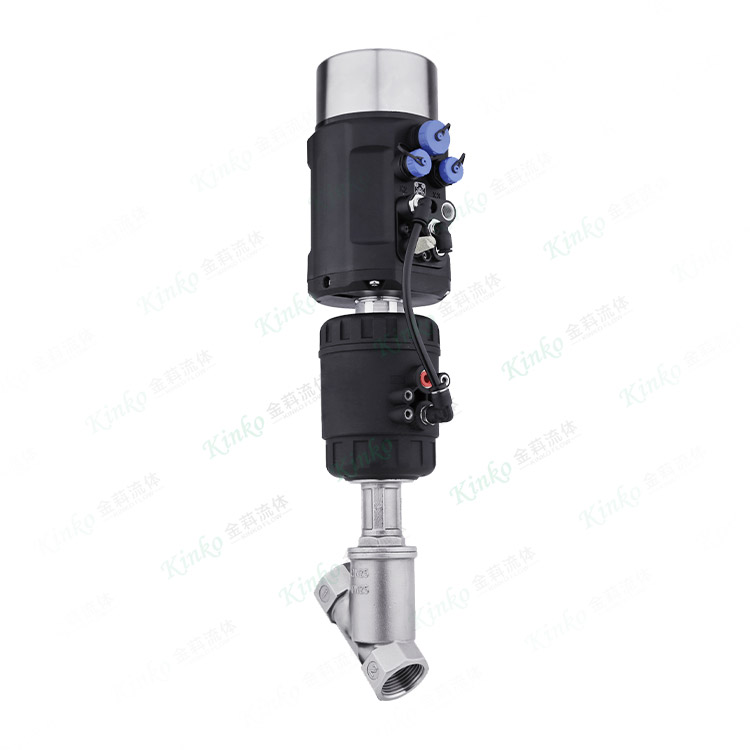
Kinko option: Soft‑closing angle seat valves available for water hammer‑prone applications.
8. Pressure and Cycle Life Relationship
Higher pressure = shorter seal life. Below is typical data for Kinko angle seat valves (PTFE seal, water media, 25°C).
| Media Pressure | Expected Cycle Life (millions) |
|---|---|
| 2 – 5 bar | 4 – 5 million |
| 5 – 10 bar | 2 – 3 million |
| 10 – 16 bar | 1 – 2 million |
For steam at 5–10 bar, cycle life is typically 1–1.5 million cycles due to thermal stress in addition to pressure.
9. Low Pressure Applications – Special Considerations
Below 1 bar media pressure, PTFE seals may not seal perfectly because they rely on pressure to deform and fill gaps.
| Media Pressure | Solution |
|---|---|
| 0.5 – 1 bar | Standard PTFE usually works |
| 0.2 – 0.5 bar | Use softer seal (EPDM or FKM) |
| <0.2 bar | Consider different valve type (diaphragm valve) |
Kinko note: For vacuum or very low pressure applications, please consult us — standard angle seat valves are not designed for vacuum service.
10. Pressure Selection Quick Reference
| Application | Media Pressure | Control Pressure | Recommended Valve |
|---|---|---|---|
| Water fill (low pressure) | 2–4 bar | 5 bar | NC, SS304, PTFE |
| Industrial water (medium) | 5–8 bar | 6 bar | NC, SS304, PTFE |
| High pressure water | 10–16 bar | 7–8 bar | NC, SS304/316L, PTFE |
| Steam (low) | 2–5 bar | 5–6 bar | NC, SS316L, PTFE, remote pilot |
| Steam (high) | 8–10 bar | 6–7 bar | NC, SS316L, PTFE, heat shield |
| Compressed air | 6–8 bar | 5–6 bar | NC, SS304, PTFE, lubricated |
| Oil line | 5–10 bar | 6 bar | NC, SS304, NBR or FKM |
11. Common Pressure‑Related Mistakes
| Mistake | Consequence | Correct Action |
|---|---|---|
| Using valve above max pressure rating | Body or seal failure | Check datasheet, stay within rating |
| Control pressure too low | Valve fails to open/close fully | Maintain 5–8 bar |
| Ignoring water hammer | Premature seal failure, pipe damage | Install soft‑close or reduce velocity |
| Using NC below 0.5 bar | Leakage | Consider softer seal or different valve |
| NO valve at high pressure | Cannot close fully | Use NC instead or increase control pressure |
12. Summary – Key Takeaways
✅ Know the difference: media pressure (fluid) vs control pressure (air)
✅ Kinko angle seat valves are rated up to 16 bar (DN10–DN50)
✅ Higher pressure = shorter seal life — plan maintenance accordingly
✅ Control pressure must be 4–8 bar (5–8 bar recommended)
✅ NC type with flow above seat is best for high pressure
✅ Water hammer can cause pressure spikes — use soft‑close option
✅ Low pressure (<1 bar) may require softer seal materials
Pressure affects everything from seal life to cycle speed. Choose wisely.
13. Need Help with Pressure Selection?
Kinko offers:
angle seat valves for pressures from 0.5 bar to 16 bar
soft‑closing options for water hammer reduction
technical support for pressure‑related applications
Contact Kinko with your pressure, media, and cycle requirements — we will recommend the right valve.
Ivan (Mobile:+86-18968769287)
WhatsApp:+86-13579991606
Wechat:+86-18968769287
Website:www.kinko-flow.com
ZHEJIANG KINKO FLUID EQUIPMENT CO.,LTD

 info@kinko-flow.com
 +86-133 5611 9006