Tel:
Tel: E-Mail:
 English
 Chinese
 한국어
한국어
 Español




News
Introduction
Selecting the wrong ball valve leads to leaks, unplanned downtime, and safety hazards. For procurement managers and engineers, the challenge is not finding a valve—it is matching the right specifications to your exact fluid, pressure, and temperature profile.
This guide breaks down the five critical decisions for industrial ball valve selection.
Step 1: Determine the Valve Body Configuration
Choose between 1-piece, 2-piece, or 3-piece designs.
| Body Type | Best Use Case | Maintenance |
|---|---|---|
| 1-piece | Low-pressure water/air, disposable lines | None (replace only) |
| 2-piece | General industrial, oil, gas, steam | Field repairable |
| 3-piece | Sanitary, corrosive fluids, frequent cleaning | Full access without removing pipe |
Kinko recommendation: For 80% of industrial applications, a 2-piece ball valve offers the best balance of cost and serviceability.
Step 2: Select the Correct Port Size
Port size directly affects flow rate and pressure drop.
Standard Port (Reduced Bore): Valve bore is one pipe size smaller (e.g., 2" valve has 1.5" bore). Lower cost, higher pressure drop. Acceptable for gases and low-viscosity liquids.
Full Port (Full Bore): Valve bore equals pipe inner diameter. Zero flow restriction, easier pigging, higher cost. Required for slurries, viscous fluids, and high-flow systems.
Rule of thumb: If your fluid contains solids or you cannot afford pressure loss, specify full port.
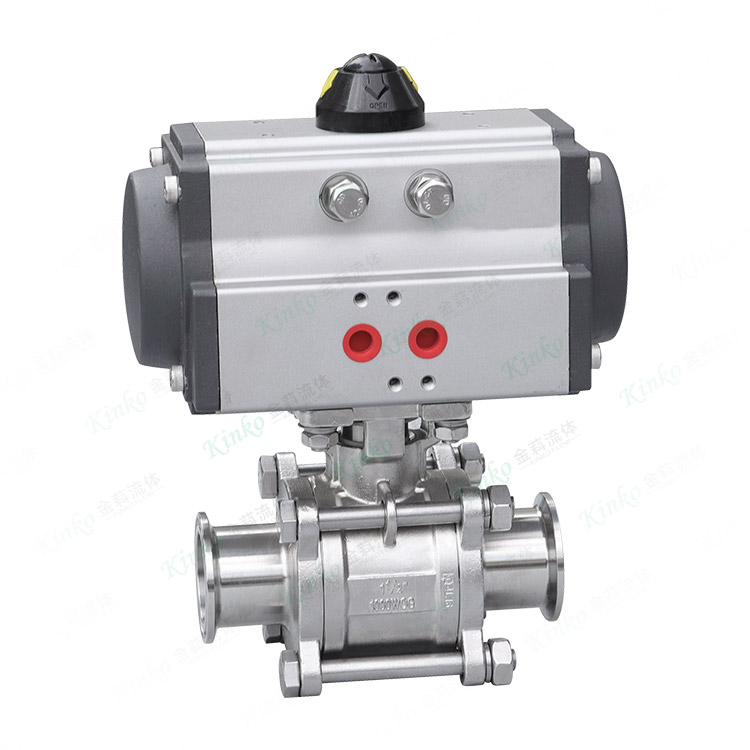
Step 3: Match Material to Fluid Compatibility
This is the #1 cause of valve failure. Use the table below.
| Material | Fluid Compatibility | Limitation |
|---|---|---|
| Brass | Water, air, oil, LPG | No saltwater, no acidic chemicals |
| CF8 (304 SS) | Mild chemicals, food, beer, oil | Limited chloride resistance |
| CF8M (316 SS) | Saltwater, bleach, acetic acid, marine | Higher cost |
| WCB (Carbon Steel) | Steam, natural gas, fuel oil | Rusts in water service |
Critical note: Never use brass with ammonia or 316 SS with concentrated hydrochloric acid.
Step 4: Verify Pressure & Temperature Ratings
Check two numbers on the valve tag:
WOG (Water, Oil, Gas): Maximum cold working pressure (e.g., 1000 PSI).
SWP (Steam Working Pressure): Maximum saturated steam pressure.
Example: A valve rated 1000 WOG / 150 SWP means:
1000 PSI max for cold water/oil/gas
150 PSI max for steam (higher temperature reduces strength)
Temperature limits by seat material:
| Seat Material | Max Temp | Best For |
|---|---|---|
| PTFE (standard) | 230°C (446°F) | General purpose |
| PEEK | 260°C (500°F) | High-temp, aggressive chemicals |
| Delrin | 80°C (176°F) | Low-cost water service |
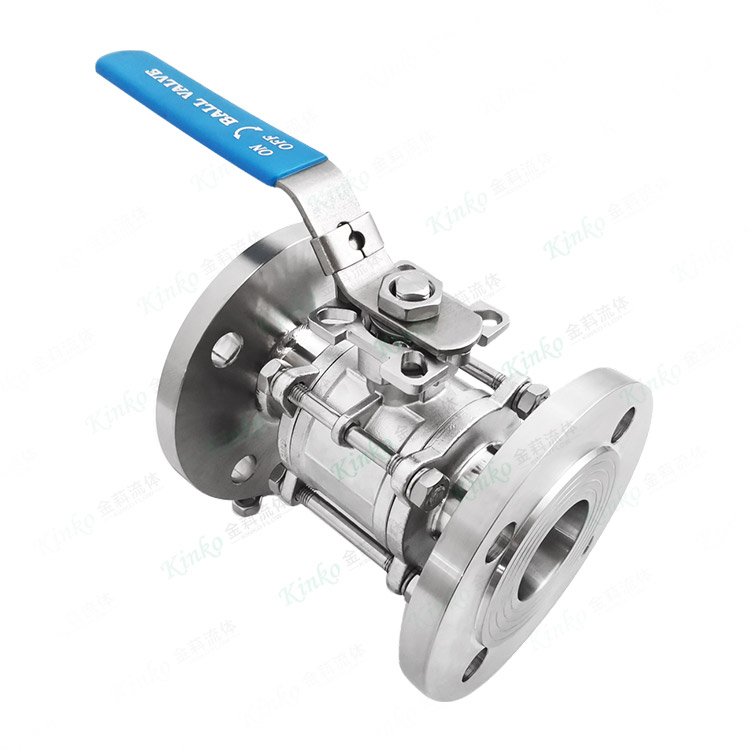
Step 5: Choose End Connections
| Connection | Pros | Cons |
|---|---|---|
| Threaded (NPT/BSP) | Low cost, easy install | Sealing tape required |
| Socket Weld | Leak-proof, permanent | Cannot remove |
| Flanged | Easy removal, high pressure | Expensive, heavy |
| Tri-clamp | Sanitary, quick open | Limited to food/pharma |
B2B tip: For threaded valves, specify NPT for North America or BSP for Asia/Europe. Mixing thread standards guarantees leakage.
Quick Selection Table by Application
| Application | Body | Port | Material | Seat |
|---|---|---|---|---|
| Compressed air line | 1-piece | Standard | Brass | PTFE |
| Chemical transfer pump | 2-piece | Full | 316 SS | PTFE |
| Low-pressure steam | 2-piece | Standard | Carbon steel | PTFE |
| Sanitary food line | 3-piece | Full | 316 SS | PTFE |
| Saltwater cooling | 2-piece | Full | 316 SS | PTFE |
| High-temp oil (200°C) | 2-piece | Full | 316 SS | PEEK |
Procurement Checklist (Copy for your RFQ)
Send this checklist to Kinko with your inquiry:
Valve size: _____ inch/mm
Body configuration: 1-piece / 2-piece / 3-piece
Port type: Standard / Full
Body material: Brass / CF8 / CF8M / WCB
Pressure required: _____ PSI or bar
Fluid temperature: _____ °C / °F
Fluid type: _____ (water / steam / chemical / gas)
End connection: Threaded / Socket weld / Flanged
Thread standard (if applicable): NPT / BSP
Conclusion
Choosing the right ball valve requires answering five questions: body type, port size, material, pressure rating, and end connection. Start with the fluid chemistry, then match pressure and temperature. For most industrial applications, a 2-piece, 316 stainless steel, full port, PTFE-seated ball valve provides the widest safety margin.
Kinko stocks the full range:
1-piece brass valves (1/4" to 2", 600 WOG)
2-piece 316/304 stainless valves (1/2" to 4", 1000-2000 WOG)
2-piece carbon steel valves (steam service, 150 SWP)
Full port and standard port options
NPT and BSP threads available
Send your RFQ with the checklist above for a same-day quotation.
Ivan (Mobile:+86-18968769287)
WhatsApp:+86-13579991606
Wechat:+86-18968769287
Website:www.kinko-flow.com
ZHEJIANG KINKO FLUID EQUIPMENT CO.,LTD

 info@kinko-flow.com
 +86-133 5611 9006