Tel:
Tel: E-Mail:
 English
 Chinese
 한국어
한국어
 Español




News
Introduction
Corrosive fluids destroy standard valves. Brass dezincifies. Carbon steel rusts. For systems handling saltwater, acids, bleach, or chemical blends, stainless steel ball valves are the only reliable choice.
This post explains the specific benefits of stainless steel (304 and 316) in corrosive applications, provides a chemical resistance comparison, and helps B2B buyers justify the higher upfront cost.
Why Corrosion Destroys Other Valve Materials
Brass valves:
Zinc leaches out in water with high chlorine or low pH.
Result: Porous, brittle body – sudden failure.
Carbon steel valves:
Iron oxide (rust) forms in moist or acidic environments.
Result: Seized stems, leaking seals, thread galling.
Stainless steel valves:
Chromium oxide passive layer self-repairs when scratched.
Result: Decades of service without degradation.
304 vs 316 Stainless Steel: Which One Do You Need?
Both grades resist corrosion, but they serve different applications.
| Parameter | 304 Stainless (CF8) | 316 Stainless (CF8M) |
|---|---|---|
| Key alloying element | 18% Chromium, 8% Nickel | 16% Chromium, 10% Nickel, 2% Molybdenum |
| Chloride resistance | Poor above 50°C | Excellent (up to 1000 ppm) |
| Pitting resistance | Low | High (due to molybdenum) |
| Acid resistance | Limited (mild acetic) | Good (dilute sulfuric, phosphoric) |
| Cost factor | 1x (baseline) | 1.3x – 1.5x |
| Typical applications | Fresh water, food, beer, oil, air | Saltwater, bleach, swimming pool chemicals, marine |
Kinko rule: When in doubt, specify 316. The cost premium is small relative to downtime from a failed 304 valve.
Chemical Resistance Comparison Table
| Fluid | Concentration | Temp | Brass | 304 SS | 316 SS |
|---|---|---|---|---|---|
| Saltwater (NaCl) | 3.5% | Ambient | No | Marginal | Yes |
| Sodium hypochlorite (bleach) | 10% | Ambient | No | No | Yes |
| Hydrochloric acid | 5% | Ambient | No | No | Marginal* |
| Sulfuric acid | 10% | Ambient | No | No | Yes |
| Acetic acid | 50% | 50°C | No | Yes | Yes |
| Ammonia | Anhydrous | Ambient | No (cracks) | Yes | Yes |
| Deionized water | 100% | 80°C | No | Yes | Yes |
| Chlorinated water (pool) | 3 ppm | 40°C | No | Marginal | Yes |
*316 SS has limited life in hydrochloric acid. For HCl, consider Hastelloy or lined valves.
Five Operational Benefits of Stainless Steel Ball Valves
1. Zero Rust Contamination
No red water or fluid discoloration.
Critical for food, pharmaceutical, and semiconductor industries.
2. High Temperature Tolerance
316 SS maintains strength up to 450°C (body).
PTFE seats limit service to 230°C – upgrade to PEEK for higher.
3. Longer Cycle Life in Aggressive Media
Brass valves in saltwater: 6-12 months.
316 SS valves in same service: 10+ years.
4. Lower Total Cost of Ownership (TCO)
Higher purchase price vs. brass: +100-200%.
Replacement interval: 10x longer.
Result: 70% lower TCO over 10 years.
5. Hygienic and Cleanable
Smooth surface resists biofilm.
Compatible with CIP (clean-in-place) chemicals.
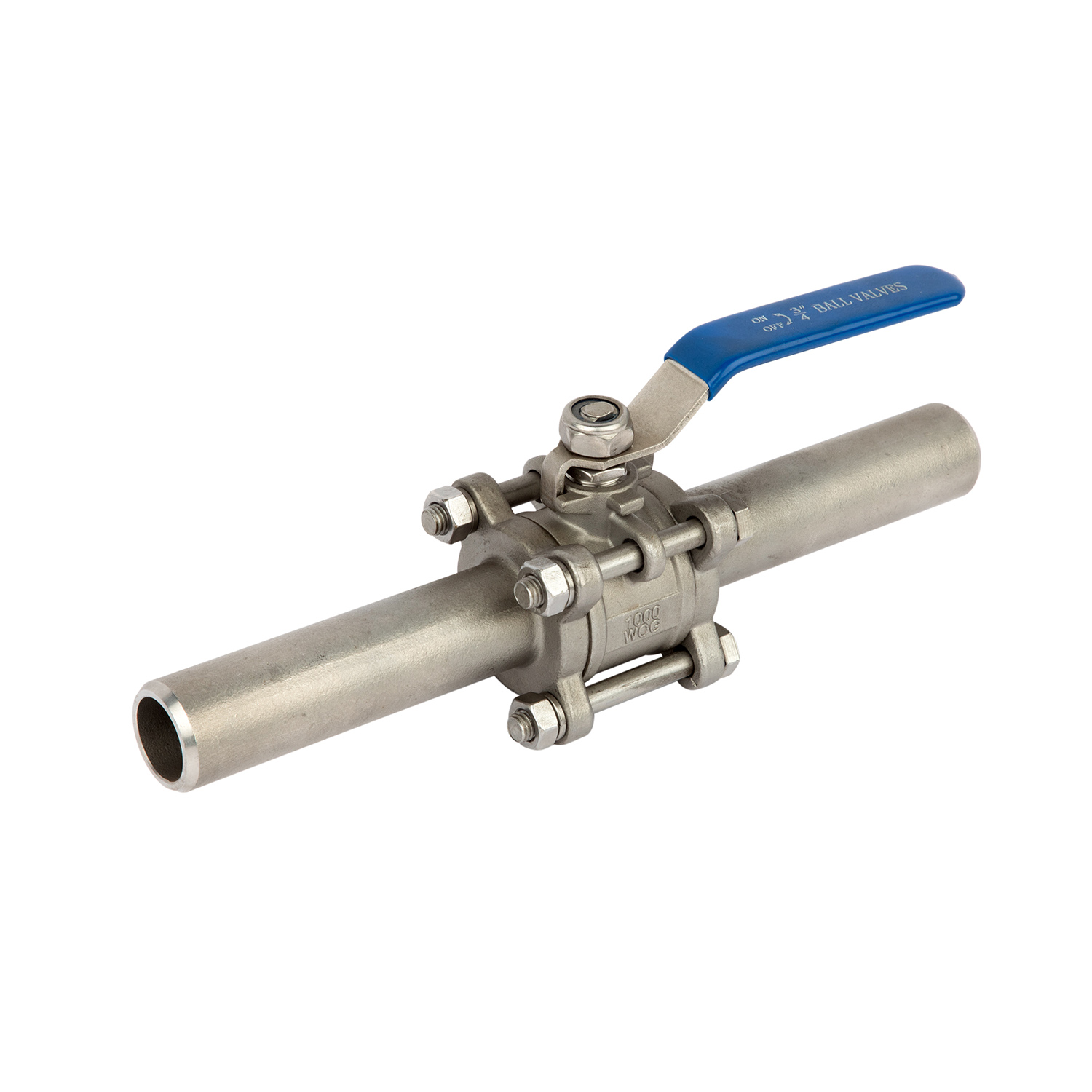
Technical Specifications Table (Kinko 2-Piece 316 SS Valve)
| Parameter | Value |
|---|---|
| Body material | CF8M (316 stainless steel) |
| Ball material | 316 stainless steel |
| Stem material | 316 stainless steel |
| Seat material | PTFE (standard) / PEEK (optional) |
| Pressure rating | 1000 PSI WOG (1/2" to 2") |
| Temperature range | -20°C to 230°C (PTFE seats) |
| End connections | Threaded NPT / BSP or Socket Weld |
| Port options | Full port or standard port |
| Blowout-proof stem | Yes |
| Anti-static device | Optional (for explosive environments) |
| Sizes available | 1/4" to 4" |
When NOT to Use Stainless Steel Ball Valves
Stainless steel is not universal. Avoid in these cases:
| Environment | Better Alternative |
|---|---|
| Concentrated hydrochloric acid (>15%) | PTFE-lined ball valve |
| High-temperature sulfuric acid (>80°C, >70%) | Alloy 20 or Hastelloy |
| Dry chlorine gas (above 150°C) | Monel |
| High-pressure steam (>250 PSI) | Carbon steel with Stellite seats |
| Extreme low temperature (-196°C) | 304 SS (austenitic retains impact strength) |
Procurement Guide: Ordering Stainless Steel Ball Valves
When requesting a quote from Kinko, specify:
Grade: 304 SS / 316 SS
Size: _____ inch
Port: Standard / Full
Connection: NPT / BSP / Socket weld
Temperature: _____ °C
Fluid: _____ (to confirm compatibility)
Optional features: Lockable handle / Anti-static / PEEK seats
Cost Comparison (B2B Buyer Analysis)
| Valve type | Unit cost (2", full port) | Expected life (saltwater service) | Annualized cost |
|---|---|---|---|
| Brass | $18 | 6 months | $36/year |
| Carbon steel (coated) | $45 | 12 months | $45/year |
| 304 SS | $65 | 5 years | $13/year |
| 316 SS | $85 | 10+ years | $8.50/year |
Conclusion: 316 SS pays for itself in under two years in corrosive service.
Conclusion
For any system handling saltwater, bleach, dilute acids, or chlorinated fluids, 316 stainless steel ball valves deliver the lowest long-term cost and highest reliability. 304 SS is adequate for fresh water, mild chemicals, and food service. Brass and carbon steel should never be used in corrosive environments.
Kinko offers:
CF8M (316) ball valves – full stock, 1/4" to 4"
CF8 (304) ball valves – economical alternative for non-chloride service
Fast quotation with chemical compatibility verification
Bulk pricing for OEM and maintenance contracts
Contact Kinko with your fluid analysis for a material recommendation.
Ivan (Mobile:+86-18968769287)
WhatsApp:+86-13579991606
Wechat:+86-18968769287
Website: www.kinko-flow.com
ZHEJIANG KINKO FLUID EQUIPMENT CO.,LTD

 info@kinko-flow.com
 +86-133 5611 9006