Tel:
Tel: E-Mail:
 English
 Chinese
 한국어
한국어
 Español




News
Introduction
Threaded ball valves are the most widely purchased valve type in the world. They install quickly, require no welding, and work reliably for thousands of applications. But small mistakes—wrong thread standard, incorrect sealant, or mismatched pressure rating—cause leaks and failures.
This complete buyer’s guide covers everything procurement managers and engineers need to specify, order, and install threaded ball valves correctly.
What Is a Threaded Ball Valve?
A threaded ball valve has female or male threads machined into its ends, allowing it to screw directly onto pipe nipples or fittings. Sizes typically range from 1/4" to 4".
Common applications:
Instrumentation lines
Compressed air systems
Low to medium pressure water lines
Chemical transfer (with compatible materials)
Gas and LPG service (brass or carbon steel)
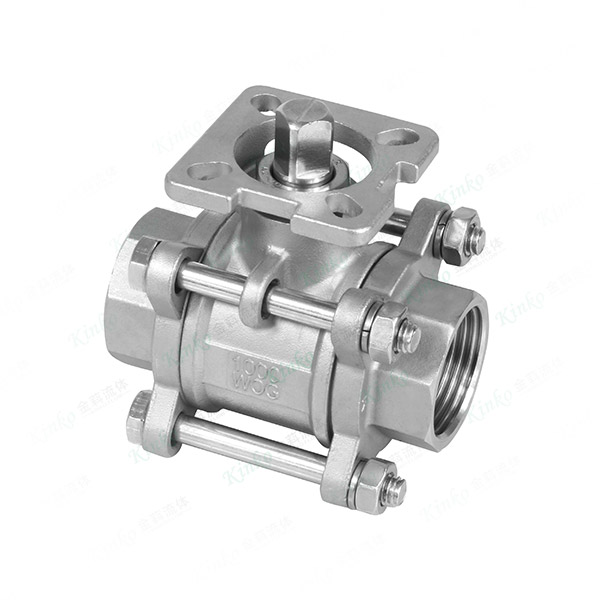
Thread Standards: NPT vs BSP – The #1 Problem
Mixing thread standards is the most common procurement error. NPT and BSP look similar but are not compatible.
| Parameter | NPT (National Pipe Taper) | BSP (British Standard Pipe) |
|---|---|---|
| Standard region | North America | Asia, Europe, Australia, Middle East |
| Thread angle | 60° | 55° |
| Sealing mechanism | Thread interference (taper-on-taper) | Metal-to-metal at crests + washer or sealant |
| Pressure rating | Generally higher | Moderate |
| Common confusion point | Looks similar to BSP above 1" | Looks similar to NPT above 1" |
Kinko recommendation: Verify thread standard before ordering. Mixing NPT and BSP guarantees leakage, even with tape.
Quick identification guide:
Measure 10 threads on the male fitting.
For 1" pipe, NPT = 11.5 threads per inch. BSP = 11 threads per inch.
Or use a thread gauge.
Threaded Connection Types (End Configurations)
| Configuration | Symbol | Best for |
|---|---|---|
| Female-Female | F-F | Standard pipeline installation |
| Male-Male | M-M | Direct connection to equipment ports |
| Female-Male | F-M | Transition or repair applications |
| Female x Socket weld | Mixed | High-temperature systems |
| Female x Flanged | Mixed | Large valves or frequent removal |
Procurement note: Most standard ball valves come F-F (female NPT or BSP). Specify M-M or mixed ends as a special order.
Thread Sealing Methods (Critical for Leak-Free Service)
Threaded connections do not seal on the threads themselves—they seal on the sealant.
| Method | Best for | Pressure limit | Reusability |
|---|---|---|---|
| PTFE tape (white) | Water, air, oil | 5000 PSI | No (retape each time) |
| PTFE tape (yellow) | Gas, LPG (thicker) | 3000 PSI | No |
| Pipe dope (paste) | Large diameters, high vibration | 10000+ PSI | No |
| PTFE thread seal cord | Chemical service, high temp | 6000 PSI | No |
| Anaerobic sealant (Loctite) | Hydraulic, permanent | Very high | No |
Sealant rules:
Never use tape on BSP parallel threads (requires bonded washer or O-ring).
For gas service, use yellow gas-rated tape or approved pipe dope.
Over-wrap causes cross-threading – apply 2-3 wraps only, followed by pipe dope.
Material Options for Threaded Ball Valves
| Material | Pressure rating (WOG) | Best applications | Limitations |
|---|---|---|---|
| Brass | 600 - 1000 PSI | Water, air, fuel oil, LPG | No saltwater, no acids |
| 304 SS (CF8) | 1000 - 2000 PSI | Food, beverage, mild chemicals | Limited chloride resistance |
| 316 SS (CF8M) | 1000 - 2000 PSI | Saltwater, bleach, marine, acids | Higher cost |
| Carbon steel (WCB) | 2000+ PSI | Steam, natural gas, hydraulic oil | Rusts in water service |
Pressure Ratings Explained (WOG, WSP, CWP)
Threaded ball valves typically carry three ratings:
| Rating | Meaning | Example |
|---|---|---|
| WOG (Water, Oil, Gas) | Maximum cold pressure | 1000 PSI at -20°C to 38°C |
| WSP (Working Steam Pressure) | Maximum steam pressure | 150 PSI at 185°C |
| CWP (Cold Working Pressure) | Same as WOG | 1000 PSI |
Important: Pressure rating decreases as temperature increases. A 1000 PSI WOG valve may only handle 600 PSI at 120°C.
Threaded vs Welded vs Flanged – When to Choose Threaded
| Connection type | Install time | Removal | Best for |
|---|---|---|---|
| Threaded | 5 minutes | Yes | Small lines (≤2"), maintenance-friendly |
| Socket weld | 20 minutes | No | Permanent, high pressure, steam |
| Flanged | 30 minutes | Yes | Large lines (≥2"), frequent removal |
Rule: Use threaded for sizes up to 2 inches. Above 2 inches, flanged connections prevent over-tightening damage.
Size Table (Threaded Ball Valve Dimensions – 2-Piece, 316 SS, Full Port)
| Nominal size | F-F length (face-to-face) | Thread per inch (NPT) | Approx. weight |
|---|---|---|---|
| 1/4" | 2.17" (55mm) | 18 | 0.3 lb |
| 3/8" | 2.36" (60mm) | 18 | 0.4 lb |
| 1/2" | 2.56" (65mm) | 14 | 0.6 lb |
| 3/4" | 3.07" (78mm) | 14 | 0.9 lb |
| 1" | 3.62" (92mm) | 11.5 | 1.4 lb |
| 1-1/4" | 4.06" (103mm) | 11.5 | 2.2 lb |
| 1-1/2" | 4.53" (115mm) | 11.5 | 2.9 lb |
| 2" | 5.24" (133mm) | 11.5 | 4.3 lb |
Dimensions vary by manufacturer. Always request Kinko’s spec sheet.
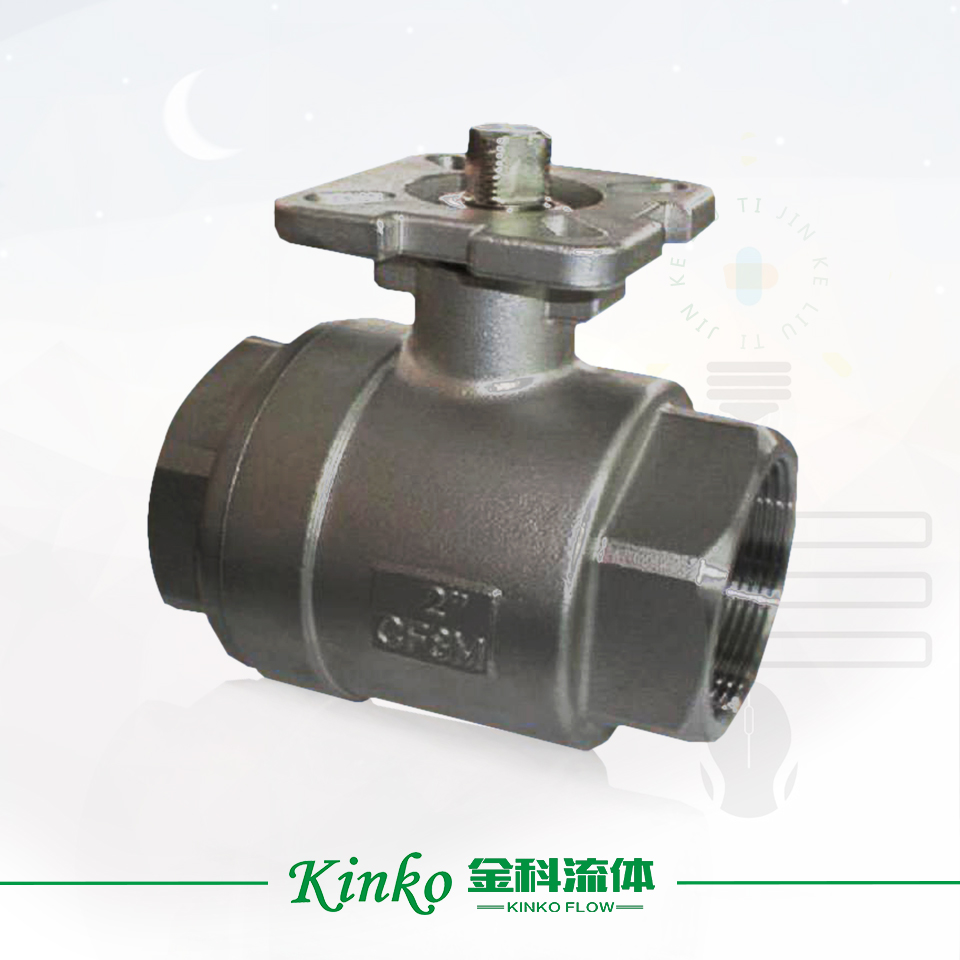
Installation Best Practices (Prevent Leaks)
Step 1 – Inspect threads
Look for burrs, damage, or debris.
Clean with a wire brush if necessary.
Step 2 – Apply sealant correctly
Tape: Wrap clockwise (as you face the end). Start at second thread, end before first.
Dope: Apply to first three threads only. Not inside the valve.
Step 3 – Hand-tighten first
Threads should engage smoothly. If resistance at 2 turns, check standard mismatch.
Step 4 – Torque properly
1/2" valve: 1 - 1.5 turns past hand-tight.
1" valve: 1.5 - 2 turns past hand-tight.
Never use pipe to extend leverage – use a wrench on the valve body only.
Step 5 – Pressure test
Slowly pressurize to 1.5x working pressure.
Check all connections with soap solution (for gas) or visual (for liquid).
Common Problems and Solutions
| Problem | Most likely cause | Solution |
|---|---|---|
| Leak at thread | Wrong sealant or cross-threading | Disassemble, reseal, or replace fitting |
| Leak at stem | Stem packing loose | Tighten packing nut 1/8 turn |
| Valve difficult to turn | Over-tightened pipe | Reduce torque, check alignment |
| Valve seizes after months | Corrosion (wrong material) | Upgrade to 316 SS |
| Threads gall (stick) | Similar materials on both sides | Use anti-seize compound |
Procurement Checklist for Threaded Ball Valves
Copy this checklist into your RFQ to Kinko:
Size: _____ inch
Thread standard: NPT / BSP / Other: _____
End configuration: F-F / M-M / F-M / Mixed: _____
Body material: Brass / 304 SS / 316 SS / Carbon steel
Port type: Standard / Full
Pressure required: _____ PSI
Temperature: _____ °C / °F
Fluid type: _____
Seat material: PTFE / PEEK / Other: _____
Quantity: _____ pieces
Need lockable handle? Yes / No
Cost Factors for Threaded Ball Valves (B2B Procurement)
| Factor | Impact on price |
|---|---|
| Material | 316 SS > 304 SS > Carbon steel > Brass |
| Port type | Full port + 15-25% |
| Size | 2" costs ~8x more than 1/2" |
| Thread standard | NPT and BSP same price (tooling dependent) |
| Quantity | 100+ pieces = 20-30% discount |
| Special threads (e.g., metric) | +30-50% |
Conclusion
Threaded ball valves are the workhorse of industrial piping. Select the correct thread standard (NPT or BSP), use proper sealant for your fluid, and match material to your environment. For most industrial applications, a 2-piece, 316 stainless steel, full port, F-F NPT threaded ball valve with PTFE seats provides the widest safety margin and lowest TCO.
Kinko’s threaded ball valve inventory includes:
Brass (600 WOG) – 1/4" to 2", NPT or BSP
304 SS (1000 WOG) – 1/4" to 3", NPT or BSP
316 SS (1000-2000 WOG) – 1/4" to 4", NPT or BSP
Carbon steel (2000 WOG) – 1/2" to 2", NPT
Full port and standard port
Lockable handle option available
Email Kinko your checklist for a same-day quote
Ivan (Mobile:+86-18968769287)
WhatsApp:+86-13579991606
Wechat:+86-18968769287
Website: www.kinko-flow.com
ZHEJIANG KINKO FLUID EQUIPMENT CO.,LTD

 info@kinko-flow.com
 +86-133 5611 9006