Tel:
Tel: E-Mail:
 English
 Chinese
 한국어
한국어
 Español




News
YTC Product Line Overview: Matching the Model to the Application
YTC categorizes its positioners primarily by pneumatic output and input signal type. Understanding the nomenclature is critical for B2B purchasing.
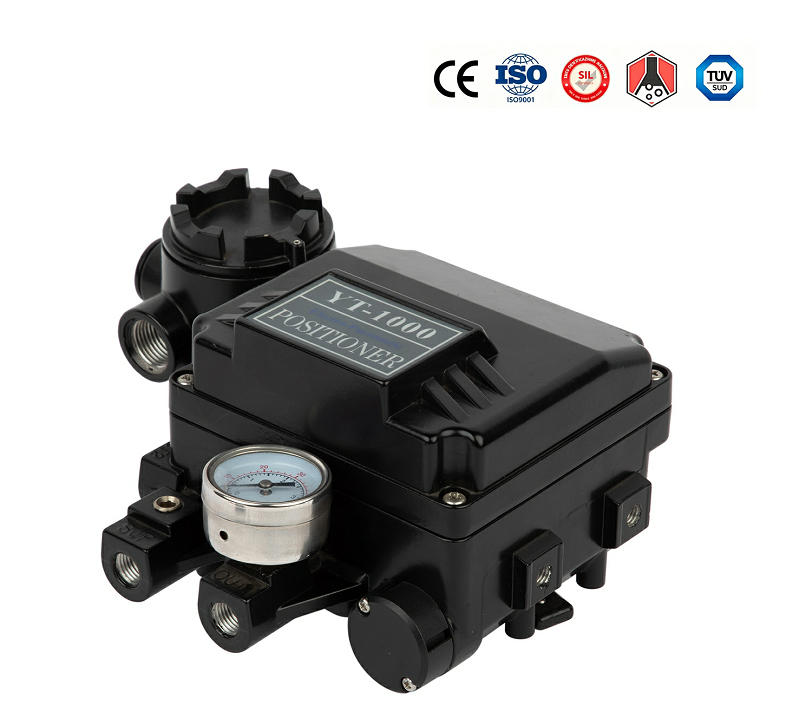
YT-1000 Series (Analog Workhorse): The most widely installed series globally. Converts a 4-20mA DC signal into pneumatic output. Known for exceptional vibration resistance and simple cam adjustment. Best for: General process control in chemical plants, paper mills, and power generation. Stroke: 10~150mm (Linear) / 0~90° (Rotary).
YT-3300 Series (Smart HART): For plants utilizing HART protocol. Allows remote monitoring, diagnostics, and configuration via handheld communicator or DCS. Features lower air consumption than analog models. Best for: Critical control loops requiring predictive maintenance. Protocol: HART 7.0. Diagnostics: Valve signature analysis, friction calculation.
YT-1200 Series (Compact): Designed specifically for small bore and rack-and-pinion actuators. Lightweight, features built-in pressure gauge manifold, easy to mount. Best for: OEM skid packages and compact valve assemblies.
YT-2500 / YT-2600 (Intrinsically Safe & Explosion Proof): For oil & gas and petrochemical applications. Ex ia IIC T6 and Ex d IIC T6 certified models ensure reliable operation in Zone 0 and Zone 1 hazardous areas.
Technical Specifications & Comparison Table
For procurement engineers, the datasheet is law. Below is a comparative table of the flagship models. Use this to filter your selection based on supply voltage, air consumption, and environmental limits.
| Specification | YT-1000 (Analog) | YT-1200 (Compact) | YT-3300 (Smart HART) | YT-2500 (Ex-proof) |
|---|---|---|---|---|
| Input Signal | 4-20mA DC | 4-20mA DC | 4-20mA DC (HART) | 4-20mA DC |
| Supply Pressure | 1.4~7.0 kgf/cm² | 1.4~7.0 kgf/cm² | 1.4~7.0 kgf/cm² | 1.4~7.0 kgf/cm² |
| Stroke Range | 10~150mm / 0~90° | 10~40mm / 0~90° | 10~150mm / 0~90° | 10~150mm / 0~90° |
| Air Consumption | ≤ 3 L/min | ≤ 2 L/min | ≤ 0.5 L/min | ≤ 3 L/min |
| Linearity | ±1.0% F.S. | ±1.0% F.S. | ±0.5% F.S. | ±1.0% F.S. |
| Hysteresis | ±0.5% F.S. | ±0.5% F.S. | ±0.3% F.S. | ±0.5% F.S. |
| Sensitivity | ±0.2% F.S. | ±0.2% F.S. | ±0.1% F.S. | ±0.2% F.S. |
| Ex Classification | Ex nA / Ex d (Opt) | Ex nA | Ex ia IIC T6 | Ex d IIC T6 / Ex ia |
| Ambient Temp | -30°C to +85°C | -20°C to +80°C | -30°C to +80°C | -40°C to +85°C |
| Output Pressure | 0~10 kgf/cm² | 0~10 kgf/cm² | 0~10 kgf/cm² | 0~10 kgf/cm² |
Calibration Procedure (Zero & Span)
While the YT-3300 allows for auto-calibration via a communicator, the YT-1000 requires mechanical setup.
Tools Required: 4-20mA signal generator, Digital Multi-meter, Hex wrenches.
Input Signal (Zero): Supply a 4mA signal. Adjust the "Zero" screw until the valve just begins to move, then back it off slightly to the mechanical stop.
Input Signal (Span): Supply a 20mA signal. Adjust the "Span" screw so the valve reaches 100% stroke exactly at 20mA.
Feedback Linkage: Ensure the feedback lever arm is at a 90° angle to the actuator shaft at 50% stroke (12mA) for best linearity.
Verification: Ramp the signal 4mA → 20mA → 4mA. Check the 12mA mid-point (should be 50%). Repeat Zero and Span until linearity is achieved.
How Valve Positioners Improve Control Accuracy
Without a positioner, a spring-and-diaphragm actuator is an open-loop system. Friction in the packing, fluctuating supply pressure, and dynamic fluid forces introduce positional errors. The YTC positioner eliminates these through a continuous closed-loop feedback system.
The Feedback Loop Physics:
DCS sends a 4-20mA target signal.
Feedback lever reports actual valve position.
Positioner compares target vs. actual (error detection).
Pilot valve increases or decreases output pressure until error = zero.
This correction happens millions of times per day, compensating for packing friction, differential pressure changes, and supply pressure drops.
Accuracy Metrics Explained:
| Metric | YT-1000 Spec | Real-World Impact |
|---|---|---|
| Linearity | ±1.0% | Max deviation of 1.5mm on a 150mm stroke |
| Hysteresis | ±0.5% | Same position regardless of approach direction |
| Sensitivity | ±0.2% | Responds to just 0.032mA change |
YT-3300 Smart Advantage: Adds auto-calibration, friction compensation (dither signal), and dynamic gain control—pushing accuracy beyond ±0.5% with predictive diagnostics.
Troubleshooting Accuracy Issues:
| Symptom | Root Cause | Fix |
|---|---|---|
| Poor linearity | Incorrect cam or feedback lever angle | Reinstall lever at 90° at 50% stroke |
| Excessive hysteresis | Loose mechanical connections | Tighten all coupling bolts |
| Slow response | Blocked pilot nozzle or low supply pressure | Clean nozzle; increase supply to 7.0 kgf/cm² |
| Hunting (oscillation) | Gain too high | Reduce gain or increase deadband |
Types of Valve Positioners and Their Applications
Selecting the right positioner depends on your control loop requirements, environment, communication infrastructure, and budget.
Pneumatic Positioners (Analog Air-to-Air):
Accept a 3-15 psi pneumatic input signal. No electricity required. Intrinsically safe by design. Robust and reliable in harsh environments. Ideal for: Remote wellhead control, water treatment, offshore platforms, and explosive dust environments.
Electro-Pneumatic Positioners (Analog 4-20mA):
Convert 4-20mA DC signal to pneumatic output. Industry standard interface. Good accuracy (±1.0%) at moderate cost. Available with explosion-proof certifications. Ideal for: Chemical processing, power generation, pulp & paper, and general-purpose control loops. YTC Equivalent: YT-1000 Series.
Smart/Digital Positioners with HART:
Microprocessor-based devices with HART digital overlay on 4-20mA. Superior accuracy (±0.5%). Auto-calibration, remote diagnostics, valve signature analysis, predictive maintenance alerts. Lower air consumption. Ideal for: Refining, petrochemical, LNG, nuclear power, and large chemical complexes with asset management systems. YTC Equivalent: YT-3300 Series.
Foundation Fieldbus / Profibus Positioners:
Fully digital communication (eliminates analog 4-20mA). Multi-drop capability (up to 32 devices per segment). Rich diagnostic data and integrated PID function blocks. Ideal for: LNG terminals, mega-scale chemical facilities, offshore platforms, and greenfield digital plants. YTC Equivalent: YT-3400 (FF) / YT-3500 (Profibus PA).
Application Selection Quick Guide:
| Facility Type | Recommended Positioner | Rationale |
|---|---|---|
| Brownfield refinery (analog) | YT-1000 | Direct replacement; minimal wiring changes |
| Greenfield chemical plant | YT-3300 Smart HART | Future-proof; predictive maintenance |
| Sour gas / high H₂S | YT-2500 Ex-proof | Ex d IIC T6 certification required |
| High-vibration compressor | YT-1000 with heavy bracket | Analog units tolerate vibration better |
| Water treatment (small bore) | YT-1200 Compact | Space-constrained; simple and cost-effective |
Installation Best Practices & Commissioning Checklist
Pre-Installation Verification:
Confirm model, Ex rating, and port size against purchase order.
Verify actuator compatibility (output flow capacity).
Check ambient temperature rating for site conditions.
Test instrument air quality (must meet ISO 8573-1 Class 3).
Mechanical Mounting (Critical for Linearity):
For linear actuators: Feedback lever must be at 90° to actuator stem at 50% stroke.
For rotary actuators: Connecting rod must be parallel to actuator body at 50% travel.
Mounting bracket must be rigid (steel or stainless steel). Use thread-locking compound on bolts.
Pneumatic Plumbing Rules:
Install an Air Filter Regulator (AFR) immediately upstream (within 30cm).
Purge supply lines for 30 seconds before connecting to positioner.
Use PTFE tape sparingly—leave first two threads bare to prevent sealant ingress.
Electrical Wiring:
Use twisted-pair shielded cable. Ground shield only at DCS end.
Verify loop voltage: 8-30V DC (YT-1000) / 10-32V DC (YT-3300).
For HART: Ensure loop resistance of 230-600Ω for communication.
Commissioning Sequence:
Pneumatic startup: Apply air supply (no electrical signal). Check for leaks at OUT and EXH ports.
Signal verification: Apply 4mA. Valve should move to zero position. If wrong direction, switch Direct/Reverse action.
Auto-calibration (YT-3300): Use HART communicator to run "Auto Stroke Calibration." Verify at 4mA, 12mA, 20mA.
Manual calibration (YT-1000): Adjust Zero (4mA) and Span (20mA) screws iteratively until 12mA = 50% stroke.
Common Installation Mistakes to Avoid:
| Mistake | Consequence | Prevention |
|---|---|---|
| Feedback lever not at 90° at mid-stroke | Non-linear response | Set at 12mA before tightening |
| No AFR installed | I/P nozzle clogged with debris | Install AFR within 30cm upstream |
| Shield grounded at both ends | Ground loops / erratic signal | Ground shield only at DCS end |
| Insufficient loop voltage | Positioner won't initialize | Verify 10-32V DC at terminals |
Maintenance Schedule for Longevity
To maximize MTBF (Mean Time Between Failures), follow this schedule:
Monthly: Check air filter regulator for moisture and debris. Drain water trap.
Quarterly: Inspect I/P converter nozzle and flapper for dust. Clean with isopropyl alcohol.
Annually: Perform full re-calibration (Zero/Span) to account for mechanical wear in valve linkage.
For YT-3300: Run "Valve Signature" test quarterly via HART to trend friction increase—early warning for packing adjustment needs.
Ivan (Mobile:+86-18968769287)
WhatsApp:+86-13579991606
Wechat:+86-18968769287
Website:www.kinko-flow.com
ZHEJIANG KINKO FLUID EQUIPMENT CO.,LTD

 info@kinko-flow.com
 +86-133 5611 9006