Tel:
Tel: E-Mail:
 English
 Chinese
 한국어
한국어
 Español




News
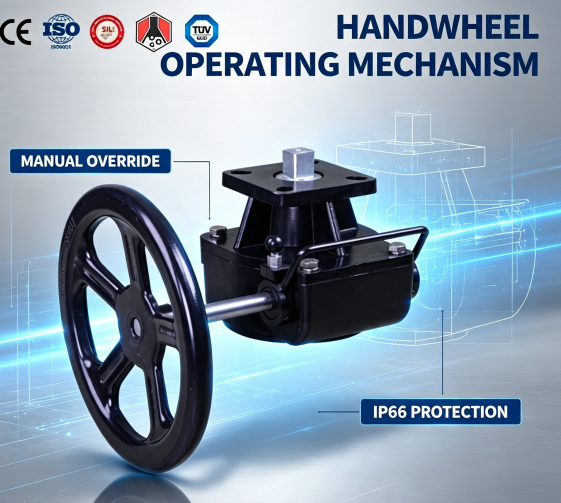
What Is a Manual Override?
A manual override is a mechanical device—typically a handwheel, hex key, or lever—that allows operators to manually open, close, or position a valve without compressed air or electrical signals. It provides direct mechanical intervention when automated control is unavailable.
Top Reasons to Add a Manual Override
Air supply failure – compressors trip, pipes leak, or freeze-ups occur; manual override keeps the valve operable.
Control signal loss – when 4–20mA or digital communication drops, manual operation bridges the gap.
Emergency isolation – in fires, gas leaks, or overpressure events, immediate manual closure saves lives and equipment.
Commissioning and loop-check – stroking the valve manually verifies travel, seating, and linkage during startup.
Maintenance and repair – safely close the valve without de-pressurizing the line when replacing positioners or solenoids.
Lockout/tagout compliance – manual override with a padlockable feature supports OSHA and site safety procedures.
Common Manual Override Types
| Type | Best For |
|---|---|
| Handwheel (direct or geared) | Frequent manual operation, precise positioning |
| Hex key / Allen key | Compact, low-cost, tool-operated backup |
| Lever handle | Fast open/close, visual position indication |
| Remote pull-cable | Hazardous or hard-to-reach locations |
| Declutch mechanism | Smooth engagement/disengagement without back-driving |
Among these, the declutch handwheel is the most preferred design—it engages only when needed, disengages automatically when air returns, and supports lockout/tagout.
When Is Manual Override Mandatory?
Industry standards and codes frequently require manual override for critical valves:
API 6D / API 608 – pipeline valves must have manual operation capability
ASME B31.3 – process piping considers manual access in valve placement
IEC 61511 (SIS) – safety instrumented functions often mandate independent manual shutdown
OSHA 1910.147 – lockout/tagout requires positive mechanical means to lock valves
If your plant operates under these standards, manual override is not optional—it is compliance.
Spring-Return vs. Double-Acting – What Changes?
| Actuator Type | Manual Override Role |
|---|---|
| Spring-return (fail-safe) | Overrides spring force to open/close against it—requires geared handwheel or declutch |
| Double-acting (air-to-air) | No spring backup; manual override is the only mechanical fallback |
For spring-return actuators, the manual override must be robust enough to overcome spring force. Geared handwheels are strongly recommended.
Application Scenarios That Demand Manual Override
Manual overrides are frequently specified in:
Oil and gas – remote valve stations, emergency shutdown valves
Chemical plants – toxic or hazardous service isolation
Water and wastewater – filter backwash valves prone to air failure
Power generation – cooling water, boiler feed, steam isolation
Mining and slurry – abrasive services where positioners may fail
Food and beverage – steam-in-place (SIP) valves requiring manual verification
Pharmaceutical – WFI and pure steam valves during maintenance
Manual Override vs. Electric Actuator – Backup Philosophy
| Aspect | Pneumatic + Manual Override | Electric Actuator (e.g., KK Series) |
|---|---|---|
| Primary power | Compressed air | Electrical |
| Backup operation | Handwheel or lever | Handwheel (standard on KK) |
| Fail-safe | Spring-return | Spring-return option (KK-FS) |
| Ease of manual operation | May require high gear ratio | Lower torque = easier manual turn |
Both technologies benefit from manual override—but electric actuators on small valves require significantly less manual effort.
Common Pitfalls and Maintenance Tips
To ensure manual override works when needed:
Grease handwheel shafts and gears annually to prevent seizing
Check declutch engagement pins for sticking; apply dry lubricant
Inspect gear teeth for wear if manually operated frequently
Verify position indicator alignment after each manual use
Keep spare lockout pins in the toolbox
Regrease every 2–3 years to prevent grease hardening
Manual Override Operating Best Practices
Confirm process conditions before manual operation
Put controller in manual or bypass mode
Engage declutch mechanism per manufacturer instruction
Turn handwheel slowly—observe position indicator
Never force movement; if stuck, stop and investigate
Disengage override and return to auto mode after use
Document the operation in shift logs
Cost-Benefit Insight
| Override Type | Cost Premium | Value |
|---|---|---|
| Hex-key | +5–10% | Basic emergency stroking |
| Direct handwheel | +15–25% | Convenient continuous control |
| Geared declutch handwheel | +25–40% | Ergonomic, high-torque, safety-compliant |
| Remote pull-cable | +20–35% | Safe-distance operation in hazardous areas |
Given that unscheduled downtime often costs thousands per hour, manual override is a high-ROI specification.
Frequently Asked Questions
Q1: Can I retrofit a manual override to an existing pneumatic actuator?
Yes—retrofit kits are available, but verify housing and pinion compatibility.
Q2: Does manual override affect normal pneumatic operation?
No—when disengaged, it has zero impact on speed or torque.
Q3: What is a declutch handwheel?
A handwheel that engages/disengages without stopping the actuator, avoiding back-driving.
Q4: Is manual override needed on fail-safe actuators?
Not for fail-safe function, but highly recommended for maintenance and commissioning.
Q5: Can I lock the handwheel in position?
Yes—most declutch models include a padlock hole for LOTO compliance.
Ivan (Mobile:+86-18968769287)
WhatsApp:+86-13579991606
Wechat:+86-18968769287
Website:www.kinko-flow.com
ZHEJIANG KINKO FLUID EQUIPMENT CO.,LTD

 info@kinko-flow.com
 +86-133 5611 9006