Tel:
Tel: E-Mail:
 English
 Chinese
 한국어
한국어
 Español




News
What Is an Angle Seat Valve?
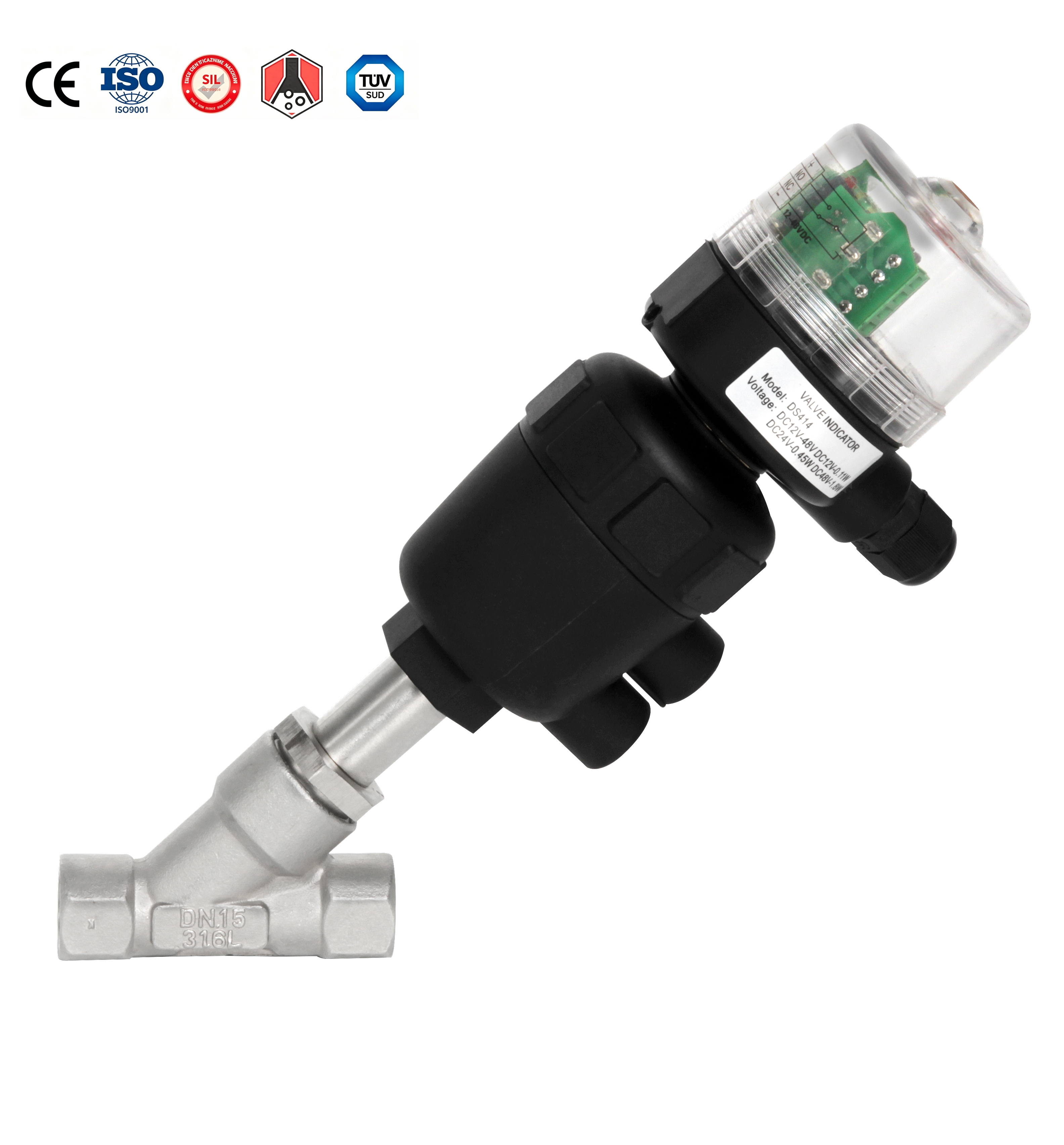
An angle seat valve is a type of shut-off or control valve with a body design that changes flow direction by 90°. The sealing element—a piston or disc—moves linearly against an angled seat, creating a tight seal with minimal turbulence.
Key design features:
Straight-through or angled body
Spring-loaded stem
Piston-style actuator (normally open or normally closed)
Self-adjusting packing gland
Available in stainless steel, brass, or PTFE-lined versions
Why Pneumatic Angle Seat Valves Excel in Fast Cycling
Pneumatically actuated angle seat valves are particularly well-suited for fast cycling because of several inherent design advantages:
| Advantage | Why It Matters for Fast Cycling |
|---|---|
| Short stroke | Linear travel is typically short (10–25mm), reducing cycle time |
| Low moving mass | Lightweight stem and disc allow rapid acceleration and deceleration |
| High actuation force | Pneumatic piston provides consistent, strong closing force against pressure |
| Self-cleaning shear action | The disc cuts through media, preventing buildup that can stick other valve types |
| No rotating stem seals | Linear movement reduces seal wear compared to quarter-turn valves |
| Simple construction | Fewer parts means less to wear or fail |
Typical Cycle Times for Pneumatic Angle Seat Valves
| Valve Size | Actuator Bore | Cycle Time (Open → Close) |
|---|---|---|
| DN15 – DN25 | 40mm piston | 0.3 – 0.8 seconds |
| DN32 – DN50 | 63mm piston | 0.5 – 1.2 seconds |
| DN65 – DN80 | 80mm piston | 0.8 – 1.8 seconds |
With proper solenoid valve and quick-exhaust fittings, cycle times can be reduced to under 0.5 seconds for small sizes—comparable to or faster than many ball valves.
Fast Cycling Performance Factors
Even with good design, actual cycle life depends on several variables:
| Factor | Impact |
|---|---|
| Media temperature | Higher temperatures soften seals and reduce life |
| Differential pressure | Higher pressure increases closing force and wear |
| Cycle frequency | Above 10–20 cycles per minute, heat buildup accelerates seal degradation |
| Media type | Abrasive or crystallizing media erodes the seat faster |
| Actuator size | Oversized actuators cause higher impact velocity and seat wear |
| Solenoid valve response | Faster solenoid valves reduce total cycle time and improve repeatability |
Angle Seat vs. Ball Valve for Fast Cycling
| Feature | Angle Seat Valve (Pneumatic) | Ball Valve (Pneumatic / Electric) |
|---|---|---|
| Cycle time | Very fast (0.3–2 sec) | Moderate (1–5 sec) |
| Stroke type | Linear (short) | Quarter-turn (90°) |
| Moving mass | Light | Heavier (ball + stem) |
| Seat wear in fast cycling | Moderate (self-compensating) | Higher (ball rubbing against seats) |
| Sealing at high temp | Good (PTFE/PEEK options) | Good but seat wear accelerates |
| Resistance to particulates | Good (shear action) | Moderate (can trap particles) |
| Maintenance frequency | Low–moderate | Moderate–high in fast cycling |
| Typical cycle life | 1–5 million cycles | 0.5–2 million cycles (fast cycling) |
For applications exceeding 10 cycles per minute, angle seat valves generally outperform ball valves in terms of seal longevity.
When Does Angle Seat Valve Performance Degrade?
Even robust angle seat valves have limits. Common failure modes in fast cycling include:
Seat wear – repeated impact gradually deforms or erodes the sealing face
Stem seal leakage – high-speed stroking wears packing or O-rings
Actuator overheating – excessive duty cycle can overheat solenoid coils or pilot valves
Spring fatigue – return spring tension weakens over millions of cycles
Water hammer – rapid closure against high velocity can damage piping and seat
To mitigate these, specify higher-grade seat materials (e.g., PEEK or reinforced PTFE), use speed-control fittings, and select actuators with appropriate cycle-rated solenoids.
Application Examples – Where Fast Cycling Is Critical
Pneumatic angle seat valves are widely used in fast cycling processes:
Filling and dosing machines – bottle filling, ink dosing, chemical batching
Sterilisation (SIP/CIP) – steam and rinse valve sequencing
Air and gas sampling – rapid stream switching for analyzers
Packaging – pouch filling, tube sealing, bagging machines
Textile dyeing – rapid liquor transfer in jet dyeing machines
Brewing and beverage – can/bottle filling lines
Pharmaceutical vials – high-speed filling under aseptic conditions
Pneumatic Actuator Configuration for Fast Cycling
For optimal fast cycling performance, choose the following actuator and accessory configuration:
| Component | Recommendation |
|---|---|
| Actuator type | Double-acting (faster return) or spring-return with high spring force |
| Solenoid valve | 3/2-way, high-flow (Cv ≥ 0.8), low-power, fast response (<20ms) |
| Quick-exhaust fitting | Mounted directly on actuator port to reduce exhaust time |
| Speed controls | Adjustable to tune opening/closing speed to prevent water hammer |
| Supply pressure | 5–6 bar (stable, filtered, lubricated if required) |
| Duty cycle | Keep below 70% to allow coil cooling |
Using a 5/2-way solenoid with quick-exhaust can reduce cycle time by up to 40% compared to standard 3/2-way configurations.
Cycle Life Expectations
With proper selection and maintenance, pneumatic angle seat valves offer impressive cycle life:
| Seat Material | Expected Cycles (Fast Cycling) | Typical Service Life |
|---|---|---|
| PTFE | 1–2 million | 1–3 years |
| Reinforced PTFE | 2–4 million | 3–5 years |
| PEEK | 3–5 million | 5–8 years |
| Stainless steel (metal seat) | 1–3 million (with higher leakage) | 3–5 years |
Note: These are estimates—actual life depends on pressure, temperature, and media abrasiveness.
Common Issues and Solutions in Fast Cycling
| Issue | Cause | Solution |
|---|---|---|
| Seat leakage | Wear or debris on sealing face | Inspect regularly; use filtered media |
| Slow stroking | Low air pressure or undersized solenoid | Increase pressure; upgrade solenoid valve |
| Solenoid coil burn-out | Excessive cycling without cooling period | Use duty-cycle-rated coil; add heat sink |
| Stem sticking | Media residue or packing too tight | Use self-adjusting packing; clean media |
| Water hammer noise | Excessive closing speed | Install speed control fitting to cushion closure |
How to Extend Angle Seat Valve Life in Fast Cycling
Size the actuator correctly – not too large (excessive impact) or too small (slow/incomplete stroke)
Use soft-start or cushioning – reduce mechanical shock at end positions
Install filter-regulator-lubricator – clean, dry air reduces actuator wear
Monitor cycle count – schedule seat replacement before failure
Select higher-grade seals – PEEK or reinforced PTFE for demanding service
Optimise supply pressure – just enough for reliable stroking, not excessive
Use solenoid valves with manual override – for commissioning and troubleshooting
Electric vs. Pneumatic for Fast Cycling – Quick Comparison
| Feature | Pneumatic Angle Seat | Electric Actuator (KK Series) |
|---|---|---|
| Cycle time | 0.3–2 sec | 5–30 sec |
| Fast cycling suitability | Excellent | Limited (for quarter-turn, slower) |
| Energy source | Compressed air | Electricity |
| Maintenance | Moderate (air prep, seals) | Low |
| Control | Solenoid ON/OFF | Digital or analog modulating |
| Best use | High-speed On/Off | Modulating or slower cyclic duty |
For fast cycling (≥10 cycles/min), pneumatic angle seat valves are the clear winner. Electric actuators are better suited for precise modulation or lower-frequency operation.
Frequently Asked Questions
Q1: What is the maximum cycle rate for a pneumatic angle seat valve?
Small sizes (DN15–DN25) can achieve up to 60–100 cycles per minute with optimized solenoids and air supply.
Q2: Can angle seat valves handle steam in fast cycling?
Yes – stainless steel bodies with PTFE/PEEK seats are widely used for steam sterilization (SIP) applications, though cycle life may reduce at high temperatures.
Q3: Do I need lubricated air for the actuator?
Most pneumatic actuators are designed for lubricated or non-lubricated air. Check manufacturer specification. For fast cycling, a small amount of lubricant can extend seal life.
Q4: How do I know when the seat needs replacement?
Monitor leakage rate, cycle time increase, or audible blow-by. Seat life can also be estimated based on cycle count.
Q5: Is a solenoid valve with manual override necessary?
Highly recommended – it allows manual stroking during installation and troubleshooting without electrical signals.
Q6: Are angle seat valves suitable for cleanroom/food applications?
Yes – with electropolished stainless steel bodies, sanitary connections (clamp or weld), and FDA-compliant seals.
Ivan (Mobile:+86-18968769287)
WhatsApp:+86-13579991606
Wechat:+86-18968769287
Website:www.kinko-flow.com
ZHEJIANG KINKO FLUID EQUIPMENT CO.,LTD

 info@kinko-flow.com
 +86-133 5611 9006