Tel:
Tel: E-Mail:
 English
 Chinese
 한국어
한국어
 Español




News
What Is a Direct-Mount Solenoid?
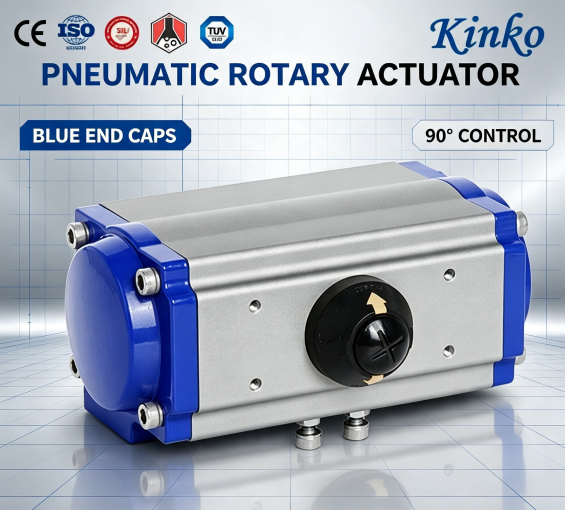
A direct-mount solenoid is a solenoid valve that attaches directly to the pneumatic actuator's port interface—usually via a Namur mounting pad or ISO standard pattern. There are no tubes or hoses between the solenoid and the actuator. The solenoid ports align directly with the actuator's air supply and exhaust ports.
This configuration is available for both single-acting (spring-return) and double-acting pneumatic actuators.
Key Advantages of Direct-Mount Solenoids
| Advantage | Explanation |
|---|---|
| Faster response time | No tubing means no air volume to fill between solenoid and actuator. The actuator strokes immediately upon solenoid switching. |
| Compact footprint | Solenoid mounts directly on the actuator—no additional bracket or panel space required. |
| Simpler installation | No tubing cutting, bending, or fitting assembly. Fewer connections mean faster installation. |
| Reduced leak points | Every tube fitting is a potential leak. Direct mounting eliminates tubing and reduces leak paths. |
| Lower maintenance | No tubes to inspect, tighten, or replace. Solenoid replacement is a simple bolt-off/bolt-on operation. |
| Improved reliability | Fewer fittings and seals mean fewer failure points—critical in harsh or vibration-prone environments. |
| Cleaner appearance | No tangles of tubing or brackets—professional, organized installation. |
| Standardized interface | Namur mounting ensures interchangeability between different solenoid and actuator brands. |
Response Time Improvement – Real Impact
The difference in response time is measurable:
| Configuration | Typical Open/Close Time (DN50 actuator) |
|---|---|
| Remote solenoid with 500mm tubing | 0.8 – 1.2 seconds |
| Direct-mount solenoid | 0.3 – 0.5 seconds |
In fast-cycling or safety-critical applications, this speed advantage can be decisive.
Namur Interface – The Industry Standard
Direct-mount solenoids follow the Namur standard (VDI/VDE 3845), which specifies:
Mounting hole pattern
Port sizes and positions
Gasket interface dimensions
Actuator interface geometry
This standard ensures that solenoids from different manufacturers fit actuators with the same Namur pad—giving flexibility and supply chain security.
Direct-Mount vs. Remote-Mount – Quick Comparison
| Feature | Direct-Mount | Remote-Mount |
|---|---|---|
| Response time | Very fast | Slower (tubing volume) |
| Installation time | Short | Longer (tubing work) |
| Leak points | Minimal | Multiple |
| Vibration resistance | Excellent (rigid) | Moderate (tubing loosens) |
| Maintenance | Simple (unbolt/replace) | More involved |
| Space required | Compact | Requires panel or bracket |
| Cost (installation) | Lower | Higher (fittings + labor) |
When Direct-Mount Is Most Beneficial
Fast-cycling applications – filling machines, packaging, dosing
Hazardous areas – fewer connections reduce leak risk
Vibration-prone installations – compressors, engines, mobile equipment
Space-constrained skids – no room for remote solenoid panels
Maintenance-focused plants – quick solenoid swaps without retubing
Critical safety functions – faster stroking and higher reliability
Direct-Mount Solenoid Types
| Type | Ports | Best For |
|---|---|---|
| 3/2-way (single solenoid, spring return) | 1 inlet, 1 output, 1 exhaust | Single-acting actuators (spring-return) |
| 5/2-way (single or double solenoid) | 1 inlet, 2 outputs, 2 exhausts | Double-acting actuators |
| 5/3-way (closed or exhaust center) | 1 inlet, 2 outputs, 2 exhausts | Double-acting with center-off feature |
Installation Best Practices
Use the correct gasket – included with most direct-mount solenoids
Tighten mounting screws to specified torque (avoid overtightening)
Apply thread sealant to inlet/outlet fittings if used
Check supply pressure – must match solenoid rating
Test manual override – before electrical connection
Verify electrical supply – AC/DC matching solenoid coil rating
Maintenance and Troubleshooting
Direct-mount solenoids are simpler to maintain:
| Issue | Likely Cause | Solution |
|---|---|---|
| Actuator does not stroke | No air supply, coil not powered | Check pressure; check voltage at coil |
| Slow or incomplete stroke | Dirty solenoid, low pressure | Clean or replace solenoid; check regulator |
| Clicking sound but no stroke | Manual override engaged or internal spool stuck | Reset override; replace spool/valve |
| Leakage at solenoid base | Gasket damaged or screws loose | Replace gasket; retighten screws |
Because the solenoid is directly on the actuator, replacement typically takes minutes—no retubing required.
Electric vs. Direct-Mount Pneumatic – Quick Perspective
For plants where compressed air is available, direct-mount pneumatic solenoids offer:
Faster response than most electric actuators
Higher cycle rates capability
Intrinsically safe operation (no electrical spark)
For applications requiring slower speeds, energy efficiency, or digital communication, KK Series electric actuators remain a strong alternative.
Frequently Asked Questions
Q1: Can I retrofit a direct-mount solenoid to an existing actuator?
Yes—if the actuator has a Namur pad. Most modern actuators do. A conversion bracket may be available for older designs.
Q2: Does direct-mount eliminate all tubing?
Nearly all—the only tubing remaining is from the FRL to the solenoid inlet. The solenoid-to-actuator connection is direct.
Q3: Are direct-mount solenoids more expensive?
Typically slightly higher upfront, but the total installed cost is often lower due to reduced labor, fittings, and tubing.
Q4: What is the typical power consumption?
Low-power coils draw 1–2W (DC) or 2–4VA (AC), suitable for direct PLC output without interposing relays.
Q5: Can I use a direct-mount solenoid in hazardous areas?
Yes—many direct-mount solenoids are certified Ex d, Ex mb, or intrinsically safe, with appropriate coils.
Q6: What voltage options are available?
Common options include 24V DC, 110V AC, 220V AC, and 12V DC.
Ivan (Mobile:+86-18968769287)
WhatsApp:+86-13579991606
Wechat:+86-18968769287
Website: www.kinko-flow.com
ZHEJIANG KINKO FLUID EQUIPMENT CO.,LTD

 info@kinko-flow.com
 +86-133 5611 9006