Tel:
Tel: E-Mail:
 English
 Chinese
 한국어
한국어
 Español




News
1. Slow or Erratic Operation
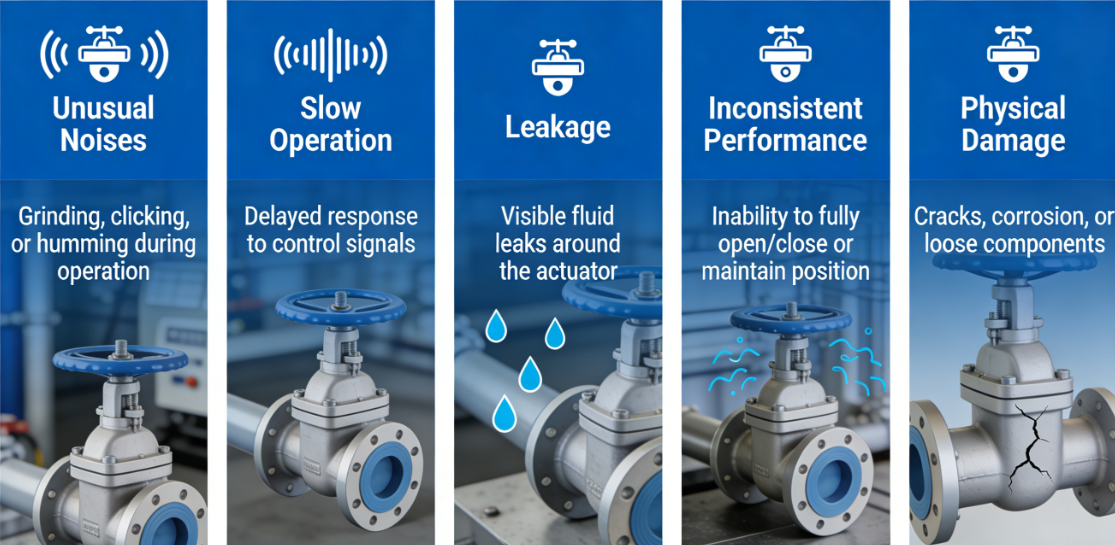
One of the most noticeable signs of actuator degradation is sluggish or inconsistent movement. If the valve takes longer than usual to open or close, or if the movement is jerky, this indicates internal wear or mechanical issues.
| Possible Causes | What to Check |
|---|---|
| Worn internal gears | Listen for grinding or unusual noise |
| Reduced air pressure (pneumatic) | Check supply pressure and leaks |
| Motor degradation (electric) | Verify voltage and current draw |
| Binding valve stem | Disconnect actuator and test valve manually |
If the root cause is internal to the actuator and not easily repairable, replacement is often the most cost-effective solution.
2. Failure to Reach Full Position
When an actuator consistently fails to fully open or close the valve, process control is compromised. This can lead to:
Incomplete shutoff, causing leakage
Reduced flow capacity
Inaccurate process regulation
Test: Disconnect the actuator from the valve and operate it independently. If the actuator still fails to reach its full travel range, internal components such as limit switches, cams, or gear trains may be worn beyond adjustment.
3. Excessive Noise or Vibration
Unusual sounds — grinding, clicking, humming, or chattering — are clear indicators of mechanical or electrical problems.
| Noise Type | Likely Cause |
|---|---|
| Grinding | Worn gears or bearings |
| Clicking without movement | Failed motor start capacitor or stuck solenoid |
| Chattering (pneumatic) | Insufficient air supply or pilot valve issues |
| Loud humming (electric) | Motor stall or seized mechanism |
Vibration can also indicate misalignment between the actuator and valve, which accelerates wear and may lead to catastrophic failure if not addressed promptly.
4. Visible Leaks
For pneumatic actuators, air leaks are a common failure mode. Signs include:
Hissing sounds from the actuator body
Visible oil residue around seals or connections
Gradual drop in system pressure
For electric actuators, while air leaks aren't applicable, seal failure can allow moisture or contaminants to enter the enclosure, leading to corrosion and electrical failure.
When leaks originate from internal seals or the actuator housing, replacement is often more practical than attempting a costly rebuild.
5. Position Feedback Malfunction
Many modern actuators provide position feedback to control systems via limit switches, potentiometers, or 4–20 mA transmitters. If the control system shows:
Incorrect valve position readings
No feedback signal
Erratic or intermittent signals
The issue may be with internal feedback components. While some sensors can be replaced, repeated failures or integrated designs may warrant complete actuator replacement.
6. Frequent Cycling or Overheating
Electric actuators are rated for specific duty cycles (e.g., S2, S4). If an actuator operates beyond its rated duty cycle, it may overheat, leading to:
Thermal shutdown
Motor insulation breakdown
Premature component failure
If your application requires more frequent cycling than originally anticipated, replacing the actuator with a model rated for higher duty is the best long-term solution.
7. Corrosion and Housing Damage
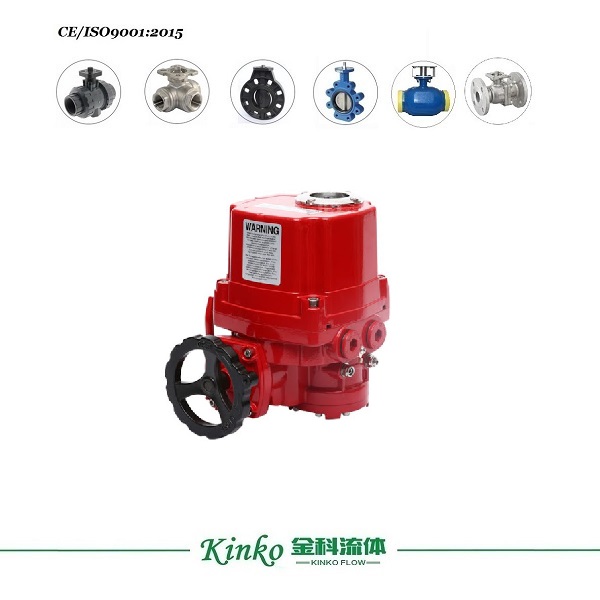
In harsh environments, actuator housings can suffer from corrosion, pitting, or physical damage. For painted aluminum actuators, once the coating fails, corrosion quickly compromises structural integrity.
| Environment | Risk |
|---|---|
| Marine / offshore | Saltwater corrosion |
| Chemical processing | Acid or alkali exposure |
| Outdoor installations | UV degradation, moisture ingress |
When the housing is compromised, internal components are at risk. Upgrading to a stainless steel actuator may be the most durable solution for corrosive environments.
8. Age and Obsolescence
Even without visible failures, age alone can justify replacement. Consider:
Parts availability: Older models may have discontinued components
Technology upgrades: Newer actuators offer better efficiency, diagnostics, and communication protocols
Reliability decline: After 10–15 years of service, failure rates typically increase
Proactive replacement of aging actuators during planned shutdowns is often more cost-effective than emergency replacements during production.
When to Repair vs. Replace
| Condition | Repair | Replace |
|---|---|---|
| Minor seal leak | ✅ | — |
| Worn limit switch | ✅ | — |
| Failed solenoid (pneumatic) | ✅ | — |
| Worn internal gears | — | ✅ |
| Motor burnout | — | ✅ |
| Severe corrosion | — | ✅ |
| Obsolete model | — | ✅ |
| Frequent failures | — | ✅ |
| Increased duty requirement | — | ✅ |
General rule: If repair costs exceed 50–60% of a new actuator's price, or if the actuator has a history of repeated failures, replacement is the better investment.
Benefits of Timely Replacement
Replacing a failing actuator before it fails completely offers several advantages:
Eliminates unplanned downtime — schedule replacement during planned maintenance
Improves process accuracy — new actuators provide precise positioning
Reduces energy consumption — modern units are more efficient
Enables predictive maintenance — newer actuators offer diagnostic capabilities
Simplifies spare parts inventory — standardize on current models
Summary: Signs Your Actuator May Need Replacement
| Sign | Action |
|---|---|
| Slow or erratic operation | Inspect; consider replacement if internal wear |
| Failure to reach full position | Test independently; replace if travel incomplete |
| Excessive noise or vibration | Investigate cause; replace if gears or motor damaged |
| Visible air or fluid leaks | Replace if seals/housing compromised |
| Position feedback failure | Replace if integrated components failed |
| Frequent overheating | Upgrade to higher duty cycle model |
| Corrosion or housing damage | Replace with stainless steel for corrosive environments |
| Age > 10 years | Consider proactive replacement |
Final Thoughts
Valve actuators are critical to reliable industrial operations. Recognizing the signs of impending failure allows you to plan replacements strategically — minimizing downtime, controlling costs, and maintaining process integrity.
Whether you're dealing with pneumatic actuators, electric actuators, or applications requiring corrosion-resistant materials, selecting the right replacement ensures long-term performance.
For assistance with actuator selection, sizing, or replacement planning, feel free to reach out — we're here to help.
Ivan (Mobile:+86-18968769287)
WhatsApp:+86-13579991606
Wechat:+86-18968769287
Website:www.kinko-flow.com
ZHEJIANG KINKO FLUID EQUIPMENT CO.,LTD

 info@kinko-flow.com
 +86-133 5611 9006