Tel:
Tel: E-Mail:
 English
 Chinese
 한국어
한국어
 Español




News
Step 1: Define Your Process Media
The fluid or gas passing through the valve is the most important selection factor. Different media require different body and seal materials.
| Media Type | Examples | Recommended Body Material | Recommended Seal Material |
|---|---|---|---|
| Water (clean) | City water, demineralized water | Brass, SS304 | PTFE, EPDM |
| Water (dirty) | Cooling tower water, river water | SS304, SS316 | PTFE |
| Steam | Saturated steam, pure steam | SS304, SS316 | PTFE |
| Hot water | 60°C – 100°C | Brass, SS304 | PTFE, EPDM |
| Air (compressed) | Instrument air, plant air | Brass, SS304 | PTFE, NBR |
| Inert gas | Nitrogen, argon, CO2 | SS304, SS316 | PTFE |
| Corrosive gas | Chlorine, ammonia, H2S | SS316 | PTFE, FKM |
| Oil (mineral) | Lubricating oil, hydraulic oil | Brass, SS304 | NBR, FKM |
| Oil (hot) | Thermal oil (up to 150°C) | SS304, SS316 | PTFE, FKM |
| Food / beverage | Dairy, beer, juice, CIP | SS304, SS316 | PTFE, EPDM (food grade) |
| Chemical (mild) | Dilute acids, bases | SS316 | PTFE, FKM |
| Chemical (aggressive) | Concentrated acids, solvents | SS316, Hastelloy (special) | PTFE |
Kinko recommendation: When in doubt, choose stainless steel 316 body and PTFE seals. This combination handles 90% of industrial steam, water, gas, and chemical applications.
Step 2: Determine Temperature Requirements
Temperature affects seal material selection and actuator performance.
Seal Material Temperature Limits
| Seal Material | Minimum Temperature | Maximum Continuous Temperature | Best For |
|---|---|---|---|
| PTFE | -10°C (14°F) | 180°C (356°F) | Steam, hot water, chemicals |
| FKM (Viton) | -15°C (5°F) | 160°C (320°F) | Hot oil, fuels, acids |
| EPDM | -30°C (-22°F) | 120°C (248°F) | Water, steam (low temp), brake fluid |
| NBR (Buna-N) | -20°C (-4°F) | 90°C (194°F) | Air, oil, diesel |
Actuator Temperature Considerations
| Condition | Recommendation |
|---|---|
| Ambient temperature below 0°C | Use low-temperature grease and NBR or EPDM seals |
| Ambient temperature above 60°C | Remote mount the solenoid valve; use heat shield |
| Media temperature above 150°C | Use extended bonnet (thermal spacer) between body and actuator |
Kinko note: For steam applications at 180°C, always use PTFE seals and consider an extended bonnet to protect the actuator from radiant heat.
Step 3: Specify Pressure and Flow Requirements
Operating Pressure
Angle seat valves are rated for a maximum operating pressure. This rating decreases as valve size increases.
| Valve Size (DN) | Maximum Operating Pressure (bar) | Maximum Operating Pressure (PSI) |
|---|---|---|
| DN15 (1/2") | 16 | 232 |
| DN20 (3/4") | 16 | 232 |
| DN25 (1") | 16 | 232 |
| DN32 (1-1/4") | 16 | 232 |
| DN40 (1-1/2") | 16 | 232 |
| DN50 (2") | 16 | 232 |
| DN65 (2-1/2") | 10 | 145 |
| DN80 (3") | 10 | 145 |
Important: The pressure rating above is for the valve body. The actuator's ability to open the valve against differential pressure depends on actuator size and air supply pressure.
Differential Pressure Across the Seat
For normally closed (NC) angle seat valves, the valve closes with flow direction under the seat (flow pushes the seal closed). The actuator must overcome this differential pressure to open the valve.
| Differential Pressure (bar) | Actuator Size Required |
|---|---|
| 0 – 6 bar | Standard actuator (40mm – 63mm depending on DN) |
| 6 – 10 bar | Oversized actuator (63mm – 80mm) |
| 10 – 16 bar | Consult Kinko for high-pressure actuator |
Rule of thumb: Higher differential pressure requires larger actuator piston diameter.
Flow Rate (Cv Requirement)
Calculate the required Cv (flow coefficient) using this formula:
Cv = Q / √(ΔP / SG)
Where:
Q = Flow rate (GPM for water, SCFM for air, lb/hr for steam)
ΔP = Pressure drop across valve (PSI)
SG = Specific gravity (1.0 for water)
| Valve Size (DN) | Typical Cv Range (Angle Seat Valve) |
|---|---|
| DN15 | 4.0 – 5.5 |
| DN20 | 7.0 – 9.0 |
| DN25 | 11.0 – 14.0 |
| DN32 | 18.0 – 22.0 |
| DN40 | 25.0 – 30.0 |
| DN50 | 40.0 – 48.0 |
| DN65 | 65.0 – 75.0 |
| DN80 | 90.0 – 105.0 |
Select the smallest valve that meets your Cv requirement. Oversizing causes poor control and seal wear.
Step 4: Choose Actuation Type
Angle seat valves are available in three actuation configurations.
| Actuation Type | How It Works | Fail-Safe Position | Best For |
|---|---|---|---|
| Normally Closed (NC) | Spring closes; air opens | Closed (on air loss) | Most steam, water, gas applications |
| Normally Open (NO) | Spring opens; air closes | Open (on air loss) | Cooling water, emergency dump |
| Double-Acting (DA) | Air opens; air closes | Last position (on air loss) | High cycle rates, no spring required |
Selection Guidance
| Application Requirement | Recommended Actuation |
|---|---|
| Safe shut-off on air failure | NC or NO (spring return) |
| Minimal air consumption | NC or NO (air used only during stroke) |
| Very high cycle rates (60+ cycles/min) | Double-acting |
| Valve must stay put on air failure | Double-acting (but unsafe for many processes) |
| Standard steam or water control | NC |
Kinko recommendation: For 95% of industrial applications, choose Normally Closed (NC). It provides fail-safe closure and consumes air only during the opening stroke.
Step 5: Select Actuator Size
Actuator size is determined by valve orifice diameter and differential pressure.
| Valve Size (DN) | Recommended Actuator Diameter (mm) | Minimum Air Pressure (bar) |
|---|---|---|
| DN15 | 40 | 4.0 |
| DN20 | 50 | 4.0 |
| DN25 | 50 or 63 | 4.0 – 5.0 |
| DN32 | 63 | 4.5 – 5.0 |
| DN40 | 63 or 80 | 5.0 |
| DN50 | 80 | 5.0 – 6.0 |
| DN65 | 100 | 5.0 – 6.0 |
| DN80 | 100 | 6.0 |
Larger actuator = higher opening force but slower cycle time and higher air consumption.
For high differential pressure (above 6 bar), increase actuator size by one step. Consult Kinko for exact sizing.
Step 6: Specify End Connections
Angle seat valves are available with several connection types.
| Connection Type | Standards | Best For |
|---|---|---|
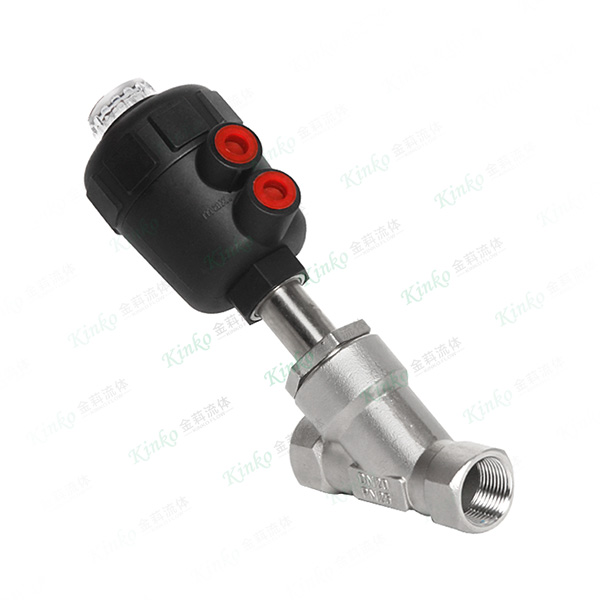
| Threaded | BSP (G), NPT | General industrial, easy installation |
| Flanged | PN16, PN40, ANSI 150 | Large sizes (DN50+), high pressure |
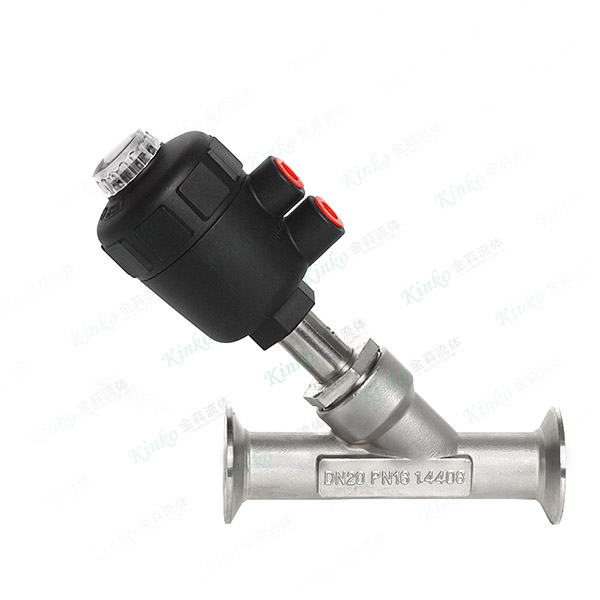
| Clamp (tri-clamp) | DIN 32676, ISO 2852 | Food, dairy, pharmaceutical (sanitary) |
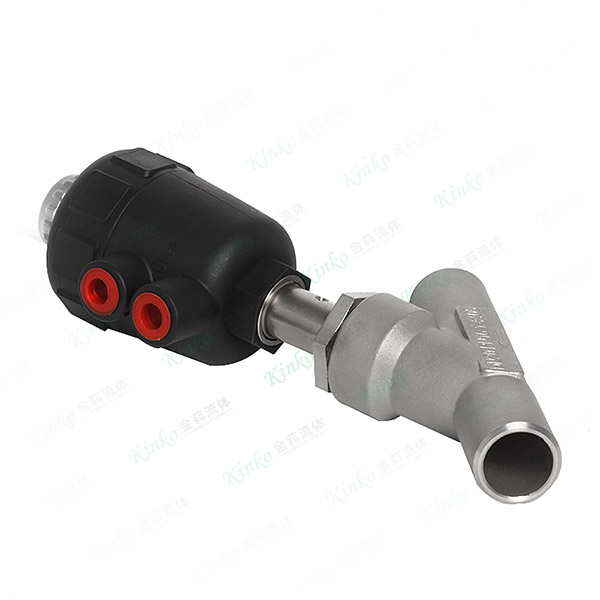
| Weld end | Butt weld, socket weld | Permanent installation, high temperature |
Threaded connection sizes:
| Valve Size | Thread Size (BSP or NPT) |
|---|---|
| DN15 | 1/2" |
| DN20 | 3/4" |
| DN25 | 1" |
| DN32 | 1-1/4" |
| DN40 | 1-1/2" |
| DN50 | 2" |
| DN65 | 2-1/2" |
| DN80 | 3" |
Kinko recommendation: For most industrial applications, BSP threaded connections are standard. For North America, specify NPT threads.
Step 7: Select Solenoid Pilot Valve (for Pneumatic Actuation)
The solenoid valve controls air flow to the actuator.
| Parameter | Common Options | Selection Criteria |
|---|---|---|
| Voltage | 24V DC, 110V AC, 220V AC | Match your control system |
| Function | 3/2 way (for NC/NO), 5/2 way (for DA) | NC/NO uses 3/2; DA uses 5/2 |
| Mounting | NAMUR (direct mount on actuator) | Preferred – no external tubing |
| Coil type | Standard (100% ED), Explosion-proof (Ex) | Hazardous area requires Ex rating |
| Manual override | Push button, lockable | Useful for commissioning |
| Actuation Type | Solenoid Valve Function |
|---|---|
| Normally Closed (NC) | 3/2 way, normally closed |
| Normally Open (NO) | 3/2 way, normally open |
| Double-Acting (DA) | 5/2 way (single or double coil) |
Step 8: Consider Optional Features
| Optional Feature | Purpose | When to Specify |
|---|---|---|
| Position indicator (visual) | Shows valve open/closed at a glance | All applications (recommended) |
| Limit switches | Provides electrical feedback to PLC | Automated processes, remote monitoring |
| Manual override | Allows manual operation without air | Commissioning, emergency backup |
| Flow control silencer | Adjusts closing speed | Steam service (reduces water hammer) |
| Extended bonnet | Protects actuator from high media temperature | Media above 150°C |
| IP67 / IP68 enclosure | Protects actuator in wet environments | Outdoor, washdown, marine |
| Explosion-proof (Ex) solenoid | Prevents ignition in hazardous areas | Oil & gas, chemical plants |
Common Selection Mistakes to Avoid
| Mistake | Consequence | Correct Approach |
|---|---|---|
| Choosing PTFE for cold water | Stiff seal may leak below -10°C | Use EPDM for cold water |
| Undersizing actuator for steam pressure | Valve fails to open against differential pressure | Use larger actuator for high ΔP |
| Oversizing valve (too high Cv) | Poor control, seal chatter | Select smallest valve meeting Cv |
| Using NC on cooling tower (needs fail-open) | Valve closes on air loss; equipment overheats | Use NO for fail-open applications |
| No strainer upstream | Debris damages PTFE seat | Always install 40-mesh strainer |
| Mounting actuator pointing down | Condensate enters actuator | Mount between 0° and 90° |
Quick Selection Guide by Application
| Application | Typical Specification |
|---|---|
| Saturated steam (up to 180°C) | SS316 body, PTFE seal, NC actuation, 63mm actuator (DN25) |
| Hot water (80°C) | SS304 body, EPDM or PTFE seal, NC actuation |
| Compressed air | Brass or SS304 body, NBR or PTFE seal, NC actuation |
| Natural gas | SS316 body, PTFE seal, NC actuation, Ex solenoid |
| Food / CIP | SS316 body, PTFE seal, clamp connections, NC actuation |
| Hot oil (150°C) | SS316 body, FKM seal, NC actuation, extended bonnet |
| Corrosive chemical | SS316 body, PTFE seal, NC actuation, PTFE-coated stem |
Why Kinko for Angle Seat Valves?
Kinko provides complete angle seat valve solutions including:
Valve body (multiple materials and sizes)
Pneumatic actuator (aluminum or stainless steel)
NAMUR-mount solenoid valve
Position feedback (limit switches)
Technical support for sizing
All Kinko angle seat valves are factory-tested for seat leakage and cycle operation.
FAQ: Choosing an Angle Seat Valve
Q: Can I use a PTFE-sealed angle seat valve for cold water below 5°C?
A: PTFE becomes stiff at low temperatures and may leak. Use EPDM seal for cold water service.
Q: How do I know if I need a 50mm or 63mm actuator?
A: For DN25 with differential pressure below 6 bar, 50mm is sufficient. For 6–10 bar differential, use 63mm.
Q: What is the difference between BSP and NPT threads?
A: BSP is parallel thread (seals with washer or sealant). NPT is tapered (seals by thread deformation). They are not interchangeable.
Q: Do I need a filter before the angle seat valve?
A: Yes. Always install a 40-mesh (0.4mm) strainer upstream to protect the PTFE seat from debris.
Q: Can I use one angle seat valve for multiple media?
A: Only if the media are compatible with the same seal and body material. Changing media without changing seals risks chemical attack or swelling
Ivan (Mobile:+86-18968769287)
WhatsApp:+86-13579991606
Wechat:+86-18968769287
Website:www.kinko-flow.com
ZHEJIANG KINKO FLUID EQUIPMENT CO.,LTD

 info@kinko-flow.com
 +86-133 5611 9006