Tel:
Tel: E-Mail:
 English
 Chinese
 한국어
한국어
 Español




News
What Defines "High-Performance" in a Pneumatic Actuator?
Before diving into selection criteria, let's clarify what high-performance means in this context.
| Performance Factor | What It Means | Why It Matters |
|---|---|---|
| Torque Output | The rotational force the actuator delivers to the valve stem. | Must exceed the valve's breakaway and running torque under all operating pressures. |
| Cycle Life | The number of full open/close operations the actuator can perform before wear affects performance. | High-cycle applications require actuators rated for millions of operations. |
| Speed Control | The ability to adjust opening and closing times. | Prevents water hammer and extends valve life. |
| Environmental Resistance | Protection against moisture, dust, corrosion, and extreme temperatures. | Ensures reliability in harsh plant conditions. |
| Fail-Safe Capability | The actuator's behavior upon loss of air supply (spring-return vs. double-acting). | Critical for safety-instrumented systems. |
| Accessory Integration | Ease of mounting solenoids, positioners, and limit switches. | Reduces installation time and eliminates leak points. |
Step 1: Understand Your Valve Type and Torque Needs
The first and most important step is understanding the valve you are automating. Different valve types have different torque profiles.
Ball Valves require high breakaway torque to overcome the friction between the ball and the seats. Once rotating, the running torque is significantly lower. The actuator must be sized for the peak breakaway torque, which can increase with pressure and temperature.
Butterfly Valves generally require less torque than ball valves of the same size, but the torque curve is less linear. The disc experiences varying resistance throughout the 90° stroke, especially at the final sealing position.
Recommended torque margin: Always select an actuator with a torque output at least 20-30% higher than the valve's maximum required torque. This margin accounts for supply pressure fluctuations, temperature effects, and wear over time.
Step 2: Double-Acting vs. Spring-Return
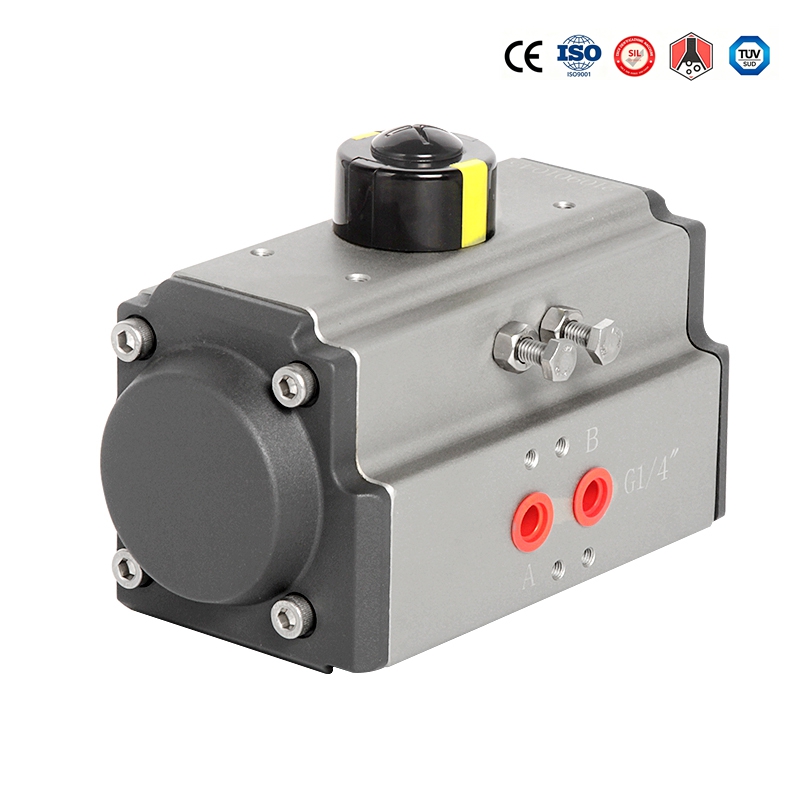
Pneumatic actuators fall into two main categories, each with distinct advantages.
Double-Acting Actuators
These actuators use compressed air to move the piston in both directions. Air pressure opens the valve, and air pressure closes it.
Best for: Applications where fail-safe action is not required, and air supply is reliable.
Advantages: Lower cost, higher torque output per size, simple construction.
Consideration: If air supply fails, the valve remains in its last position—which may be unsafe in some processes.
Spring-Return (Single-Acting) Actuators
These actuators use air pressure to move the piston in one direction, and a mechanical spring to return it when air is exhausted.
Best for: Safety-critical applications requiring fail-safe open or closed positions.
Advantages: Built-in fail-safe protection without external equipment.
Consideration: Higher cost and larger size for the same torque output due to the spring chamber.
| Feature | Double-Acting | Spring-Return |
|---|---|---|
| Fail-Safe | No (stays in position) | Yes (spring returns to set position) |
| Cost | Lower | Higher |
| Torque per Size | Higher | Lower |
| Application | General on/off duty | Safety loops, emergency shutdown |
Step 3: Environmental and Operating Conditions
The environment where the actuator is installed significantly impacts material selection and enclosure rating.
Temperature: Standard actuators typically operate from -20°C to +80°C. For extreme environments—high-temperature foundries or cryogenic cold boxes—special seals and lubricants are required.
Corrosive Exposure: Chemical plants, marine environments, and outdoor installations require actuators with corrosion-resistant coatings or stainless steel housings.
Hazardous Areas: If the actuator is installed in a potentially explosive atmosphere, look for appropriate international certifications (e.g., ATEX, IECEx) for both the actuator and mounted accessories.
Moisture and Dust: The enclosure rating determines protection against ingress. For washdown areas or dusty environments, higher-rated enclosures are recommended.
Step 4: Accessory Integration
A pneumatic actuator rarely works alone. It requires a suite of accessories to become a fully automated control element.
| Accessory | Function | When Required |
|---|---|---|
| Solenoid Valve | Directs air pressure to the actuator. | All remote on/off applications. |
| Positioner | Adjusts actuator position based on analog control signal. | Modulating (throttling) control applications. |
| Limit Switch Box | Provides electrical feedback of valve position. | Remote monitoring, safety interlocks. |
| Filter Regulator | Cleans and stabilizes air supply. | All pneumatic systems (highly recommended). |
| Quick Exhaust Valve | Accelerates actuator stroking speed. | Emergency shutdown, fast-cycling processes. |
Integration tip: Choose actuators with standardized mounting interfaces (such as ISO 5211). This ensures that accessories and brackets are readily available and simplifies future replacements.
Step 5: Quick Selection Checklist
Use this checklist to guide your actuator selection process:
□
What is the valve type (ball, butterfly, or others) and size?
□
What is the maximum operating pressure and temperature?
□
What is the required breakaway torque at the highest pressure?
□
Do you need fail-safe action upon air loss?
□
What is the control signal (on/off or 4-20mA modulating)?
□
What are the environmental conditions (temperature, corrosives, outdoor)?
□
Is the location hazardous (explosion-proof required)?
□
What accessories (solenoid, positioner, limit switch, FRL) are needed?
□
What is the expected cycle frequency (daily operations)?
□
What is the supply air pressure available at the site?
Ivan (Mobile:+86-18968769287)
WhatsApp:+86-13579991606
Wechat:+86-18968769287
Website:www.kinko-flow.com
ZHEJIANG KINKO FLUID EQUIPMENT CO.,LTD

 info@kinko-flow.com
 +86-133 5611 9006