Tel:
Tel: E-Mail:
 English
 Chinese
 한국어
한국어
 Español




News
How Angle Seat Valves Work
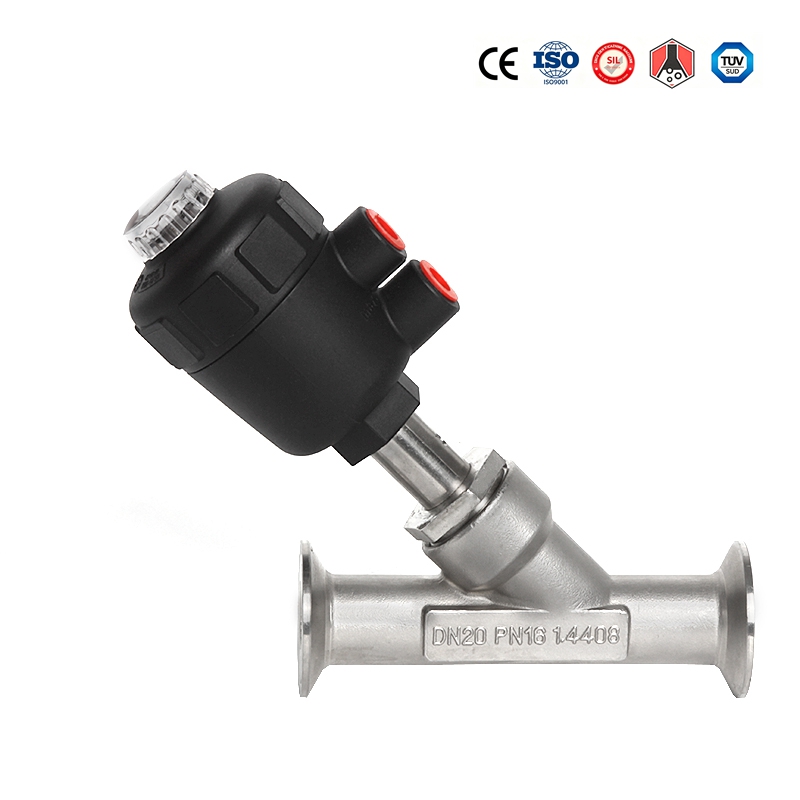
In an angle seat valve, the fluid enters through one port and exits through another at a 90° or 105° angle. The valve stem is connected to a piston, typically actuated by compressed air. When air pressure is applied, the piston lifts the stem and the seal from the seat, opening the flow path. When air is exhausted, a spring returns the piston and closes the valve.
Key characteristics:
Straight-through flow path with minimal pressure drop
Fast opening and closing speeds
Self-draining design when installed correctly
Available in normally closed or normally open configurations
These characteristics make angle seat valves particularly attractive for applications requiring fast cycling, high flow rates, and clean operation.
Suitability for Sterile Applications
Sterile applications—common in pharmaceutical, biotechnology, food and beverage, and medical device manufacturing—place extreme demands on valve design. Any crevice, dead leg, or rough surface can harbor bacteria, compromising product safety.
Advantages for Sterility
Self-draining design: When installed with the valve body angled correctly, the Y-shape allows complete drainage of the valve cavity. This eliminates fluid hold-up where bacteria can proliferate.
Smooth internal surfaces: High-quality angle seat valves feature polished internal surfaces with low surface roughness. This reduces bacterial adhesion and simplifies cleaning.
Clean-in-place (CIP) compatibility: The straight-through flow path and absence of complex cavities allow CIP fluids to effectively reach all wetted surfaces. Many angle seat valves are specifically designed for CIP and steam-in-place (SIP) protocols.
No dead legs: The flow path design minimizes stagnant zones where media could remain trapped between cycles.
Limitations to Consider
Seal material matters: The seat seal is the critical interface. For sterile applications, seals must withstand repeated CIP and SIP cycles without degrading. Materials like PTFE and advanced elastomers are commonly used.
Surface finish requirements: Not all angle seat valves offer the internal finish required for sterile service. Specify electropolished or special finishes for pharmaceutical applications.
Valve orientation: The self-draining feature is only effective if the valve is installed correctly. Incorrect orientation eliminates this advantage.
Suitability for Corrosive Applications
Corrosive fluids—acids, bases, solvents, and aggressive chemicals—attack valve materials over time. Material selection is the primary factor determining a valve's suitability for corrosive service.
Material Considerations
Body materials:
Stainless steel (CF8M/316L): The most common choice for corrosive service. Offers excellent resistance to a wide range of chemicals, including many acids and caustics.
Hastelloy and higher alloys: For extremely aggressive media (e.g., hydrochloric acid, hot sulfuric acid), specialty alloys are required.
Plastic bodies (PP, PVDF): For specific low-pressure, moderate-temperature corrosive applications, engineered plastics offer exceptional chemical resistance at lower cost.
Seal and seat materials:
PTFE (Teflon): Excellent chemical resistance across a broad pH range. Suitable for most corrosive media.
EPDM: Good resistance to acids and alkaline solutions, but limited with oils and hydrocarbons.
FPM/Viton: Good resistance to hydrocarbons and strong acids, but limited with solvents and steam.
PEEK and other high-performance polymers: For high-temperature corrosive applications.
| Corrosive Media | Recommended Body Material | Recommended Seal Material |
|---|---|---|
| Dilute acids (e.g., acetic, citric) | Stainless steel 316L | EPDM or PTFE |
| Strong acids (e.g., sulfuric, nitric) | Hastelloy or higher alloy | PTFE |
| Caustic solutions (e.g., sodium hydroxide) | Stainless steel 316L | EPDM |
| Saltwater / brine | Stainless steel 316L | PTFE or EPDM |
| Organic solvents | Stainless steel 316L | PTFE or FPM |
| Chlorinated media | Specialty alloy or plastic | PTFE |
Advantages for Corrosive Service
Flow path design: The angled body creates a smooth, unrestricted flow path. This reduces turbulence and erosion, which can accelerate corrosion in aggressive media.
Minimal stagnant areas: Reduced fluid hold-up means less opportunity for corrosive media to concentrate and attack the valve body.
Easy maintenance: The seat seal is typically accessible without removing the entire valve from the pipeline, simplifying seal replacement in corrosive environments.
Limitations to Consider
Actuator material: The pneumatic actuator is exposed to the same environment. Standard aluminum actuators may corrode in harsh atmospheres. Specify stainless steel or coated actuators for corrosive plant conditions.
Seal longevity: Even with proper material selection, seals in corrosive service have a finite life. Regular inspection and replacement schedules are essential.
Temperature effects: Corrosive attack accelerates with temperature. Ensure the valve is rated for both the chemical and temperature combination.
Comparison: Angle Seat Valve vs. Alternatives
| Feature | Angle Seat Valve | Ball Valve | Globe Valve |
|---|---|---|---|
| Flow Path | Straight-through, angled | Straight-through | Tortuous, changes direction |
| Pressure Drop | Low | Low | High |
| Cleaning (CIP/SIP) | Excellent | Good (full port) | Poor |
| Self-Draining | Excellent (correct orientation) | Moderate | Poor |
| Crevice Risk | Low | Moderate (seat area) | High |
| Throttling Capability | Moderate | Poor (not recommended) | Excellent |
| Speed | Fast | Fast | Moderate |
| Cost | Moderate | Moderate | High |
| Seal Replaceability | Easy (top-entry) | Moderate | Complex |
Ivan (Mobile:+86-18968769287)
WhatsApp:+86-13579991606
Wechat:+86-18968769287
Website: www.kinko-flow.com
ZHEJIANG KINKO FLUID EQUIPMENT CO.,LTD

 info@kinko-flow.com
 +86-133 5611 9006