Tel:
Tel: E-Mail:
 English
 Chinese
 한국어
한국어
 Español




News
Why Temperature Matters for Actuator Performance
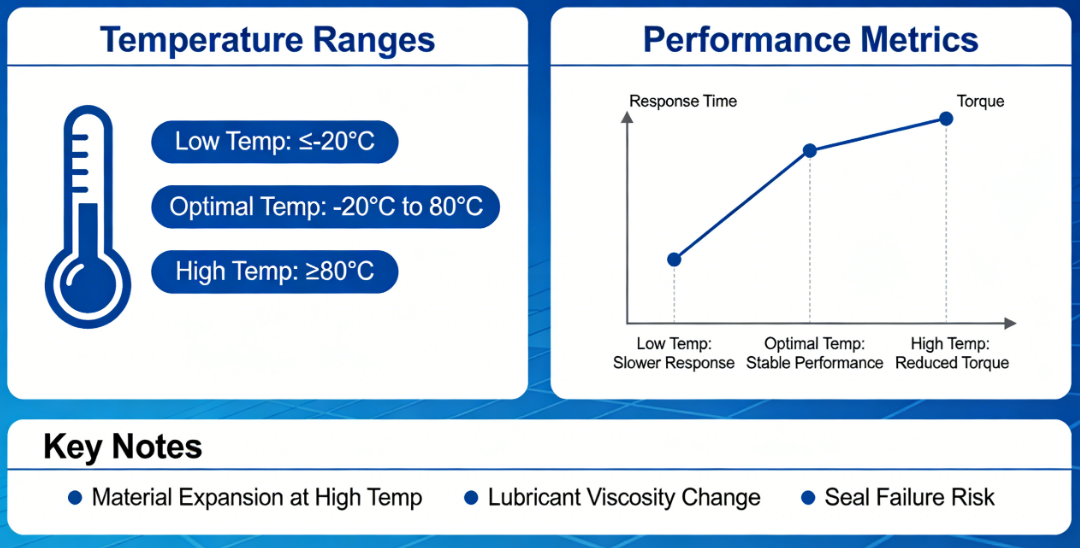
Temperature affects actuators in multiple ways:
| Temperature Impact | Effect |
|---|---|
| Material properties | Metals expand/contract; elastomers harden or soften |
| Lubricant viscosity | Thickens in cold, thins in heat |
| Seal integrity | Shrinking or swelling affects sealing |
| Electrical components | Circuitry performance and lifespan |
| Torque output | Changes in air density, motor efficiency |
| Condensation | Moisture ingress from thermal cycling |
Understanding these effects is the first step in selecting actuators capable of reliable operation across your application's temperature range.
Temperature Ranges and Classifications
| Temperature Range | Classification | Typical Applications |
|---|---|---|
| Below -40°C (-40°F) | Cryogenic / Extreme cold | LNG, arctic installations |
| -40°C to -10°C (-40°F to 14°F) | Low temperature | Cold climate outdoor installations |
| -10°C to 60°C (14°F to 140°F) | Standard industrial | General purpose, indoor installations |
Effects on Different Actuator Types
Pneumatic Actuators
Pneumatic actuators rely on compressed air and elastomeric seals — both of which are temperature-sensitive.
| Temperature | Effect on Pneumatic Actuators |
|---|---|
| Low temperature | • Seals become brittle, increasing leakage risk • Lubricants thicken, slowing operation • Condensation can freeze, blocking ports • Reduced air flow due to density changes |
| High temperature | • Seals soften, leading to extrusion or blow-by • Lubricants degrade, increasing wear • Springs lose tension (affecting fail-safe torque) • Reduced air density affects torque output |
Critical Considerations:
Select low-temperature seals (e.g., silicone, FKM) for cold environments
Use high-temperature lubricants for process heat applications
Consider spring-return derating at elevated temperatures
Electric Actuators
Electric actuators contain motors, electronics, and gear trains — all with specific temperature sensitivities.
| Temperature | Effect on Electric Actuators |
|---|---|
| Low temperature | • Motor lubricants thicken, increasing starting torque • Electronics may operate outside specified range • Condensation causes corrosion or short circuits • Batteries (for fail-safe) lose capacity |
| High temperature | • Motor overheating reduces lifespan • Electronics degrade; capacitor life halves every 10°C rise • Gear lubricants thin, reducing protection • Thermal shutdown may occur |
Critical Considerations:
Verify operating temperature range of all components
Consider heater circuits for cold environments
Ensure adequate ventilation or cooling for high-temperature installations
Hydraulic Actuators
Hydraulic actuators use fluid power, making them sensitive to fluid viscosity changes.
| Temperature | Effect on Hydraulic Actuators |
|---|---|
| Low temperature | • Fluid viscosity increases, slowing response • Pump cavitation risk • Seal hardening leads to leakage • Pressure drops due to flow resistance |
| High temperature | • Fluid viscosity decreases, increasing internal leakage • Seal degradation • Fluid oxidation and degradation • Reduced component life |
Critical Considerations:
Use temperature-appropriate hydraulic fluids
Consider heaters for cold start conditions
Install coolers for continuous high-temperature operation
Common Failure Modes Related to Temperature
Seal Failure
| Issue | Temperature-Related Cause |
|---|---|
| Brittle cracking | Low temperatures cause elastomers to lose flexibility |
| Extrusion | High temperatures soften seals, allowing deformation under pressure |
| Swelling | Incompatible materials or thermal expansion |
| Leakage | Loss of seal compression due to material changes |
Lubrication Failure
| Issue | Temperature-Related Cause |
|---|---|
| Starvation | Low temperatures cause lubricant to become too viscous to flow |
| Burn-off | High temperatures cause lubricant evaporation or oxidation |
| Wear increase | Lubricant breakdown leads to metal-to-metal contact |
Electrical Component Failure
| Issue | Temperature-Related Cause |
|---|---|
| Capacitor failure | High temperatures accelerate electrolyte evaporation |
| Solder joint cracking | Thermal cycling causes fatigue |
| Condensation | Rapid temperature changes cause moisture ingress |
Mechanical Binding
| Issue | Temperature-Related Cause |
|---|---|
| Expansion | High temperatures cause components to expand and bind |
| Contraction | Low temperatures cause clearance reduction between mating parts |
| Galling | Differential expansion of dissimilar metals |
Selecting Actuators for Extreme Temperatures
For Low-Temperature Applications
| Consideration | Recommendation |
|---|---|
| Seals | Specify low-temperature elastomers (silicone, low-temp FKM, PTFE) |
| Lubricants | Use low-temperature greases (e.g., synthetic, silicone-based) |
| Materials | Avoid materials prone to embrittlement (certain carbon steels) |
| Electronics | Verify operating range; consider remote mounting |
| Moisture protection | Install breather heaters to prevent condensation freezing |
| Manual override | Ensure operability with cold-thickened lubricants |
For High-Temperature Applications
| Consideration | Recommendation |
|---|---|
| Seals | Specify high-temperature elastomers (FKM, FFKM, PTFE) |
| Lubricants | Use high-temperature greases (synthetic, PFPE-based) |
| Materials | Stainless steel or high-temperature alloys |
| Heat isolation | Use thermal spacers between valve and actuator |
| Cooling | Consider cooling fins, heat shields, or forced air |
| Electronics | Remote mount control components away from heat |
Thermal Isolation Strategies
When process temperatures exceed actuator ratings, thermal isolation becomes essential.
Heat Transfer Paths
| Path | Mitigation Strategy |
|---|---|
| Conduction through valve stem | Install thermal spacer; increase stem length |
| Convection from process | Add heat shield; maintain air circulation |
| Radiation from equipment | Use reflective shielding; increase distance |
Common Thermal Isolation Methods
| Method | Application | Temperature Reduction |
|---|---|---|
| Thermal spacer | Between valve and actuator | 20–50°C |
| Extended stem | Increases conduction path length | 30–80°C |
| Heat shield | Blocks radiant heat | 20–100°C |
| Cooling fins | Increases heat dissipation | 10–30°C |
| Forced air cooling | Active cooling for extreme conditions | 50–150°C |
Temperature Effects on Torque/Thrust Output
Pneumatic Actuators
| Temperature Effect | Torque Impact |
|---|---|
| Low temperature | Air density increases (slightly higher torque), but seal friction increases (reduces net output) |
| High temperature | Air density decreases (slightly lower torque), seal friction decreases, but spring force reduces (critical for fail-safe) |
Rule of Thumb: Spring-return pneumatic actuators typically derate 0.3–0.5% per °C above 20°C for spring force.
Electric Actuators
| Temperature Effect | Torque Impact |
|---|---|
| Low temperature | Motor torque may be reduced at start; gear friction increases |
| High temperature | Motor torque capability decreases; thermal protection may limit duty cycle |
Temperature Ratings and Standards
| Standard | Description |
|---|---|
| IEC 60068 | Environmental testing including temperature |
| ISO 5211 | Mounting interface — does not specify temperature range |
| ATEX / IECEx | Hazardous area certification includes temperature class |
| NAMUR NE 43 | Temperature effects on position feedback signals |
Temperature Classes for Hazardous Areas
| Temperature Class | Max Surface Temperature |
|---|---|
| T1 | 450°C |
| T2 | 300°C |
| T3 | 200°C |
| T4 | 135°C |
| T5 | 100°C |
| T6 | 85°C |
Actuators used in hazardous areas must maintain surface temperatures below these limits.
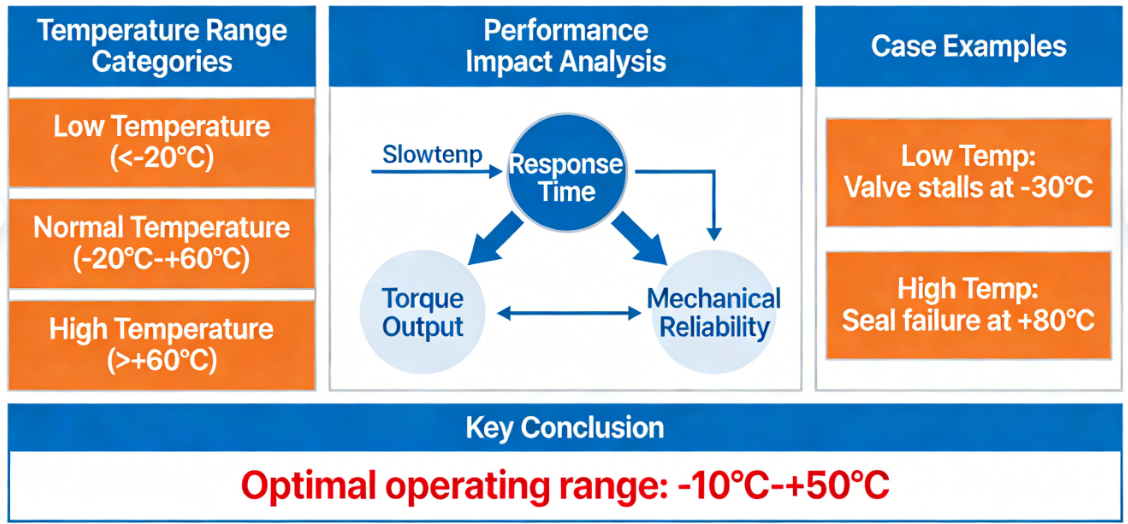
Temperature Effects Comparison
| Parameter | Pneumatic Actuator | Electric Actuator | Hydraulic Actuator |
|---|---|---|---|
| Low temperature sensitivity | High (seals, lubricants) | Moderate (electronics, lubricants) | High (fluid viscosity) |
| High temperature sensitivity | Moderate (seals, springs) | High (electronics, motor) | Moderate (fluid, seals) |
| Typical operating range | -20°C to +80°C | -20°C to +60°C | -20°C to +80°C |
| Extended range options | -40°C to +150°C* | -40°C to +80°C* | -40°C to +120°C* |
With appropriate materials, lubricants, and design modifications.
Application Examples by Temperature
Cold Climate / Arctic (-40°C to -20°C)
| Application | Recommended Solution |
|---|---|
| Pipeline valve automation | Pneumatic with low-temp seals, silicone lubricants, breather heaters |
| LNG terminal | Cryogenic-rated actuators with extended stems |
| Outdoor instrumentation | Electric with internal heaters, remote electronics |
High-Temperature Process (100°C to 200°C)
| Application | Recommended Solution |
|---|---|
| Steam isolation | Pneumatic with thermal spacer, high-temp seals |
| Heat tracing | Electric with remote control module |
| Reactor feed | Hydraulic with high-temp fluid and cooling |
Thermal Cycling
| Application | Recommended Solution |
|---|---|
| Sterilization (CIP/SIP) | Stainless steel actuators with high-temp seals, condensation protection |
| Batch processing | Actuators rated for full temperature range, moisture-resistant electronics |
Maintenance Considerations for Temperature Extremes
| Temperature Condition | Maintenance Practice |
|---|---|
| Low temperature | • Check for condensation and ice buildup • Verify lubricant remains pliable • Test fail-safe operation at operating temperature |
| High temperature | • Monitor surface temperatures • Inspect seals for hardening or cracking • Verify thermal isolation effectiveness |
| Thermal cycling | • Check mounting bolt torque (expansion/contraction) • Inspect for fatigue cracks • Verify electrical connections remain tight |
Summary: Temperature-Related Selection Checklist
| Factor | Consideration | Verified |
|---|---|---|
| Ambient temperature | Minimum and maximum expected | ☐ |
| Process temperature | Valve body temperature transferred to actuator | ☐ |
| Actuator type | Pneumatic, electric, or hydraulic — each has different sensitivities | ☐ |
| Seal material | Low-temp, standard, or high-temp elastomers | ☐ |
| Lubricant type | Temperature-appropriate grease | ☐ |
| Thermal isolation | Spacer, extended stem, or heat shield required | ☐ |
Final Thoughts
Temperature is a critical factor that can significantly impact valve actuator performance, reliability, and service life. Whether your application involves arctic cold, process heat, or frequent thermal cycling, selecting actuators with appropriate materials, seals, lubricants, and thermal isolation strategies is essential for long-term reliable operation.
Ivan (Mobile:+86-18968769287)
WhatsApp:+86-13579991606
Wechat:+86-18968769287
Website:www.kinko-flow.com
ZHEJIANG KINKO FLUID EQUIPMENT CO.,LTD

 info@kinko-flow.com
 +86-133 5611 9006